
An Interview With ‘Inbetweens’ Creator Faith Erin Hicks
by Rachel Bellwoar
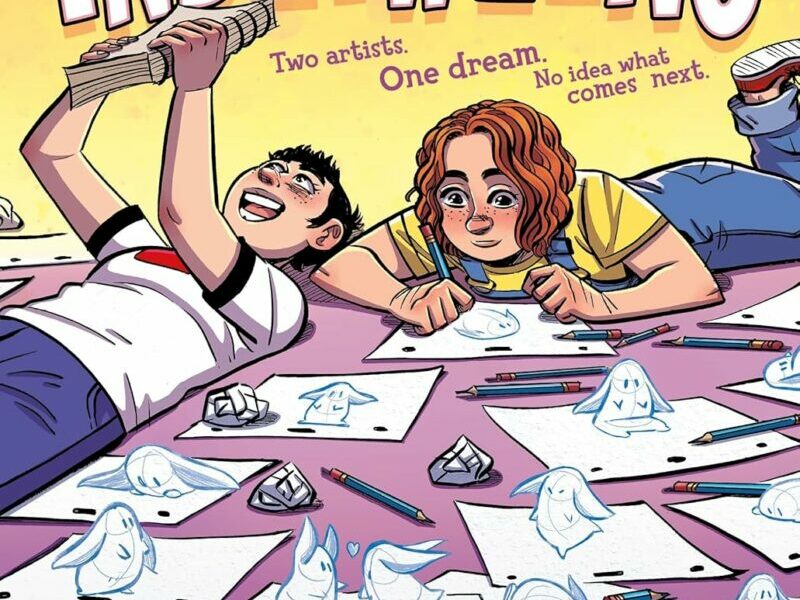
Summer school tends to get a bad rep, but not for Ash and Sloane. In Faith Erin Hicks‘ latest graphic novel Inbetweens, the twins are given the chance to enroll in a seven-week program for future animators. With colors by Kelly Fitzpatrick (with assistance from Lucy Xue), here’s what Hicks had to say about the sisters and their career goals:

Rachel Bellwoar: “Inbetweens” is actually an animation term, but it’s also a good way of describing where Sloane and Ash are at, age-wise. How long did it take for you to land on that title?
Faith Erin Hicks: It took no time at all! Usually, finding a title for a book is agony for me (Ride On was particularly hard), but Inbetweens was the title for this comic right from the beginning. It just fit.
Bellwoar: Inbetweens is set in 1999. Was that a choice you made in large part because of how much technology has changed in the world of animation?
Hicks: Inbetweens is inspired by my own experiences at a competitive animation college, and even though I went to school a few years after Sloane and Ash did (2001-2004), I wanted their experiences to be somewhat similar to my own. I also picked 1999 because on many levels, that was the beginning of the end of Disney’s golden age of traditional animation. They had a few successful traditionally animated movies after that year, but the era of the late ’80s and ’90s where they absolutely dominated the market, was pretty much over.
Bellwoar: While Sloane and Ash reminisce about a time when they used to have to hand out comics they made to help people be able to tell them apart, did you always want to introduce the twins at a point when they aren’t as visually identical?
Hicks: Yes, absolutely. They’re 13 and establishing their own separate identities. Sloane dresses very differently from Ash and vice versa. It’s something I knew would be a big part of the story right from the beginning: they’re incredibly close and they’ve always shared this big commonality in their lives, their love of art. So what happens when that commonality starts to look different for each twin? And their visual designs help that part of the story along.
Bellwoar: Every artist has their own style. What was it like coming up with styles for and drawing as your characters?
Hicks: It’s really fun! I looked at my own artwork that I drew at that age, as well as the artwork of some of my peers. Obviously, Ash & Sloane’s drawings are going to look a little similar to mine, but I tried to put their personalities into their art. Ash’s work is a little “tougher” looking, a little more edgy. I could see her getting into Invader Zim in the 00s. Sloane’s art is cuter and more subtle. The way they draw reflects who they are as people.
Bellwoar: Sloane and Ash’s bedroom is covered with posters from some of their favorite animated movies, like The Great Mouse Detectives and Monstrous (which sounds like a riff on The Iron Giant). Were there any films you specifically turned to for inspiration when writing and drawing Inbetweens?
Hicks: Kiki’s Delivery Service was a formative movie for me, and it shows up in the book in a big way. Kiki’s arc as someone who loves flying and gets a lot of joy out of it, and loses touch with that ability when it becomes something she does for work instead of a joyful expression of who she is an arc many professional artists have.
Bellwoar: As the summer program goes on, each of the characters becomes more aware of what they want from animation. Cameron, for instance, came in knowing he loved to draw backgrounds and that’s only solidified as he’s asked to try other things. When you worked in animation was there a part of the process you enjoyed the most or a favorite thing you liked to draw?
Hicks: I really loved storyboards, which use some of the same skills as comic-making, so when I left the animation industry, I ended up in comics instead. I actually hated animating, like Cameron does in Inbetweens. The fun thing about the animation industry is that there are lots of different jobs, so if you don’t like one part of the animation process, you might be able to flourish in another part.
Bellwoar: Some of my favorite panels are of the twins together, when one isn’t picking up on the others’ body language. Do you enjoy creating those moments for readers to pick up on that the characters in the scene might miss?
Hicks: When I was a kid and obsessed with comics, I used to re-read a book I liked dozens of times. I loved pouring over the artwork and picking up little flourishes the artist would put in the book, and I would feel rewarded when I noticed something new. I always want to put those flourishes into my comics, to reward kids (of any age) who re-read their comics.
Bellwoar: Ash ends up having a “don’t meet your heroes” moment with one of her teachers. Is that an experience you knew you wanted to warn young people about?
Hicks: It’s important to remember that the people who create the art we love are still people. Some of them are good and kind, and some are not. I’ve been fortunate to meet several of my art heroes, and they were genuinely lovely. I treasure my memories of them. But I’ve also had moments of incredible disappointment, when my art heroes didn’t live up to my expectations. I think it’s important that we don’t excuse creators who are unkind, thoughtless or bigoted just because they made a movie, comic or book we love. Creating great art and being a decent human being are not mutually exclusive ideas. I am grateful to know many wonderful creators who are also good people.
Bellwoar: Thanks for agreeing to this interview, Faith!
Inbetweens goes on sale March 31st from First Second.

