
Characterization In The Buffyverse — ‘Angel’ Season 2, Episode 17
by Benjamin Hall
This is part of a bi-weekly series concerning the characterization of Buffyverse characters. Arguably the best place to begin reading this series is at the beginning, but that is up to each reader. As a reminder this column will cover major and some minor characters from the shows Buffy The Vampire Slayer (1997-2003) and Angel (1999-2004). Other Buffyverse media, such as the graphic novel Spike: Into The Light (2014) are not pertinent to this series. Also there will be no referencing real world events that have direct relation to either show in this bi-weekly series. Although this series does reference things that have no direct relation to the show in order to examine things such as metaphors and literary analogues.

This week: Angel Investigations gets a temporary new staff member. At the same time, a cult of vampires starts a recruitment drive.
(Warning of spoilers from this point on!)
(Trigger warning for talk of cults and cult behavior)
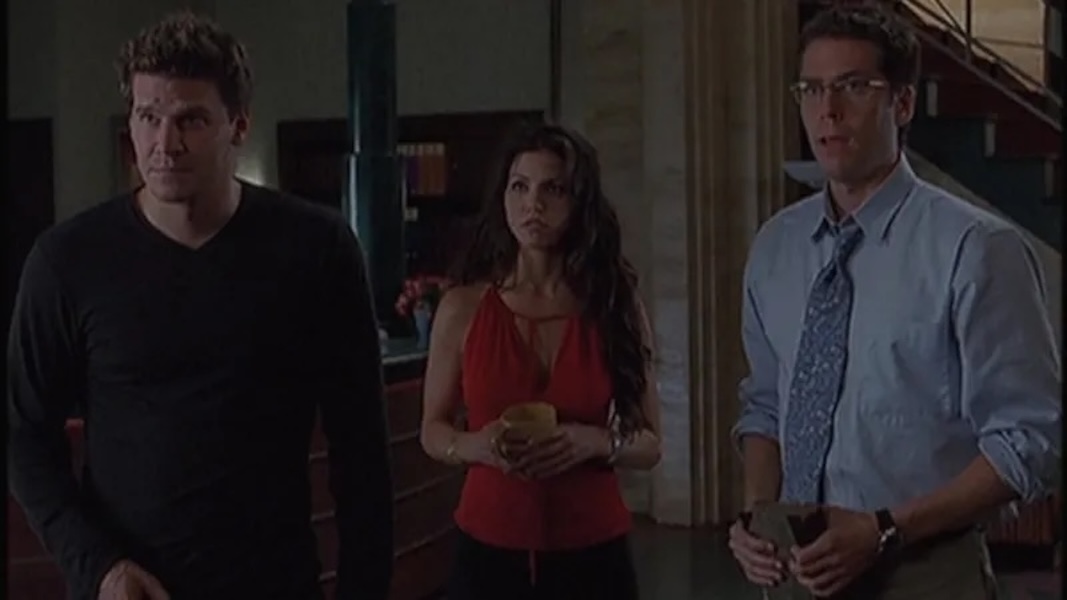
Angel (David Boreanaz) detests being the junior employee at Angel Investigations. Although he is trying to make amends with the rest of the company, his ego is clearly on display and this is making him figuratively chafe at the job. The clearest example: when he has to get coffee for the others at the end of the cold open. His attempts to be remorseful to Cordelia Chase (Charisma Carpenter) are sincere and stem from the effects of his guilt curse plus his love for her that is very slowly becoming romantic. Nevertheless, his attempt to force these and other social issues that need time and effort to remedy them suggests he is still being inconsiderate.
Cordelia ranges from mature to naïve and back again when it comes to how she acts throughout this episode. The maturity appears when she is having a serious discussion with Angel in the scene that occurs after the credits. She handles the conversation in a way that displays her growth as a person while being stern, but fair regarding their interpersonal dynamic. Upon seeing Harmony Kendall (Mercedes McNab) again, though, she regresses like most might when encountering someone they remember from their past. Cordelia has feelings of nostalgia from Harmony’s presence, and this is making Cordelia miss clues about her friend’s vampire status. When Cordelia learns the truth by Willow Rosenberg (Alyson Hannigan) literally telling her, it exposes Cordy’s homophobia. Thus, she is still far from a truly mature adult.
Wesley Wyndham-Pryce (Alexis Denisof) exhibits a larger-than-normal interest in Cordelia and Angel when the two are discussing the pair’s broken friendship. He does so in a subtle enough manner that another character could construe it as simple eavesdropping. From a viewer’s perspective, his recent failure at a romantic relationship and a desire for connection is leading him to want another chance with Cordelia (Season 2, Episode 15, “Reprise”). He exhibits very little patience for Harmony’s antics, but fails to provide any good solutions for dealing with her. He also backslides in his leadership role by pleading with Angel to convince Cordelia that she rid them all of Harmony’s presence. Yet, Wesley mostly is just the boss dealing with too much stress from his employees’ various behaviors.
Charles Gunn (J. August Richards) spends most of this adventure trying to get information off-screen. While he does have some screentime, it’s mostly brief bursts of exposition. Otherwise, he spends the narrative assisting with moments of levity or action. Therefore, Gunn gets very little growth. What little development he receives here amounts to viewers learning his coffee preference.
Lorne (Andy Hallett) provides commentary and some advice as he usually happens to do. Otherwise, there is no real use of the character this week.
Willow appears in this episode seemingly to remind readers to watch both Angel and Buffy The Vampire Slayer. Her conversation with Cordelia does not help the former’s development, and the corresponding reveal could see replacement with another method, such as a mirror.
Doug Sanders (Pat Healy) runs a typical pyramid-scheme-type cult, which makes him a devious vampire in terms of realizing his ambitions. Yet, most viewers of the Buffyverse have previous exposure to his method of modernizing humans as food stock from the Wishverse version of The Master (Buffy The Vampire Slayer Season 3, Episode 9, “The Wish”).
Harmony apparently still knows almost nothing about her vampiric nature, especially that drinking any kind of blood will stop cravings. Additionally, her intellect continues to vary from “realistically dumb” to “how is she continuing to exist?” Yes, she is pitiful and appears to be unnaturally lucky both in this episode and in the past (Buffy The Vampire Slayer Season 4, Episode 3, “The Harsh Light of Day”). Nevertheless, the amount of plot armor she seems to have is arguably the only legitimate reason she does not see a proper dusting. As far as this episode goes, it is a waste of potentially growing the character either into a valid potential enemy or a true ally of Angel Investigations.
Tibor (Marcus Shirock), the people in the cages (Adam Weiner, Rebecca Avery, Freda Nelson Evans), along with Mexican vampire #1 (Luis Contreras), Mexican vampire #2 (Luis Chávez), and the two other vampires (Candice Cook, Roger Stoneburner) help populate the cast. Yet, none of them are memorable enough to leave a clear narrative impact.
This episode regresses each respective character to an almost base-level. For example: Angel is all about his ego while Gunn is the “token Angry Black Guy”. Still, regression of characterization can make a story work when it comes from a plot requiring it. This is not one of those stories. Both the Harmony and Cordelia friendship and the cult plots have a theme of growing. Unfortunately, the plots require additional complexity when it comes to the characterization — plus more runtime than they get from this single installment.