
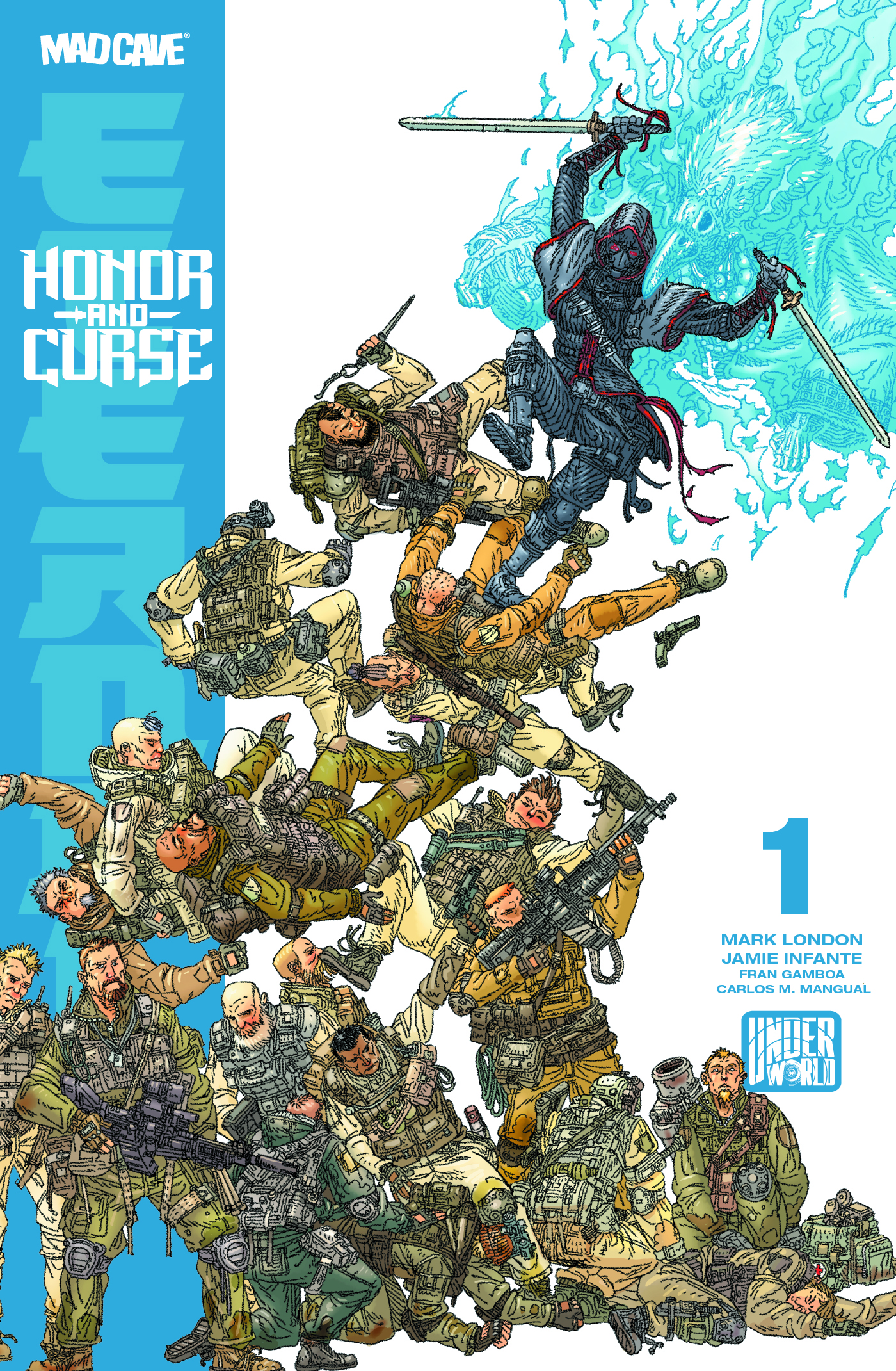
Interview — Mark London Talks Mad Cave Studios’ ‘Honor And Curse: Eternal’
by Anton Kromoff
Welcome to the table,
Folklore and swinging swords are always an exciting combination, and when applied to the paneled page of a Mad Cave comic book, it’s normally a recipe for a good time.
Honor & Curse: Eternal, the continuation of the series created by Mark London that introduced readers to Genshi Sakagura. This new chapter picks up 600 years later and expands the series’ mythology through bold storytelling and atmospheric sequential art. I recently had a chance to catch up with Mark and ask him about the book and his thoughts on moving the series forward. You can check out the interview below.

Anton: Hey Mark, thank you so much for being with me here today. Before we dig into the series, can you tell our readers a little bit about yourself and how you first got into writing comics?
Mark London: Thanks for having me. I really appreciate it. At the end of the day, I’m just someone who is completely in love with storytelling. I grew up in the late 80s, which was a great time to be exposed to all sorts of media: comics, video games, movies, animation, and literature. All great platforms for storytelling in their own way.
I devoured everything I could get my hands on, but comics were always something special to me. There is something about sequential art that truly connects with me and still mesmerizes me to this day. To some, comics are just pictures divided into panels, into pages, but for me, they’re so much more. Ultimately, it was my wife who encouraged me to pursue my passion, and I’m forever grateful for that.
I’m also the CEO and Chief Creative Officer of Mad Cave Studios, we’re an independent publisher with four imprints (Mad Cave, Maverick, Papercutz, Nakama Press), and we’ve spent years building what I’d call a real universe of original IP, creator-owned, and licensed books. But all of that grew out of that same love for story. I didn’t set out to run a publishing company. I set out to tell stories that felt urgent, that had weight to them. Mad Cave was the infrastructure I built to do that, and then it became something much bigger than I ever expected.
Anton: When you first created Genshi Sakagura, did you already imagine a story that might one day stretch centuries into the future, or did the idea for Honor & Curse: Eternal come later?
London: Honestly, when I created Genshi, I knew there was more to him than one story could hold. He was always meant to be a character of enormous depth, a man living with something inside him that he didn’t ask for and can’t get rid of. The original series was about his origin, his fall, his horror. But the question that haunted me the whole time I was writing it was: what happened after? Nobody knows what happened to Genshi after he disappeared from the records before he was thirty. That mystery was always the invitation for something bigger. Eternal isn’t a sequel so much as it’s the rest of the story I was always planning to tell.
Anton: Six hundred years is a long time to live with a curse. How has Genshi changed emotionally or philosophically between the original story and where we find him now?
London: He’s exhausted. That’s the first thing. A lot of immortal characters in fiction become these wise sages with all the answers, but Genshi is the opposite. Six hundred years of penance doesn’t make you enlightened. It makes you tired in a way that sleep can never fix.
He’s accumulated so much grief, so many lost connections, so many faces he watched age and die while he stayed the same, that the only way he survived was to retreat from all of it. He meditates for days at a time. He lives in silence. He built an entire company (Mountain Honor Protection) just so he could maintain a purpose without having to be present in the world. Philosophically, he’s made a decision: the only way to be good is to stop fighting. Because every time he fights, Minamoto (The Tengu) gets stronger. So his entire philosophy for six centuries has been stillness. And when we meet him in Eternal, that stillness is about to be shattered.

Anton: I’ve always been intrigued by the concept of stillness. There is something so cool about that. Now, you mentioned the Tengu spirit inside Genshi has always been a bit of a fascinating element in folklore. What new layers of that lore are you exploring in this series?
London: What I’ve always loved about the tengu in Japanese mythology is the duality; they’re not simply evil. They’re ancient, they’re connected to war and conflict, but they also have their own code, their own tragedy. In the original series, Minamoto was very much the antagonist. But in Eternal, I wanted to complicate that. Minamoto has been caged in a corner of Genshi’s mind for six hundred years. That’s not nothing.
There’s a twisted intimacy to that coexistence. They’ve been prisoners of each other. And now I’m exploring what that does to a war spirit, does isolation change it? Does it hunger differently? Does it, in some strange way, need Genshi as much as Genshi needs to contain it? The deeper I got into that relationship, the more I realize that their story is really about what happens when two beings who can’t exist without each other are also fundamentally at war with each other.
Anton: This story takes us from feudal Japan into a modern-day setting. What new layers of the story are you excited to explore this time around?
London: What gets me most excited is just the sheer contrast of it. This guy has been alive since the 1400s, he looks twenty-something, and he’s running a corporate security company out of New York City. That image alone tells you everything about who Genshi is now, someone who figured out how to function in the modern world without ever really being part of it. There’s something almost darkly funny about a feudal Japanese shinobi navigating Manhattan.
But then it gets serious fast, because the threats he’s facing aren’t that different from the ones he knew centuries ago; they’ve just changed their clothes. The Order of Nine wants to drag humanity backwards. Unity Ultima wants to own its future. And Genshi is caught in the middle of both because of what he carries inside him. That’s the story. Ancient war, modern setting, and a man who just wants to be left alone, finally being pulled back in.

Anton: You’ve described Genshi as someone who spent centuries running from power. What does power mean to you?
London: Power is the thing most people want, and very few people understand. The assumption is that power is freedom, that if you have enough of it, you can do whatever you want, be whoever you want. But Genshi is a character who has more raw power than almost any being in our universe, and it’s a prison. The more power Minamoto gives him, the less of himself remains. I think about power that way in my own life, honestly.
The things that make you formidable are also the things that can consume you if you don’t have discipline around them. Genshi’s six centuries of restraint aren’t a weakness. It’s the hardest thing he’s ever done. There’s a version of power that’s about domination, and there’s a version that’s about control. Control over yourself, your instincts, and your own worst impulses. Genshi chose the harder path. That’s what makes him worth following.
Anton: You’re collaborating with artist Jaime Infante on this series. What has that creative partnership been like, and what does he bring visually to the series?
London: I have to give a lot of credit here to our Editor-in-Chief, Mike Marts. Mike has this incredible instinct for matching the right artist to the right series. It’s genuinely one of his superpowers, and it was Mike who found Jaime and suggested him for Honor and Curse. Boy, was he right. Jaime is incredible. What he brings to this book is a rare ability to hold two tones at once. He can render feudal Japan with the weight and texture it deserves, and then flip to modern New York with a completely different visual energy, and both feel completely authentic.
That’s harder than it sounds. But more than the craft, what I appreciate most is that he understands Genshi. He gets the stillness. Even in action sequences, there’s something in the way Jaime draws Genshi that communicates the cost of every move. Is like the reader can feel that every punch is Minamoto getting a little stronger. That visual storytelling is something you can’t just instruct an artist to do. Either they feel the character, or they don’t. Jaime feels him.

Anton: Before we wrap, I wanted to take a second to thank you for taking the time to talk to me today. Where can our readers keep up with you and what you are working on?
London: Of course, Anton. And thank you. This was a great conversation. The best place to follow everything is madcavestudios.com, and to subscribe to our newsletter. That’s where all our announcements live. I’m also on all social media as Mark London, and have a Substack where I write about the universe, the creative process, and what we’re building. And honestly, the best way to keep up is to pick up the books. Every issue is a piece of something larger that we’ve been constructing for years.
Anton: Okay, one more before we go, what can readers look forward to as Honor & Curse: Eternal unfolds, and without spoilers, is there anything you’re excited for fans to experience?
London: What I’m most excited for readers to experience is the moment they realize this story is not what they expect. They’re going to pick it up thinking it’s a ninja action book, and it is, the action is epic, but underneath that, it’s a story about a man confronting the question of whether six hundred years of doing the right thing is enough to redeem one moment of catastrophic failure.
And I’ll be honest, the answer isn’t going to feel good. It’s also going to sting a little, and that’s intentional. Beyond that, what I really want people to feel is that this story is bigger than it first appears. We’re cracking the Underworld Universe open in a way we haven’t done before, and Genshi is the key to that. He’s been around long enough to have touched almost everything. So, for the longtime readers, just watch. Don’t skip anything. There’s a lot happening under the surface.
Anton: Until next time, it seems Mad Cave is always building something fresh and exciting. This is just another chapter on the shelf of what a truly mindful comic company can do.