
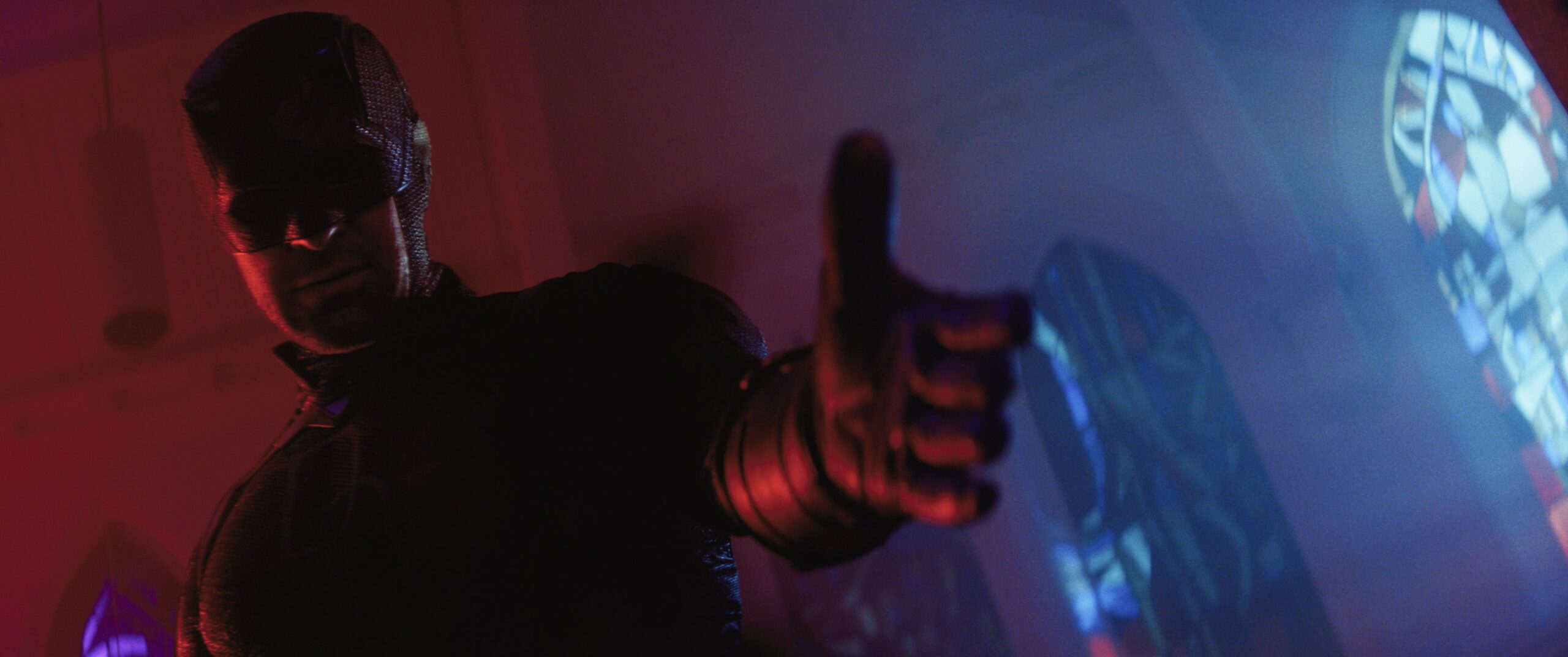
TV Review: ‘Daredevil: Born Again’ Season 2 And The Problem Of Verisimilitude
by Austin Gorton
The first season of Daredevil: Born Again is a mess. Originally envisioned as clean-ish break from the earlier Daredevil series which ran on Netflix before the arrival of Disney+, then rejiggered into a proper continuation of the original run midway through production, the end result is a tonal mishmash of a show. The original (re)vision was intended to be a lighter, less superhero-heavy, more legal hi-jinks kind of series.

Once the decision to put it back into continuity with the original was made, the darker, more violent tone of that series returned. Then pieces of episodes were cut up and redistributed, and the whole thing came out a mess. Yet the season got better as it progressed and more consistently struck the “superhero action show” tone, with the best episodes of the season (give or take a bank heist bottle episode) coming at the very end, making the arrival of a second Born Again season feel at least a little more like a promise than a threat.
Yet while the back half of Born Again Season 1 may have felt like a show slowly shedding the elements of a failed revamp, the premiere of Season 2 illustrates showrunner Dario Scardapane and directors Justin Benson & Aaron Moorhead did not use the season break to finish that job. In fact, “Northern Star”, the first episode of the new season, feels as much like Episode 9 of the first season (or, in older TV parlance, a mid-season premiere) than a true season beginning, with nearly all the characters and plotlines setup in the first season still in the mix (which makes sense given that one of the reasons we’re getting Season 2 roughly a year after Season 1 is because production began on it before Season 1 was released, meaning these early episodes, at least, would have been made with no knowledge of the reaction to some of the first season’s less effective elements).
To be clear, time has certainly passed within the context of the show. Matt (Charlie Cox) and Karen (Deborah Ann Woll) are in a full-fledged relationship now, as they work together, off the grid, to take down Mayor Kingpin (Vincent D’Onofrio) whose “safer streets” initiative, launched in the finale of season one, has indeed resulted in safer New York streets – at least for some. His anti-vigilante task force is operating with impunity (and no legal oversight), with even the district attorney from last season (Hochberg, played by John Benjamin Hickey) is frothing at the mouth to get the highly touted “Vigilante Trials” underway, with the Swordsman, Jacques Duquesne (Tony Dalton), introduced in 2021’s Hawkeye series and arrested by Kingpin in last season’s finale, returning to serve as the high profile focus of those trials.
Yet for all his (legal) power, Kingpin remains up to his usual tricks, and “Northern Star” opens with an action sequence set aboard a cargo ship of the same name which is smuggling military hardware into Kingpin’s special extra-legal port. From there, the events aboard the ship serve as the catalyst for the presumed overarching plot of the season, as Matt and Karen see it as an opening to expose Fisk.
Matt’s insistence that this is the scandal/criminal act that will finally end the threat of Fisk for good is, of course, hilariously naive. Not just in the context of the series (in which Fisk twice went to jail and still got elected mayor), but in the context of the real world outside our window, in which we receive evidence every day that there is no flaw big enough to turn at least a segment of a populace against a leader with a strong enough cult following. Similarly, the deliberate Trumpian echoes of Fisk’s rise to (political) power and the actions of his extra-legal task force introduced in the first season hit even closer to home now, with sequences of the fictional AVTF kicking down doors, dragging out “suspects” and generally pissing all over concepts like “due process” and “the law” in the interest of their self-serving master while being called fascists by justifiably angry bystanders (even while others applaud, via the newly Fisk-friendly BB Report segments, the “safer” streets their actions have theoretically delivered) playing like clips from local news broadcasts in dozens of (real) cities.
Marvel Comics (and by extension, the films and TV shows inspired by them) has long touted their stories as occurring in “the world outside your window,” but what happens when the world outside our window becomes stranger — or darker — than fiction?
The question of what role art should play in society, and the balance therein between reflection, illumination, entertainment and catharsis, is as old as art itself. It’s certainly not a question that is going to be answered by this show about a lawyer who dresses up like a devil to hit people with a club and the villain’s main fixer and business administrator is named Buck Cashman (Arty Froushan) aka “Dollar Dollarman.” Nor is it a question which a show like this is even built (or intended) to seriously grapple with. Yet at the same time, when the plotlines are tapping so directly into the imagery and vibes of the real world zeitgeist, it’s hard not to be pulled out of the story by those kinds of questions, to wonder if the most unbelievable thing in this superhero punch-’em-up story is the idea that it’s even possible for a villain to get their comeuppance someday.

Superheroes stories are, at their core, wish fulfillment stories, supported by a willingness on the part of their readers to suspend some measure of disbelief. Sometimes, that’s as simple as marveling at a man who can fly, or in watching the weak find their power. Sometimes, it’s in reveling in a world where problems can simply be punched away by the colorfully-clad virtuous, where wrong is wrong and simply speaking truth to power is enough to right it. Yet when a superhero story treads too closely to verisimilitude in its reflection of a world that increasingly seems unbelievable, it can require an unstable degree of disbelief suspension to support it.
Solving the real problems of our real world takes more than ninja training and an assortment of wigs. But in the meantime, we can find hope and catharsis in watching Daredevil and company fight the good fight in their ways, so long as his world isn’t too close a reflection of ours so as to break our suspension of disbelief. We’ve got seven more episodes of Daredevil: Born Again this season to see how well it can walk that increasingly-narrow tightrope.
The Law Review
- While most of the characters in this episode are returning from the first season, one big new addition is CIA Operative Mr. Charles, played with delightful panache by Mathew Lillard. He’s a hoot in every scene he’s in this episode, and will hopefully bring some much needed levity and verve to the Fisk family machinations (especially since most scenes between Wilson and Vanessa (Ayelet Zurer) play out with the energy of funeral dirge).
- Heather’s complete transformation from “underserved love interest” to “super-villain with PTSD” is my least favorite carryover from the first season.
- The person Mr. Charles spoke to on the phone to get the New York attorney general to back off Fisk was Julia Louis-Dreyfus‘ Valentine Allegra de Fontaine. It’s unclear where in the MCU timeline this show is meant to take place, but we last saw her in Thunderbolts*, inadvertently assembling (and being blackmailed into funding) the New Avengers.
- Speaking of which, in the ranking of spycraft story tropes, “handing someone a phone and the person on the other line says something that generates immediate compliance” comes right beneath “swirling a burner phone in a glass of whiskey.”
- Karen mentions her contact is “Jess” — this is presumably Jessica Jones (Krysten Ritter), who we know from trailers will be appearing in this season.
- The Max Headroom-esque anti-Fisk video segment seems so obviously-perpetrated by BB (Genneya Walton) as part of her “public praise Fisk, secretly blast him” routine that it makes me wonder if it actually is someone else.
- Matt’s new black Daredevil suit seems to be taking a page from his look in the “Shadowlands” comic book event.
