
Fool’s Comics Cavalcade: ‘Batman: Harley Quinn’ Plays With A Trope To Introduce A Staple
by Tony Thornley
It’s April Fool’s Day, and it’s accidentally become a tradition of mine to highlight one of comics’ most legendary Fools every year. Yes, that’s right, I’m talking about this Joker, but this year he’s bringing someone along with him.

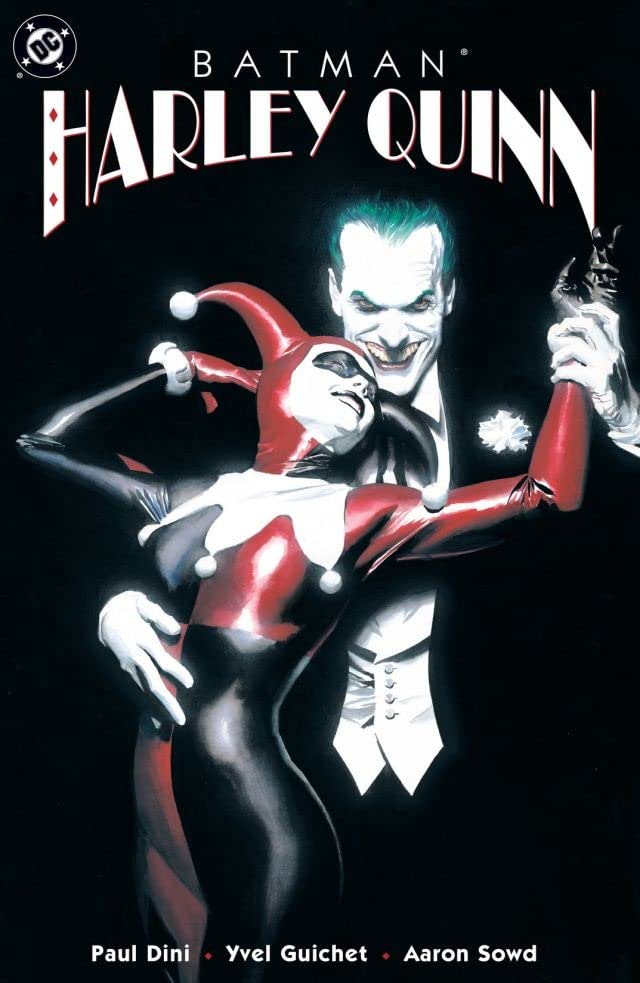
In 1992, one of the most enduring characters in the Batman mythos made her debut. However, it wasn’t in an issue of one of the core Bat-books, or even a limited series or sidekick’s solo. Doctor Harleen Quinzel, AKA Harley Quinn, made her debut in “Joker’s Favor”- an episode of Batman: The Animated Series. The character was an instant hit but it wasn’t until 1999 before the character made her first appearance in the actual DC Universe in Batman: Harley Quinn #1 by Paul Dini, Yvel Guichet, Aaron Sowd, Tanya & Richard Horie, and Willie Schubert.
In the middle of the ‘No Man’s Land’ event, Poison Ivy finds a strange young woman in the wreckage of a rocket. Harleen recounts her origin to Ivy- a story of obsession and abuse. From there, Ivy decides to help Harley get her revenge on the two men who have wronged her most — the Joker and Batman!

Harley simply is one of the most fascinating characters in comics when written well (when she isn’t, well, there’s a reason I don’t love her). Dini takes the character that he’s already done so much with and effortlessly draws her into the core DC Universe. Even better, he does it in the middle of a massive event (No Man’s Land basically transformed the core four Bat-titles into a single year-long weekly series, and every Bat-adjacent ongoing series tied into the event in some way).
The fact that he makes that side of the story still accessible is a testament to his skill as a writer. There’s just enough exposition that you get that an earthquake turned Gotham into a war zone, but not so much that you’re overwhelmed with information. He even makes the exposition-heavy opening pages — in which Harley is basically retconned into having always been around, just never seen- entertaining and engaging, getting readers to buy in on the emotional struggles of this troubled young woman.

He also makes the problematic elements of the Joker/Harley relationship explicit. “Mistah Jay” is taking advantage of an emotionally troubled young woman at best, and the two have a codependent and abusive relationship at worst. It’s an important plot point, which Dini doesn’t gloss over, and it allows for the character to grow past it in later stories.
The art in the issue is a common style that 90s readers may be familiar with- an extremely cartoony line with obvious manga influences. That’s not to say Guichet and Sowd’s work is bad though. They give the issue a bouncy energy, which keeps it from veering too far into the darker corners the story could go (after all, the team only had 50 pages to introduce her — they couldn’t address everything). I love their rendition of the Joker though, with a heavily angular look and lots of sharp lines that that make him stand out, and their Batman is great, looking just like Michael Keaton’s version of the character.

It’s not a perfect issue, but it’s a great introduction, bringing the character into the DCU. She begins a journey here that leads her to becoming one of the most popular characters in today’s DC Universe.
The issue is available digitally as well as in multiple collected editions available digitally and physically, such as Batman: Harley Quinn, and Harley Quinn: A Celebration of 25 Years.
