
An Interview With ‘Monster Locker: Nine-Tail Trouble’ Creators Jorge Aguirre And Andrés Vera Martínez
by Rachel Bellwoar
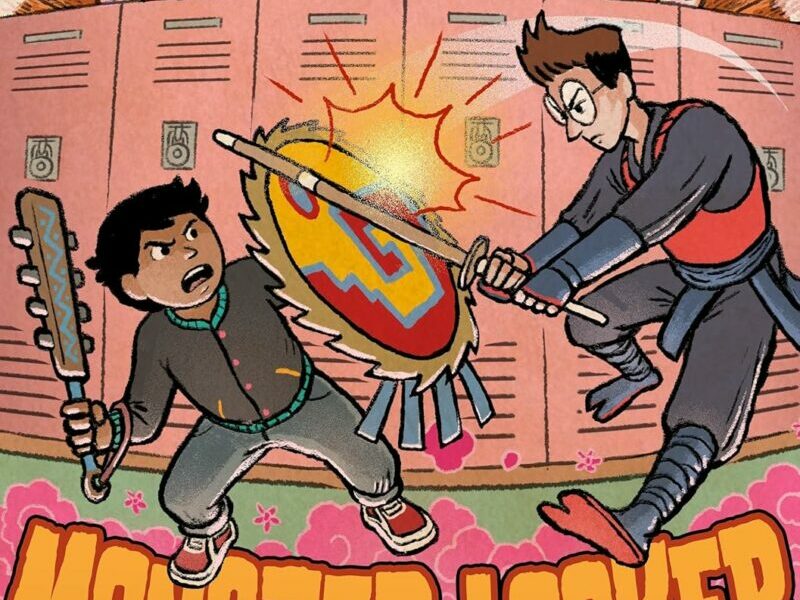
The trouble with having a monster portal in your locker is that there are always new monsters trying to come through. Pablo and his friends might have been able to convince Coatlique to stop turning their peers into animals at the end of Monster Locker, but how will they fare against a nine-tailed kitsune? For more on what readers can expect from the sequel, here’s what writer Jorge Aguire and artist Andrés Vera Martínez had to share about Monster Locker: Nine Tailed Trouble:

Rachel Bellwoar: When she was unsummoned at the end of Monster Locker I thought that was the last we would be seeing of Coatlique. Instead, Monster Locker: Nine-Tail Trouble opens with Coatlique and it turns out she and Pablo have been keeping in touch. Why did you want to show that relationship continue and have her return in book 2?
Jorge Aguirre: In Book 1, Pablo wants to be a “fly-under-the-radar” guy. He doesn’t want to do anything that calls attention to himself or his Mexican-American background. But confronting Coatlicue was a way for Pablo to learn more about himself and his cultural past. They’ve stayed pals because Pablo has learned to embrace his roots. Besides, if you could be friends with an Aztec goddess, wouldn’t you want to be, too?
Bellwoar: As the title hints at, the main monster this time around is a nine-tailed kitsune, which is both relevant to Takashi’s cultural background of being half Japanese and half Jewish but also raises interesting questions around artistic credit that feel especially relevant in light of our society’s current obsession with AI. When did that connection happen for you, where you realised you could talk about these modern issues using a mythological creature that’s been around far longer than AI’s been?
Aguirre: Love that you’re making this connection, but to be honest, when I wrote the script, I wasn’t very aware of AI. That tells you how quickly we’ve been forced to contend with it. BUT every monster in the book represents more than just itself. Kitsune is about being the fake you, even though he promises to help you be the real you. It’s a lie. There’s a parallel in which AI promises to make our lives better. To make us write better than we can write. Think better than we can think. Make the “best version” of ourselves. But I think, like Kitsune, it’s all trickery.
Andrés Martinez: AI wasn’t on my radar either when we developed Kitsune as a “better version” of the students. As an artist, I’m not intimidated by AI, yet. I see it as a tool we’ll eventually learn to harness. However, in the book, Kitsune has “tails” that give him away—like the pink smoke. AI is the same, for now. It has tells if you look closely. Maybe we should build these fail-safes in as we learn to live with AI and also train our eyes to spot them so we don’t mistake the trickery for truth.
Bellwoar: Both Coatlique and the kitsune start out wearing masks. Did you always want that common point in their designs?
Martinez: Yes. A central theme is our characters reluctantly embracing hidden parts of their heritage. I designed the monsters to reflect the kids’ specific cultural mythologies, using masks as a visual metaphor for uncovering the unknown or discovering oneself. Plus, honestly, they were just fun to draw
Bellwoar: Of course the kitsune isn’t the only monster Pablo and his friends have to deal with in book two. Do you have a favorite of the “clingers” they have to banish?
Martinez: He’s easy to miss, but I like the Naked Bear. He’s a fun callback to Book One, and I drew him to be transparent. This turned out so strange and funny to me. I’d like to draw him again.
Aguirre: The internet troll made me laugh when I first thought of it. Especially the line the troll says about doing his own research. I feel like internet trolls are truly clingy monsters who should be banished.
Bellwoar: That becomes a sticking point in this book as well. While the other students are quick to call Pablo and his friends “monster killers,” Pablo is insistent on correcting them that they’re banishers, not killers. Why was that a point you really wanted to stress?
Aguirre: One of the loveliest things about Pablo is his empathy. He’s not going to make anyone, not even a monster, suffer or be killed. But banishing them is okay in his book.
Bellwoar: Takashi is a character who’s always been very self-expressive. In book two, however, we learn that at home he has a very strained relationship with his father, and how much effort goes into that self-expression, in that he completely changes his appearance between home and school. What was it like developing that other side to Takashi and coming up with a new home wardrobe for him?
Aguirre: When I was a kid, my parents left me alone (i.e., ignored me) as long as I got good grades and stayed out of trouble. I don’t feel like they ever knew my true self. At home, I presented very differently. Maybe it’s always like that with kids and their parents. Or maybe that’s something particularly present in my Gen X generation.
Martinez: Dressing “Approved” Takashi was simple—I just mirrored his father with dull colors, semi-formal clothes, and neat hair. I modeled him after a kid I knew whose strict parents banned fantasy toys but allowed GI Joe. He dressed exactly like the version of Takashi his dad would approve of.
Bellwoar: Friendship isn’t just fighting monsters together. It’s also having the tough conversations, like breaking it to your friend that their dreams of becoming a J-pop star might be strained by their off-key singing voice. How difficult is it to find time for regular, high school conversations in a book that also deals with literal monsters?
Aguirre: The tough conversations are the soul of this book. I love the monster combat, and Andrés makes it so exciting, but these pauses in the action for character development are what I hope make readers reflect.
Martinez: Jorge once mentioned he loved a silent panel I drew while the kids discussed Maggie’s father. I shifted from medium shots of their conversation to a zoomed-out long shot that captured them avoiding eye contact and using body language to show their sadness and shame. I wanted that emotional weight to breathe and linger. Plus, I couldn’t resist drawing Obie eavesdropping in the background right when they were most vulnerable.
Bellwoar: A lot of people have come around to liking Pablo since he started banishing monsters but not Dylan. His one-sided conflict with Pablo continues. Why did you want, or feel it was important, to include a character who refuses to let go of his hate, despite how irrational (and racist) it is?
Aguirre: Pablo is evolving. Dylan’s the only kid who refuses to see that evolution. I think we all have people like that in our lives though the Dylans in our lives might not be such jerks. In a way, it reminds me of how when you’re with siblings, you revert back to the same arguments you’ve had for 30 plus years. And for as popular as Dylan is, his refusal to see Pablo for who he is, represents his own insecurity. Popular kids are always massively insecure. If we do future books, we want to really resolve Dylan’s resentment. In a Monster-y way.
Martinez: Bigotry is a learned behavior, often passed down through generations. Growing up, I met many “Dylans,” yet children’s literature often softens these issues with vague platitudes like “let’s just all get along.” I felt it was important to depict a perpetrator of this behavior honestly so readers can actually confront it. That said, Dylan isn’t one-dimensional. We have significant, unexpected plans for his role as the story moves forward.
Bellwoar: Thanks for agreeing to this interview, Jorge and Andrés!
With color assists by Lucija Freeman and Sadie Lappin, Monster Locker: Nine-Tale Troubles goes on sale April 21st from First Second.

