
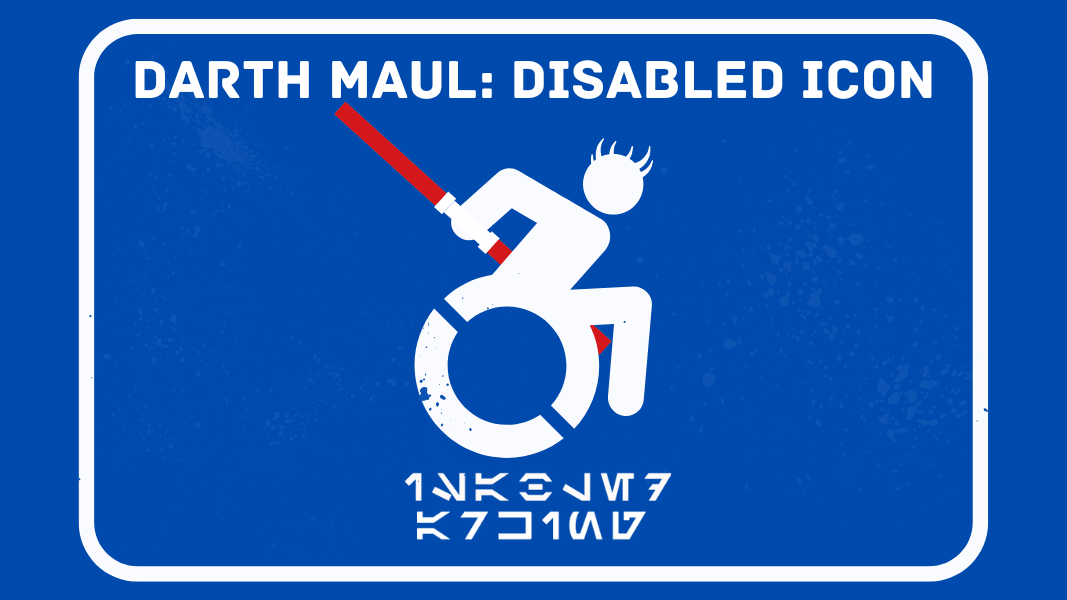
Darth Maul: The Disabled Icon We Never Asked For
by Anton Kromoff
Welcome to the table,
As someone who’s had a physical disability since birth, I’m always looking for characters that manage to represent disability in a way that feels multifaceted. More often than not, it is played in a “very special episode” kind of way.
With that in mind, I would like to make the case for Darth Maul being one of those multifaceted disabled characters.

After the tragic events on Naboo that cost Jedi Master Qui-Gon Jinn his life, Darth Maul was cut down in a fit of anger by the impulsive, reckless, and irrational Jedi Knight, Obi-Wan Kenobi. This happened in Star Wars: Episode I- The Phantom Menace, while Maul was a Sith Lord and right hand to Emperor Sheev Palpatine, known to those who know such things as Darth Sidious.
While Kenobi’s rage-fueled assault sliced Maul in half, sending him tumbling down into the depths of the royal palace, that could have spelled the end for this conflicted son of Dathomir. Somehow, through willpower, the Force, or some cosmic stroke of luck, our now double amputee survived. Against all logic, biology, and in defiance of Kenobi’s expectations, Maul returned.
Maul was not “magically” restored. This was not some Force power that allowed him to “get better” as so many people will say to you when you are disabled. The platitudes of “I hope you get better” to someone who is not “worse,” and is simply existing in the form they were born in, do not ring in the ear in a way one may expect if they have never experienced actual disability in their lives.
NO! Maul was rebuilt! He was not restored to some “factory setting” where he could flip and kick and jump as is the expectation of all humanoids across the galaxy, even those far, far away. Maul’s survival was through sheer will, adaptation, and yes, anger.
When we see him again in the animated series Star Wars: The Clone Wars, he is on the junkyard planet of Lotho Minor, having been stranded there and surviving on his own in pain for years. However, Maul is not bested by his body’s limitations. Using the Force and his technical know-how, Maul constructs spider-like limbs to replace his severed legs, making use of their multiple points of grip and balance to better navigate the treacherous and ever-shifting dystopian landscape with an accessibility device that best serves his needs at the time.

These are not bipedal legs, no. In this hellish landscape, Maul does not fold to the social norms of humanoid expectations; he forgoes the simplicity of two legs, crafting something that allows him equity while shrugging off the preconceived and shackled need to conform to the form others may expect him to traverse a landscape in.
It’s not about “looks” for Maul at this time in his life; it’s about adaptability and ease of use and as someone who used crutches to avoid having to use a wheelchair for so long, doing damage to my shoulders, knees, and legs to maintain a sense of physical acceptability in this world, I respect and adore that design choice, intentional or not, because it felt liberating to see on the screen.
We do eventually see Maul using bipedal legs, but it’s on his own terms, and it fits into the themes of accessibility nuanced with self-determination. His first legs are best for traversing rugged landscapes, making him a smaller target in combat, and being more devastating when he unleashes attacks from them in close quarters with other humanoids.

We see him with more humanoid legs in Star Wars: Maul: Shadow Lord, but again, this is Maul’s choice to select his accommodations based on his needs. His accessibility devices in Shadow Lord are more attuned to stealth and subterfuge, switching from something that is more ferocious and warlord-like to something that allows him to move more delicately through the underworld as an up-and-coming crime boss. Whatever mode Maul is in, it’s centered on his own self-directed choices, and this alone speaks volumes to those of us who often have our own agency taken away by those who think they know what is best for us.
Another deeply empowering aspect of Maul’s character is that his psychological trauma is allowed to be authentic. So often, we are shown depictions of disabled people who are very Zen-like, in an almost “inspiration porn”-like manner.
“Very special episodes,” as I have come to call them, either show a disabled person as some cheerful and “at peace” person who is there to teach the able-bodied people a lesson about humanity or humility, or they are angry and upset at the world. They have some kind of breakthrough due to their able-bodied main character saviors who teach them a lesson about friendship or love, and then they roll off into the background, never to be seen or mentioned again.
Maul treads this ground far differently. When we find him on Lotho Minor, he is consumed with rage from being in isolation for so many years, left and disregarded, as most disabled people are, as the galaxy moves on without him. As he regains his sense of self, it’s never done in a way that comes off as “overcoming” his disability.
What we are granted instead is a character who drifts between anger, worry, grief, ambition, and fear. This all happens in a non-linear fashion that is anything but neat or inspirational. Maul struggles, he relapses into anger, he rebuilds himself, then falls apart again. It’s messy, it’s painful, but more importantly, it highlights that it’s okay to struggle and fail and rise and fall.

Maul is this villain. More importantly, Maul is humanized in a way that, at least to me, sets him apart and makes him more honest and authentic, even if I don’t always agree with his ideals, than the Jedi and their monastic, rigid order.
Maul is not sanitized, and that makes him “unsafe” in the eyes of the protagonists of the Star Wars franchise. He’s angry, vengeful, and at times destructive. While this aligns with his role as a Sith, it also breaks away from the expectation that disabled characters must be inspirational or angry at their own limitations. Maul is not pissed off because he is missing his legs; he is pissed off because he clashed with Kenobi, was bested in combat, was disgraced by his master, and has had to live in squalor and pain to bring himself back to the position where he oversees vast criminal networks.
His story allows space for pain and anger, frustration and discomfort, without turning them into lessons for others. That nuance is so rare in pop culture and invaluable in the eyes of people who never see themselves as more than a very special episode.
Maul resonates with me because his story does not revolve around needing a “cure.” That’s a narrative too common with those living with a disability, whether it’s based on mobility, development or a bodily system dysfunction.
There is no moment where he returns to his “original body.” He instead adapts, grows his power, expands his influence, and increases his strength. Maul learns to fight, move, and exist in a body that is permanently changed, both mentally and physically. In most media, disabled representation often falls into the trope of “fixing” characters for them to have an arc. However, with Maul, that trope is rejected as we see his rise to power and popularity come with his altered body, not in spite of it.
I am not deluded enough to think that anyone in the Star Wars writers’ room expected to set out to make Maul a disability icon. Fandom is a funny thing, though. We interpret the characters we see in media to our lived experiences. Maul’s journey, the story of survival, reconstruction, adaptation, and ongoing struggle, hits closer to home for a community that many may not realize or consider outside the confines of “a very special episode.”
He is far from a perfect symbol. He’s not even a hero. That’s the point I am making, though. Sometimes representation isn’t about shining examples. Sometimes it’s about seeing a character who endures, changes, and keeps going anyway. Even in a galaxy far, far away, even when they have been written off, they matter.
Until next time, Peace is a lie; there is only passion. Through passion, I gain strength. Through strength, I gain power. Through power, I gain victory. Through victory, my chains are broken. The Force shall free me.