
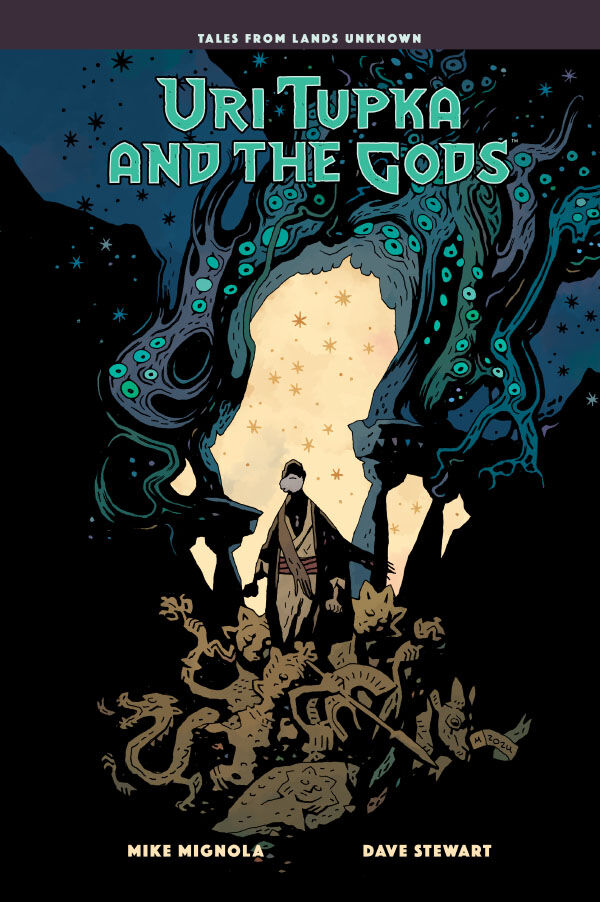
Review — “Tales From Lands Unknown: Uri Tupka And The Gods” Is Allegorical Artistry
by Anton Kromoff
Summary
Modern Mythos is being created within the pages of Uri Tupka And The Gods. Mike Mignola brings an authenticity to the allegory that is nothing short of historic, and I, for one, want nothing more than to sink into the Lands between and dwell in the places that Uri Tupka travels.
Overall
10/10Welcome to the table,
Mike Mignola is a modern myth maker. Much like Jacob and Wilhelm Grimm, the fabled Aesop, Lovecraft, Howard, and Burroughs, Mignola has created more than worlds for us to get lost in; he’s created fables, mythos, and lore that will educate, entertain, and illuminate for generations to come.
His newest installment to The Lands Unknown is titled Uri Tupka and the Gods and serves as a follow-up to Mignola’s wildly acclaimed Bowling with Corpses and Other Strange Tales.

The story, written and illustrated by Mignola, with colors by Dave Stewart and letters by Clem Robins, takes us on a pilgrimage through lands where the gods feel more akin to folk stories than existential arbiters of reality.
The story is a collection of stories, within stories, layered like a Russian nesting doll, or dreams that fold in on each other without the dreamer knowing where one escapade ends and another begins. These stories are all framed around the titular character. Uri, who looks similar to Mignola himself, begins his story recalling being awakened from his slumber by a small cat who is the Queen of Witches, or at least one of her avatars, and warned of an angry soldier coming to take Uri to the execution block.

This story quickly folds into a framed story told to Uri by a sage-like hermit. A young woman was kidnapped by a demon. The hermit called upon all the gods, gods whom everyone believed to be gone or dead, and they answered, casting the demon back to wherever it spawned from.
The seed this story plants in both Uri and the reader sets the tone for the rest of the book and serves as the most important bit of information that the collection of tales can give us about The Lands Unknown. There are gods, they are listening, and if they feel so inclined, they will answer.
-Spoilers Follow-

As someone who grew up reading the classic Sword & Sorcery adventures of Conan and Solomon Kane, I was constantly reminded while reading this of the worldbuilding done in those yellowed dime-store novels. Chapter two captures a brilliant exchange where a congregation of bandits set upon Uri, knocking him on the head and dragging him off to a cavern where the depiction of a sea god graces the wall.
Uri explains to the bandits the origins of the god of sea and storms, and the bandit king, in his blasphemous ignorance, defiles the image of the god, causing the primordial forces of wind and wave to respond in kind.

The leader of the bandits flees with Uri’s coin purse as his companions are cut down, and Uri remains relatively unscathed, though he is penniless as he continues his journey through lands unknown.
Chapter three, titled The Pilgrims’ Road, may be my favorite passage from the lore of the lands unknown so far.

Uri finds himself traveling through witch-haunted woods, where undead entice him to join them at an idyllic cottage for a feast. Mignola successfully manages to maintain an undercurrent of looming dread while maintaining a sense of faith in the Gods of the Lands Unknown.
The narrative is so strong. It illustrates the power of faith in the strange gods, removed from the typical systems of belief we are bombarded with in our modern world. These gods are small gods, powerful to be sure, ancient and mighty beyond any mortal, yet they feel personal, intentional, and engaged.

The Queen of Witches, one of these gods from the Lands Unknown, acts as a benefactor to Uri through most of the story. She provides guidance and protection from the undead and their hellish feast, and even providing Uri with knowledge of how to create a talisman of her form he can carry as his journey continues.

Chapter four, The Great Cathedral, has Uri traveling to a temple that has a brilliant commentary on the nature of the wealthy’s need to ask for more, and does a really amazing job of illustrating the dichotomy of what followers believe in and what the actual entity they are calling out to is.
The Great Cathedral is one of those chapters I can point to when I tell people that Mignola creates myth and lore. This is for sure a story, but it’s something deeper; it’s allegorical artistry.

Chapter five takes us to The Kingdom of the Dead, where Uri encounters a mysterious woman named Jassmina. In many ways, this book wears its influences on its sleeve, or perhaps I, as a reader, find threads that match the colors of those woven into the library of my life.
I found The Kingdom of the Dead to very much feel like the early stories of Tarzan and Conan in the darkest of jungles that I read in my childhood. Giant bipedal elephant entities, massive jungle beasts, dinosaurs, and other primordial horrors stalk the lush landscape, but through it all, the focus is Uri, his very human connection to the world, the gods, and the forces that oppose them and the belief in them.

Chapter Six, Urr-Sheb, in where Uri encounters the god Krator. This chapter feels powerful, like some lost holy text that could have been passed down generation after generation. Uri, the pilgrim, the wanderer, the one who believes, meets a god and promptly, after relaying yet another story, as storytellers are the ones who keep the gods alive, transubstantiates to meet more.

Chapter Seven, titled, The Gods, takes Uri “out into the sky” to a tower, a space where the intangible and existential dwell. Uri saw the gods, and the thing the gods protect The Lands Unknown from, an Unknowable Thing, that Uri now feels compelled to help mankind fight back against, along with protecting from The Queen of Witches.
The whole thing draws to a beautifully poetic close and gives a nod to the next book in Uri’s journey, Uri Tupka And The Devils.
Modern Mythos is being created within the pages of Uri Tupka And The Gods. Mignola brings an authenticity to the allegory that is nothing short of historic. I want nothing more than to sink into the Lands between and dwell in the places that Uri Tupka travels.
Until next time, this book is phenomenal. It deserves to win awards, be praised, but more importantly, this book deserves to be discussed among friends and those who love folklore over drinks and good cheer. I’m glad to be alive at a time when I could witness this book being published.

