
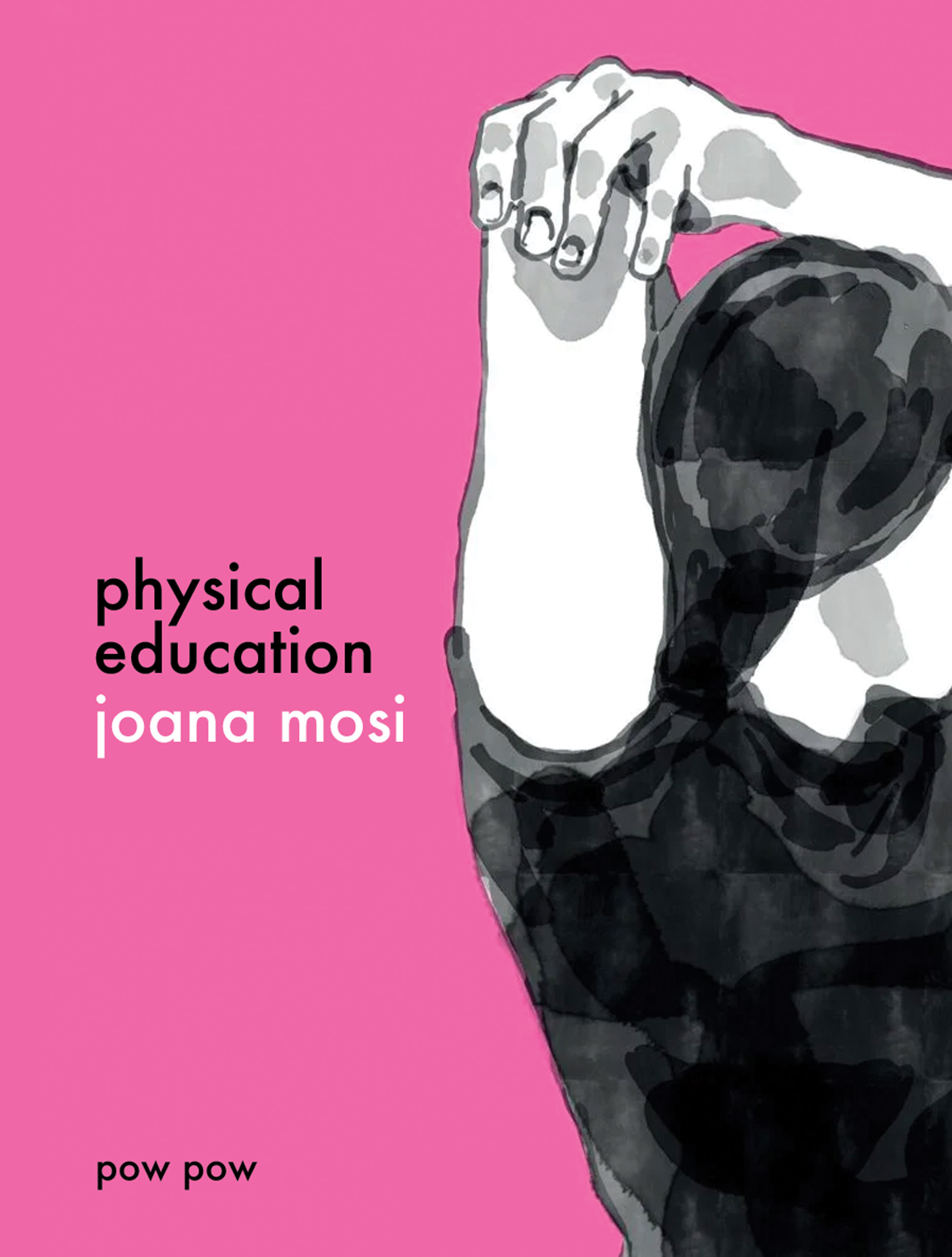
Quitting Social Media Is Essential: Talking ‘Physical Education’ With Creator Joana Mosi
by Tom Smithyman
Everything should be going great for Laura, the main character in Joana Mosi’s new graphic novel, Physical Education. She’s recently received a grant to write her debut novel, and that things seem to finally be falling into place for her. But Laura feels numb and detached from reality, meeting with friends at the gym halfheartedly. In an interview with Comicon.com, Mosi discusses why she chose a gym setting and how she deals with her own creative ennui.

Smithyman: The main character in Physical Education, Laura, meets up with her friends at the gym throughout the book. Are you a gym rat yourself? Why did you choose that as a recurring location in the book?
Joana Mosi: I’m not a gym rat at all, I actually find gyms rather overwhelming, stressful and claustrophobic. I do admire commitment and discipline, since I don’t really have any myself. Nor a knack for sports. Maybe that’s why I thought it could be a simple, direct metaphor that embodies the book’s theme. I know many people (including myself at some point) who have tried to go to the gym and make a habit out of it, and it’s a recurrent, common joke, not being able to keep it up. Life gets in the way, we all have other commitments, the weather sucks, or we simply have somewhere else to spend our money.
In the book, I try to make a parallel between the gym classes that we’re forced to attend in school, and the gym that an adult pays to go to voluntarily. The lack of will and interest doesn’t change much, though.

Smithyman: Laura is a successful writer who just seems to be floating through the life that is going on around her. I know this isn’t an autobiographical story, but how closely can you relate to Laura?
Mosi: I draw from my own experience to create fiction, but I always seem to fail… I can relate to Laura to the extent that I’ve used her to explore certain problems, complexities, and situations that are dear and personal, the same way I do with other characters as well. I guess that Laura, and the story for that matter, is a pretext to write and draw about certain themes. But of course, there’s a lot of me in her, but also a lot that is not. I’m not interested in autobiography, yet I believe that my human experience is rather unexceptional, therefore I hope that whatever I go through with the book will certainly resonate with someone else. 
Smithyman: Laura is clearly talented but seems to have lost all motivation, save for going to the gym. Have you been in a similar situation? How do you break out of creative ennui?
Mosi: Is she? I remember when I finished the book, I realized that we never really see Laura writing, or any of her writing. She got an award/grant, but other than that, she seems to be very detached from the craft itself. I didn’t change that deliberately; During the process of making the book, I was so focused on writing about everything else in Laura’s life that I forgot (as well) that she was supposed to be writing a book… I guess the book became real then. I’m always struggling to do whatever I need to do, and the process of Physical Education was the hardest, messiest, and most confusing of any book I made so far. I don’t know if it works, but it’s very true to the theme on that.
Smithyman: Social media serves as a distraction for Laura here. During our interview for The Mongoose, you said that art helps us to feel more connected to reality. Do you think art is an antidote, of sorts, for technology?
Mosi: Absolutely. If by technology, we’re talking about addictive type (like the internet wormhole), yes. You asked me before how I break out of creative ennui; quitting social media (or at least avoiding it) is essential. I’m very permeable and easily absorbed by doom scrolling. Scrolling for a long time always leaves me angry, frustrated, and bitter. The more time I spend online, the more I consume, the less I have to give. I’m not against technology, or its (unavoidable) evolution. I’m very skeptical about very specific tools, though. 
Smithyman: You use a number of different artistic styles throughout the book. Do you have a default style of your own or are you always experimenting?
Mosi: I’m always experimenting, because I tend to get bored. Drawing is a tool, a language, and I see different “styles” more like different approaches. I’m always trying to test the limits of the language; Sometimes it works, sometimes it doesn’t.
Smithyman: As both a writer and illustrator, it feels like your creative process would be a lonely one. Is that the case?
Mosi: Yes. Creating, when it comes to writing and drawing a book, always demands solitude at some point. But everyone’s different, and I’m surrounded by peers, colleagues, students, all of them with different approaches to their process. I’ve collaborated and worked in studios, with teams and close friends, but I always end up feeling this isolation. Until recently, I thought it was because I needed silence and focus for many hours, away from everything and everyone. Now, I know that it’s another type of loneliness… When I’m really focused on a project, I don’t have space or emotional toll for anything else. I zone out in conversations, I’m boring around my friends, the world becomes centered around whatever I’m working on, like some kind of puzzle that only I can solve. It’s a self-imposed glass dome, and it’s not always easy for whoever I share a life and work with. Smithyman: What other projects can we expect from you?
Mosi: I’m in the thinking phase of a new graphic novel. It means that there are no sketches, no writing, no nothing. Just a constant tense mood, rumination, and a lot of research. I’m excited about it, but it doesn’t really show yet.
Smithyman: Please keep us informed about it. And best of luck with Physical Education, which comes June 5th from Pow Pow Press!

