Discussing Neon-Noir Crime Thriller ‘Palomino’ Vol.6 With Creator Stephan Franck
by Olly MacNamee
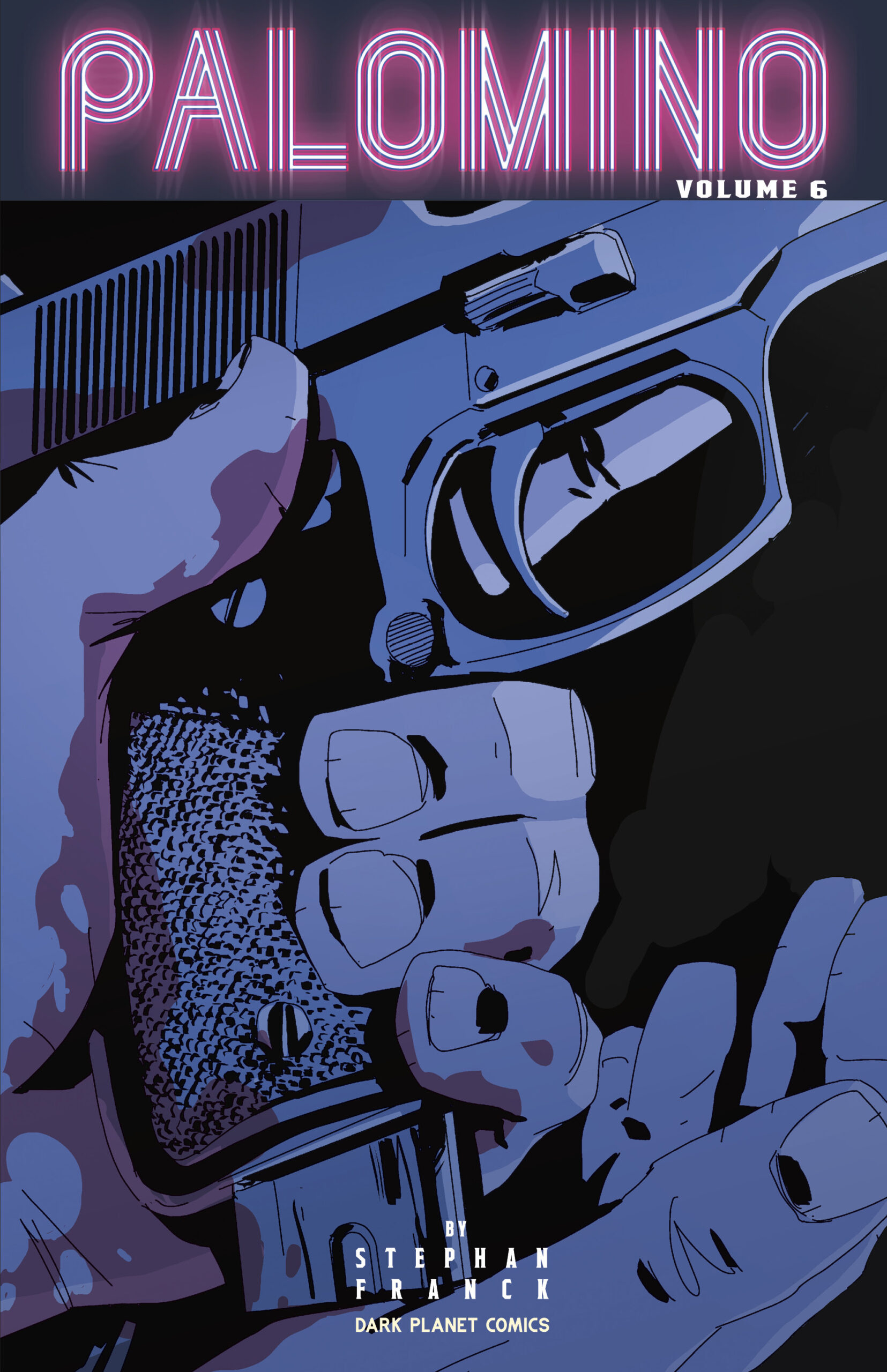
Cartoonist and award-nominated animator, writer, and director Stephan Franck and his company Dark Planet Comics are running a Kickstarter campaign for the final chapter in his neo-noir crime thriller Palomino. The Ringo Award-Nominated series chronicles the lost culture of Los Angeles’ country music clubs and throws readers into a pulse-pounding, decades-spanning mystery. And a very personal project for Francks, who lived through these heady times and played in a band himself. As he himself states of this six-volume Tinseltown saga, “LA noir with my love for the long-lost tradition of the California honky-tonks.” Having already interviewed him previously, I was keen to catch up with him one more time to discuss this new and final chapter:

Olly MacNamee: Palomino Vol. 6 brings to a close your seven-year neon-noir crime thriller, and when I say it contains the holy trinity of sex, drugs and rock and roll, I’m not kidding. But more of that in a moment. First, how does it feel to bring the curtain down on such a personal project?
Stephan Franck: It’s a mix of bittersweetness and excitement. On the one hand, it’s hard to say goodbye to characters who have been part of my daily experience for so long, and there’s something very comforting about knowing there’s always a next page to draw. Once you finish a 661-page series (!), you’re so dialed into every single aspect that going back to facing a blank page is a little daunting. That said, these characters have left it all on the field. The story arcs set up at the beginning have resolved in epic ways, and real transformation has occurred. As I was with them on their journey, I can’t help but feel the characters’ exhilaration of breaking through to the other side.

MacNamee: So … back to the sex, drugs and rock and roll. The drugs, specifically, help bring about the same (possibly) supernatural elements you’ve been playing with over the last two volumes, which helps create a haunting, almost gothic tone to proceedings.
In our last chat, you told me that it could be interpreted by the reader any way they liked. It seems very much that this is the case again in this new graphic novel?
Franck: I’m so glad you’re bringing up the “supernatural-adjacent” elements in the story. I have to confess — I’m not a drug person, so that part comes purely from other people’s accounts and my imagination. That said, I can easily accept that an altered state might allow your mind to interact with reality differently. I’ve had a couple of moments in my life where, all of a sudden, it felt like I was in a David Lynch movie. That tends to happen on the brink of big life moments — when the universe nudges you to engage with it from a different angle. The truth is, Liz has ghosts in her past — whichever way you choose to look at it. At the end of the day, I think mystery is the glue that holds the world together.

MacNamee: Liz is still haunted by the past, but in this final volume, the whole saga comes full circle thanks to some clever writing and structuring. Can you tell me whether your plans ever changed when producing this series over so many years? And if so, in what ways?
Franck: The biggest change was that the entire story was originally supposed to take place in 1981 over just four volumes. I always knew that Liz would end up retracing her mother’s steps in Malibu, but in this version she would still have been a teenager going rogue (maybe driving herself there without a license), and Eddie would have to come and save her — although there was also a notion that she would be the one who ends up saving the day. However, when I started writing volume 4 in earnest, things began to feel off. Too contrived. Not true to life, if you will. That’s when the idea of the 14-year time jump presented itself: finding 29-year-old Lisette — now going by Liz — still living in the shadow of the unresolved case that had ruined her family’s life. That’s when everything started to align — 14 years later took us to 1995, which, lo and behold, is the year the real-life Palomino closed. 1981 was the club’s high watermark, so with that symmetry, we had the framing of a truly epochal story. Then it also became obvious that Liz was such an interesting and compelling character that she needed her own three volumes. That’s how the complete series became six volumes. In Volume 4, Kathy Lane Wilcox drops a little French saying on Liz: “Il faut laisser le temps au temps,” which translates to “Even time needs time.” That ended up being the secret key to the whole story.

MacNamee: Your art style has never wavered. Bold lines and great use of negative space. Particularly in this book, where a lot of the action takes place in one particular location. Are you still using SketchUp and GCI models to help world-build?
Franck: Yes, I built all the locations as CG sets. That was especially crucial for that wild Malibu house we journey through. Each part of the house has its own vibe and function in the story, and there’s a bit of a labyrinth quality to it. At the same time, I wanted the reader to never feel lost — to always have an immediate, intuitive sense of where we are in the house.
Then there’s that end location (which I won’t spoil), where the final showdown takes place. Believe it or not, that’s something I created purely out of imagination because it made sense for the story. I figured it would be my one indulgence in terms of location realism. But as I started looking for reference to build the set, I discovered that similar places actually existed — almost exactly in the location and form I had imagined. Talk about Lynchian weirdness.
The key with CG reference — or any kind of reference — is blending the right level of specificity into the graphic style of the book so the reader never gets bothered by it.

MacNamee: In completing this graphic novel, I couldn’t help but feel this is definitely a world that you can easily come back to, if you choose to. Any plans in the near future for this to be the case?
Franck: I definitely have very specific ideas for the story and the world of Palomino to continue, which I’m very excited about. However, after six years on this book, I’m going to take a little breather. Same with Silver, by the way. Both Palomino and Silver are super immersive worlds with lots of depth and texture that lend themselves to more exploration.
MacNamee: As this is a Kickstarter campaign, what incentives do people get to back?
Franck: For this final volume in the series, we’ve created some cool commemorative rewards. From awesome Palomino shirts and sweats to super-cool mugs — real, legit stuff you’ll actually use in your everyday life.
Also, the art style of Palomino has a strong pop art quality that works beautifully as standalone pieces, so we’ve put together a series of large-format, high-resolution framed canvas prints. They’re quite striking — and, if I may say, put one in your workspace and you’ll win every Zoom call.
But most importantly, it’s about the books. As much as I’ve loved Palomino, its world and its characters from the start, it’s a project that never stopped growing — finding new depth and relevance along the way. It’s as compelling a piece of storytelling as I’ve ever done. And how cool is it that readers have the power to make projects like this exist outside of any corporate permission structure?

MacNamee: As ever, Stephan, all the best with this campaign and with any future comic book and animation projects too.
Franck: Thank you, Olly, it’s been my pleasure to chat!
Palomino Vol. 6 is currently crowdfunding on Kickstarter here.