
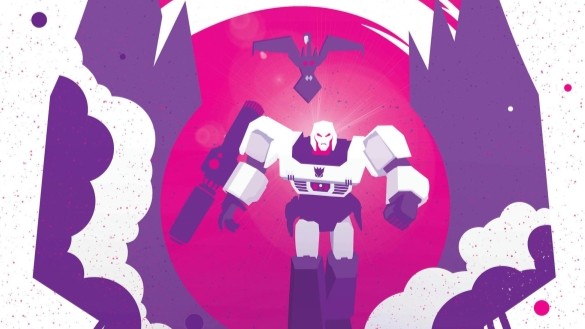
Review — ‘Transformers’ #31 Retreads Familiar Ground To Prime Something New
by Austin Gorton
Overview
Effectively a sequel to issue #19, Transformers #31 hits many of the same beats, visually and lore-wise, while having a slightly larger impact on the immediate narrative. The end result is a tick better than previous such outings, but feels a bit more workmanlike than a “regular” issue.
Overall
7/10Continuing the series semi-regular tradition of between-arc spotlight issues, Transformers #31 is effectively a sequel to the Megatron spotlight in issue #19. That issue introduced the idea of Megatron serving at the pleasure of the Quintessons, having undergone a dramatically-large number of trials by combat to break his will.
This issue picks up from there, revealing that during his recent seizures/black outs, Megatron has essentially been back in that arena, undergoing more trials overseen by Dezimir in an effort to craft him into…something else. Like issue #19, this struggles a bit under the weight of its lore, though it gains a bit from having a more direct impact on the immediate narrative.

On paper, Transformers #19 answers the question: what is happening during his recent fits? In execution, this means an issue structured a lot like the previous Megatron spotlight, that is, one where Megatron does a lot of repetitive fighting and yelling.
We get a bit of framing sequence in which the present Decepticons react to Megatron’s latest fit (in a nice touch, writer Robert Kirkman remembers that Soundwave was a captive of the Autobots when Megatron started having these attacks, and uses him as the “what’s happening?” instigator), and then a closing few panels in which they observe the outward manifestation of his journey, but the majority of the issue takes place in a non-physical realm.

Ludo Lullabi also returns as artist, giving the story a nice bit of visual continuity, and his more fluid style (relative to both Jorge Corona and Dan Mora) suits the story well, particularly the more body-horror turns taken in this installment, as Megatron is broken down and rebuilt over the course of his trials. Somewhat surprisingly, one of the weaker elements is the coloring.
Mike Spicer has been the stealth MVP of this series for much of its run, but here, the heavy infusion of purples and soft blues (clearly meant to invoke the concept of Decepticon-hood) muddy the proceedings a bit, blending everything into a kind of visual sameness. Even the typical pop of Megatron’s gray-white body is washed out, reflecting the warmer hues of its surroundings.
This may be intentional, given the theme of metamorphosis woven into the plot and the heaping helping of Decepticon lore it provides. Mentioned previously, it’s established here that Megatron literally carries the Deception Matrix of Oppression inside him (similar to Optimus Prime and the Matrix of Leadership), and we see manifestations of past Deceptions, Straxus and Trannis, two figures carried over from the old Marvel Comics lore.
They lead, in turn, to the reveal of Megatronus aka the Fallen, the first Decepticon, who is seemingly positioned as the orchestrator of Megatron’s trials, and whose success in breaking Megatron’s will triggers his transformation into an unseen form back on Earth.

Is this all pointing to the arrival of Galvatron, given the notion of Megatron becoming something else in service to a higher power, the constant purple shading, the echoes of Transformers: The Movie (at one point Megatron declares, “I accept your terms,” a bit of dialogue lifted directly from his interactions with Unicron in the movie)? Perhaps. Or perhaps it’s merely meant to make us think that’s where it’s heading while setting up something else entirely.
Either way, the end result is an issue whose success is largely tied to what is to come. If this is setting the stage for an exciting and evocative turn for the character, it will be remembered fondly. For now, it merely stands as a mostly well-executed if repetitive examination of Megatron’s character and the extreme hardship necessary to (seemingly) break his will, while serving the immediate narrative need of shedding some light on his recent behavior and setting up the next turn for the character.