
‘Star Wars’ Month: Ahsoka Tano Is The Ultimate Jedi
by Tony Thornley

In 2008, Star Wars fans were surprised to get an unexpected theatrical experience. Despite the saga’s “ending” with Star Wars: Episode III — Revenge of the Sith, the saga was taking a few steps backwards to one of the most creatively fertile eras of Star Wars. It’s not hyperbole to say that the franchise would never be the same.
That’s because, just a few minutes into Star Wars: The Clone Wars, fans would meet a character that would change the franchise. Nearly two decades removed from Ahsoka Tano’s debut, we can now say it was a change for the better.

I remember sitting down to watch The Clone Wars in the theater. I knew it was a prelude to a kid’s cartoon, but I was a little put off by how much it was a thing for kids. Nothing threw me more, though, than the introduction of Anakin Skywalker’s (Matt Lanter) padawan learner, Ahsoka. At the time her fate was obvious. She’s a lead character introduced in the leadup to the Purge — she was going to die.
The actual series launching out of the movie was just as immature as the movie. It wasn’t bad, it just wasn’t for me. Yet, something changed. Eventually, The Clone Wars found its footing, and right alongside it, the series’ young protagonist did too.
The writing changed from an impulsive apprentice to an important part of the tapestry of the war. This was a young woman who was grappling with the horrors of war, the politics of a dying government, and the bureaucracy of an Order that needed to evolve or die decades before. As she saw the universe fall apart, she was growing up.

Ahsoka’s story wasn’t a coming of age. Despite being a younger teen, she was already surprisingly grown up and intelligent. Her story was actually one of maturity, and opening her eyes to what was happening all around her.
As the character grew, so did voice actor Ashley Eckstein‘s performance. While her initial take was very youthful and exaggerated, the acting gradually became more nuanced. The bounce and occasional child-like whine gave way to a youthful wisdom. Her speaking cadence changed from a very standard exaggerated child quality to a thoughtful and tactical warrior — if still young and sometimes impulsive.
Combining those two things together — the intelligent and evolving writing and the thoughtful and nuanced performance — turned Ahsoka into a powerhouse.

Suddenly the “kiddie point of view character” had transformed into a key part of the overall Star Wars story. Here was a character whose fate wasn’t determined, whose journey was a mystery, who we could follow along with as she battled droids and crime lords, gods and politicians. As Anakin and Obi-Wan Kenobi (James Arnold Taylor) got to evolve from the teacher and student seen in Star Wars: Episode II — Attack of the Clones to the brotherly warriors of Revenge of the Sith, Ahsoka gradually became their little sister.
From there, Ahsoka expanded her influence. As soon as we learned she survived the Clone Wars, her story deepened. She became the spymaster Fulcrum in Star Wars: Rebels. She became the fascist hunter in The Mandalorian. And as we learned in the final season of The Clone Wars, she became the scapegoat, then fallen warrior, then one of the greatest forgotten heroes on the final days of the war.
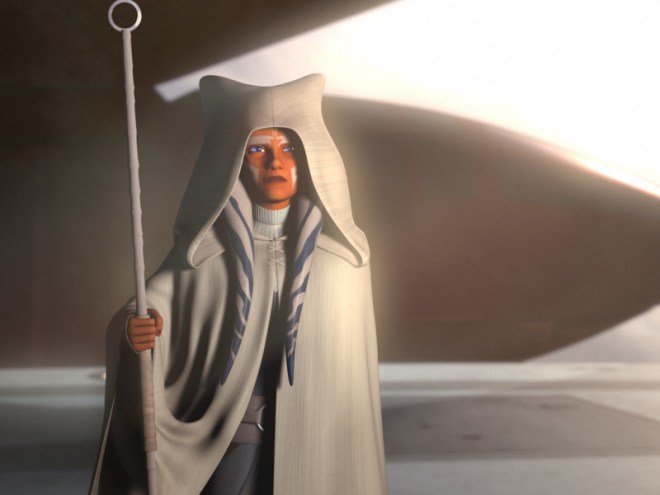
Though she would claim she is no Jedi, Ahsoka Tano became part of the three-fold embodiment of the Jedi Order, alongside her brothers and mentors. Anakin embodied the hero and the true power of the Force. Obi-Wan embodied the Order and its leadership in troubled times. But Ahsoka herself embodied what the Jedi could and should be.
She was a protector of the weak. A defender of those around her. The seeker of truth. And ultimately a figure that would help restore peace to a fallen galaxy…

We don’t know Ahsoka’s true final fate, though in those earliest days it seemed set in stone. Her story is still unfolding in Star Wars: Ahsoka as Rosario Dawson has taken the reins.
But rest assured, we’ll continue to follow that journey.
She is no Jedi. But she is the Jedi.