
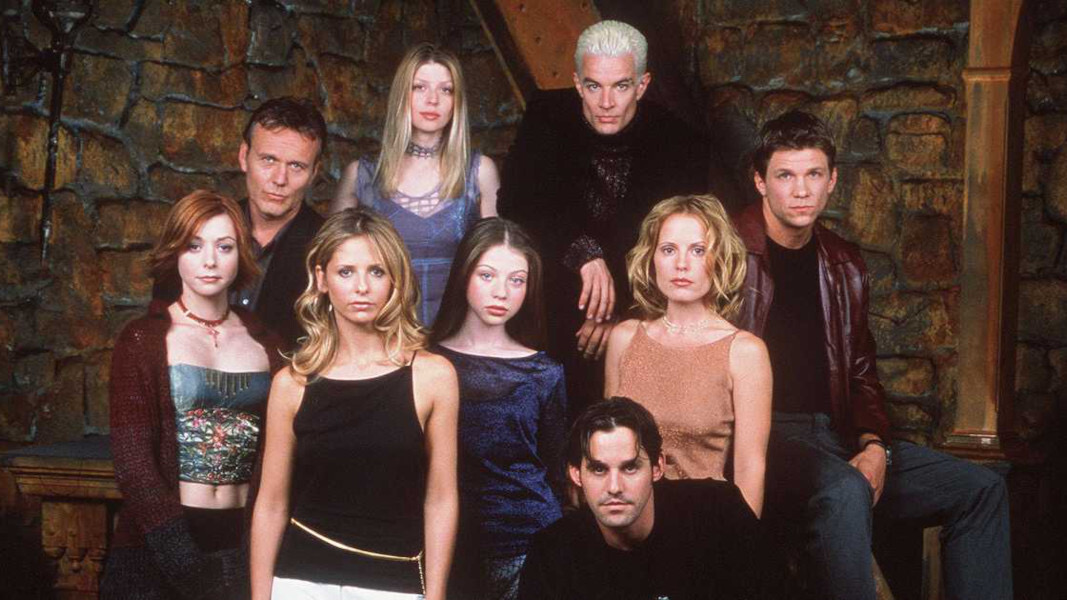
Characterization In The Buffyverse — ‘Buffy The Vampire Slayer’ Season 5, Episode 19
by Benjamin Hall
This is part of a bi-weekly series concerning the characterization of Buffyverse characters. Arguably the best place to begin reading this series is at the beginning, but that is up to each reader. As a reminder this column will cover major and some minor characters from the shows Buffy The Vampire Slayer (1997-2003) and Angel (1999-2004). Other Buffyverse media, such as the graphic novel Spike: Into The Light (2014) are not pertinent to this series. Also there will be no referencing real world events that have direct relation to either show in this bi-weekly series. Although this series does reference things that have no direct relation to the show in order to examine things such as metaphors and literary analogues.

This week: Buffy Summers (Sarah Michelle Gellar) worries about her remaining family and the threat of Glory (Clare Kramer). At the same time, Willow Rosenberg (Alyson Hannigan) and Tara Maclay (Amber Benson) have an argument.
(Warning of spoilers from this point on!)
(Trigger warnings for mentions of torture, homophobia, and toxic relationships)
Buffy’s interest in poetry (Season 1, Episode 5, “Never Kill Boy on the First Date”) gets some reinforcement at the beginning of this episode, albeit via her quitting a class on the subject. Unfortunately, her ability to communicate in a healthy way appears to deteriorate as the runtime continues. This is especially apparent when it comes to conversations she has with Willow and Dawn Summers (Michelle Trachtenberg). One could argue that she is protecting Dawn from knowing about the threat of Child Protective Services. The other side of that argument, though, is Buffy infantilizes Dawn by being overprotective. She also fails when attempting to talk Willow down before the Wicca confronts Glory, and by not explaining the threat against Dawn. Thus, Buffy is in another drama caught up in the “very special episode” trope while the others are not.
Dawn is like a lot of people of her physical age — she does not always consider possible consequences. Case in point: her absences from school are putting her and Buffy in danger of separation. Although this behavior may seem realistic, it is in a debatable way because she should be fearing capture by Glory. Instead, she is acting like she has only normal teen concerns while knowing and even pointing out that she is of mystical origin. She is still dealing with her mom’s death, though. At the same time, there is no clear evidence on her part that this is the underlying reason for her behavior.
Spike (James Marsters) mainly plays the role of supportive big brother to Dawn in his first scene. His last scene of the episode he sees him as a truth-teller to Buffy so she can realize Willow is about to put herself in danger.
Rupert Giles (Anthony Stewart Head) apparently forgets a key statement he agrees to make with Buffy and the Scoobies during a prior adventure involving Tara’s abusive relatives (Season 5, Episode 6, “Family”). Additionally, he will never deny the allegation that he views Buffy as a daughter (Season 3, Episode 12, “Helpless”). So his seeming attitude of “a bird teaching a baby bird to fly” when making Buffy take responsibility for Dawn seems rather harsh. Despite this attempt at aid, it would be more beneficial for him to act as patriarch of Buffy’s makeshift family and suggest other methods of assistance. Still, one might view his methodology here, along with examples of his mid-life crisis — such as his convertible (Season 5, Episode 2, “Real Me”) — as planting the seeds of his abandoning Buffy and the rest. Torturing Slook (Alan Heintz) off-screen suggests things are getting desperate and dangerous.
Xander Harris (Nicholas Brendon) is terrible at being emotionally supportive to Anya (Emma Caulfield Ford) and Buffy here. What he says during his apparent attempts to be supportive come across as the antithesis of both a good romantic partner and friend.
Anya’s sudden patriotism seemingly comes out of nowhere from an in-universe perspective. Her explanation exists primarily because of her love of money. However, Anya should probably be less than enthusiastic about the idea of nationalism, especially towards the United States of America. One logical reason: The Initiative’s prior existence as a secret American governmental organization throughout Season 4. Additionally, her long existence would make her knowledgeable in a first-hand way about a lot of horrible historical actions by various governments.
Tara seems more confident than usual during the initial part of her argument with Willow. While this could be a sign of personal growth, it appears more to be an aspect of how she interacts with Willow in private. During their argument, Tara reveals her reservations regarding Willow’s use of magic. Also, Tara relating to Buffy being responsible for a sibling occurs with a perspective that is potentially unhealthy. Tara’s abusive family — and the expectation of her taking care of them — is not equivalent to Buffy’s situation. When it comes to her confrontation with Glory, Tara is extremely valiant while experiencing physical harm. Lastly, the madness Glory leaves with Tara makes her more reliant on others to avoid harm while also being a liability.
Willow using a homophobic slur while arguing with Tara is both unnecessary and unfortunately realistic. Although neither woman gives a fully logical argument, the discourse plants yet more seeds for the future while moving the overarching plot. One such seed: the power Willow is developing and how dangerous it can be. This gets some figurative watering via Willow taking in some dark spells for the first time to boost her power. This action reinforces the idea that Willow has a habit of rushing to fix things to her liking (Season 4, Episode 9, “Something Blue”).
Benjamin Wilkinson’s (Charlie Weber) transformation into Glory at the beginning comes across like him fighting against dissociative identity disorder. Note his repetition of his identity in the locker room. Also, it is possible Glory is talking to Ben while relaxing in her bath. Thus, this writer’s theory that these characters represent a bad metaphor for being transgender fits with the same stereotyping that equates Anthony Perkins‘ Norman Bates (Psycho [1960]) to homicidal urges. Speaking of mental health, Glory’s description of what her brain sucking does to a person suggests she may be passing on her own state of mind to others. Lastly, when it comes to Ben’s reaction to his job loss, he acts in a believable way for someone who usually tries to pass the blame off.
Professor Lillian’s (Leland Crooke) existence allows for a scene in which Buffy visibly quits college. His characterization revolves around that and the small amount of acknowledgment he displays regarding her troubles.
Jinx (Troy T. Blendell) and Murk (Todd Duffy) do not get much to do in this episode besides toadying to Glory. Still, their servile actions are humorous.
Slook has the character traits of a distinctive voice, being very bad at spying, and caving to threats extremely easily. His expositing that Glory is attacking Tara is the main reason for his existence.
Dr. McCarthy’s (Pat Skipper) apparently has a reasonable personality … if one considers how he acts while firing Ben. Arguably, the character;s final statement is figuratively shining a spotlight on Ben’s hypocrisy when blaming Glory for everything.
Principal Stevens (Anne Betancourt) has exposition that is realistic. Yet, she comes across to this writer as going over the line by threatening Buffy with Child Protective Services during an initial meeting.
This episode has a hodgepodge of plots that are not fully coalescing while, at the same, going at a very fast pace. The result: character interactions, such as Willow and Tara’s, also seem to be rushing and not mixing well with the rest.
