
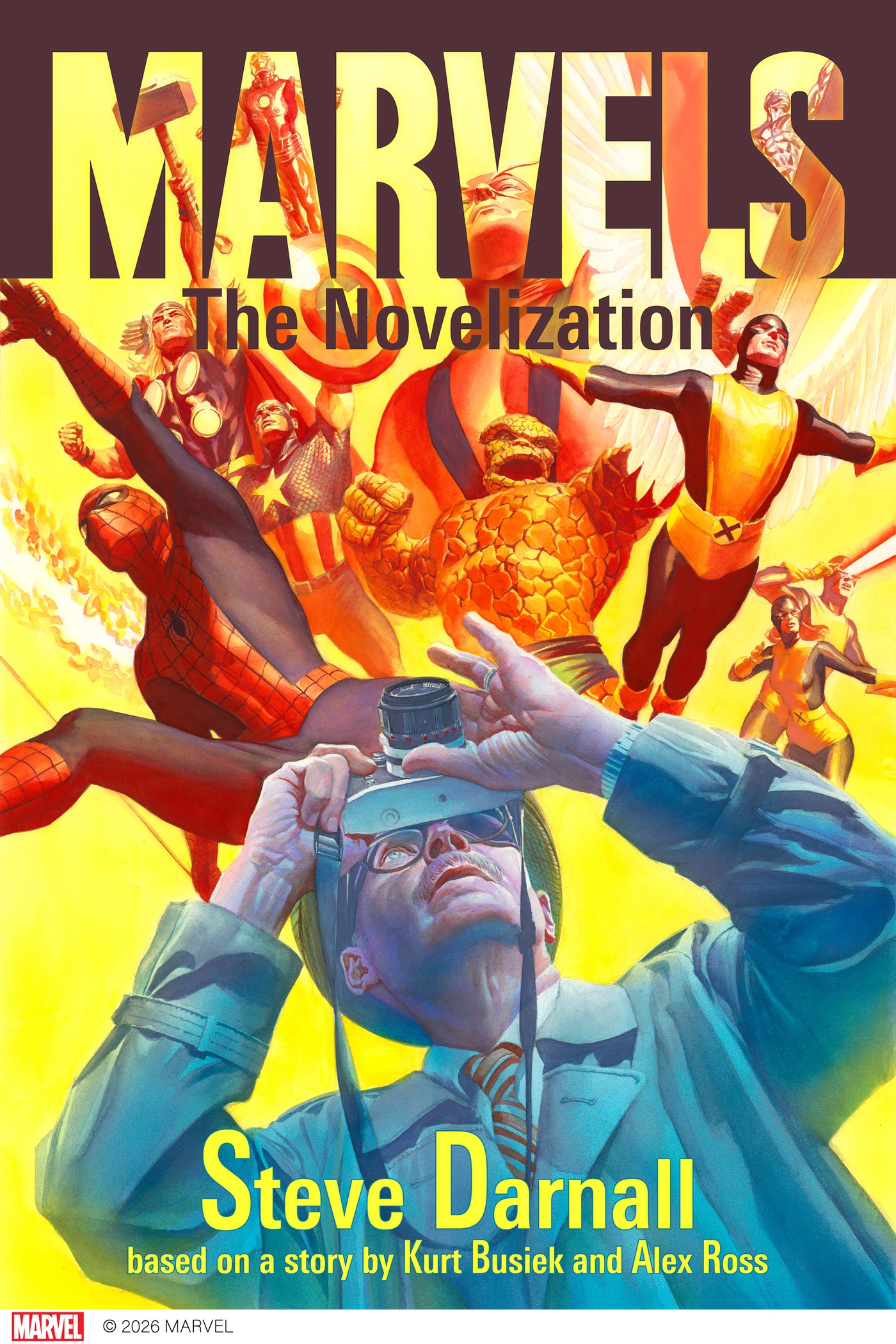
Interview: Steve Darnall Chats About His Novelisation Of Kurt Busiek And Alex Ross’ ‘Marvels’
by Olly MacNamee
Marvels by Kurt Busiek and Alex Ross was a huge comic book event when it came out over thirty years ago. But did you know that the writer who intended to write this series was writer and long-time friend of Ross, Steve Darnall, who went on to collaborate with Ross on Uncle Sam from DC Comics. Well, over three decades later, it was Darnall who was approached to write a novelisation of this four-part comic book classic, including all-new illustrations by Ross and published by Abrams ComicArts. A fan of the original series, I was interested in hearing about the process of adapting a comic into prose, working with Ross and more.

Olly MacNamee: Firstly, Steve, I’m intrigued as to how the novelisation for this contemporary classic came about in the first place, and how you became involved? It would seem, from his afterword, that Alex Ross was a big part of this.
Steve Darnall: I’d been talking with Alex when he mentioned that Charlie Kochman at Abrams had been trying to produce a novelization of Marvels, which made sense; when you’ve got a story as good and as popular as that one, you want to share it with as many different audiences as possible. My memory is that Alex told me that the project didn’t have a writer yet, so I put on my most dramatic voice and said “All right, I’ll write it.” Thankfully, that made Alex laugh, but the more we talked about it, the more we both liked the idea — and luckily, Abrams and Marvel liked it too.
MacNamee: I like the set-up to this book in your inclusion of an interview with Phil Sheldon, the man-on-the-street photographer who narrates the original Marvels series. Was this inclusion something you decided upon?
Darnall: It was! I knew I wanted to fill some of the gaps in the timeline of the original story. As you know, Marvels #1 ended in the middle of World War II and Marvels #2 began twenty years later. That worked in part because you had a month between issues, and also because, as a storytelling device, it allowed Kurt and Alex to skip over… well, what I guess we could call a somewhat slack period for the Marvel Universe. When it came to writing the novel, it felt necessary to offer some explanation as to what Phil and Doris were doing during those twenty years. At the same time, I didn‘t want to dive so deep into that period that we risked derailing the original story. The interviews involving Phil and Marcia Hardesty felt like an entertaining, efficient way to fill those gaps, while also making it clear that we were still telling Phil Sheldon’s story.

MacNamee: How does one go about adapting such a beloved work and keeping true to Kurt Busiek’s scripting? I notice a lot of dialogue makes up this book. Was that one way to maintain Busiek’s words?
Darnall: I wasn’t as interested in preserving Kurt’s original dialogue — good as it was — as I was in capturing the emotional quality of his story. When Kurt wrote Marvels, he did so with the knowledge that his ideas would be represented by Alex’s artwork. When it came to writing the novel, there were times when the narrative and dialogue had to say things that artwork would have made obvious; that’s just the vocabulary of prose fiction. Ultimately, I decided to treat the book as just that: a book, a story told by Phil Sheldon. Once that decision was made, it was fairly easy to determine when Kurt’s dialogue could be adapted and when it would be necessary to augment that.
MacNamee: You have worked with Alex Ross previously on Uncle Sam (1997), and you are both very good friends. So, I imagine this was an easy working relationship to start up again, what with Ross providing new illustrations to your novelisation?
Darnall: Oh, absolutely. Working with Alex is always a pleasure. He’s full of valuable ideas and he’s a good listener — and of course, he knows a thing or two about how to tell a story.

MacNamee: As a project, how much fun was this to do? And, how does one tackle such a task as adapting a comic into prose? Where do you even start?
Darnall: Writing this novel was an absolute delight from start to finish. I knew going in that I was going to be telling a really good story, which made it easy when it came time to do the actual work. In terms of adapting comics into prose … one analogy that comes to mind is the difference between football and baseball. In football, you’ve got a finite amount of time to accomplish your goal; you’ve got four downs to move the ball, you’ve got four quarters to score, and the game ends whether you’ve succeeded or not. Kurt and Alex had four 48-page issues, and they had to tailor what they were doing so that each issue could stand on its own; if something didn’t fit into those 48 pages, it just didn’t happen.
By comparison, in baseball, you can throw as many pitches as you need to get three outs — just as a novel can use as few or as many words or pages as you need to tell the story. That meant I had the luxury of sometimes adding a little more information or detail to existing scenes; other times, it meant I could create new scenes that would give readers more context about these characters and the decisions they make. Having that option was important, for the book and for me; I mean, if I’d wanted to just perform an act of mindless stenography, I’d have joined the Washington press corps.

MacNamee: One last question, then. What do you feel you brought to this novelisation that wasn’t necessarily present or obvious, from the comic book series, particularly in your presentation of Phil Sheldon?
Darnall: I feel like this book and this format gave me the chance to… fill in some blanks in the life of Phil Sheldon and the world he inhabited. Kurt and Alex created some really interesting characters with the Marvels series and I’ve tried with my telling to make them even more interesting. Hopefully, in the process, readers will come away with a fuller understanding of these characters and the time in which they lived.
MacNamee: Thanks for the time, and all the best with the book, Steve.
Darnall: Hey, thanks for asking, Olly!
Marvel’s novelisation is out now from Abrams ComicArts. And Steve will be supporting the release of this book with an in-person signing tour. Here are the locations and dates he’ll be doing:
Friday, May 29, 7:00 pm CST: The Book Cellar, Chicago
Thursday, June 4, 6:30 pm EST: This is a Bookstore, Kalamazoo, MI
Sunday, June 7, 2:00 pm CST: Lion’s Tooth, Milwaukee
Thursday, June 18, 6:00 pm CST: Atlas Collective, Moline, IL
Friday, June 19, 6:00 pm CST: River Lights, Dubuque, IA
Sunday, July 12, 4:30 pm EST: Roebling Books, Covington, KY
Wednesday, July 29, 7:00 pm CST: Magers and Quinn, Minneapolis

