
Talking ‘Hidden Springs’ With Rob Williams And Nil Vendrell
by Rachel Bellwoar
Getting lost in the woods is never ideal, but getting lost in the woods only to witness a kaiju crash to Earth like a meteor? Only writer Rob Williams and artist Nil Vendrell could think up such a scenario. With colors by Berta Sastre and letters by Simon Bowland, the first issue of Hidden Springs drops this month from Dark Horse, and Williams and Vendrell have the scoop on what to expect:

Rachel Bellwoar: It seems wild not to begin by talking about the giant kaiju in the room, but what actually excited me the most after reading the solicitation text for this first issue was that you were going to be focusing on “ageing ex-Hollywood stars.” When did that piece of the puzzle come in? Did the kaiju come first or the desire to tell a story about a senior community?
Rob Williams: Hidden Springs is one of those ideas that just sort of arrived fully formed. I’m not sure where exactly it came from. I loved the thought of a celebrity retirement home in LA, filled with actors and directors, comedians etc., each with their own past lives and regrets they are existentially battling. And then they go out to a national park on a day trip and just happen to come across a baby kaiju that the military is chasing, and if the bad guys get hold of it, it’ll be the end of the world. A very strange road/chase movie follows.
Bellwoar: Have you always had an interest in Hollywood and how fun was it to include references to stars like Warren Beatty and Rip Torn?
Williams: Oh yeah, I love that stuff. I’m forever reading biographies of old actors and directors. I love that Easy Riders, Raging Bulls era of late 1960s/’70s Hollywood. Given it’s now 2026, I figured that’s when these characters would have been at their height. So we’re creating fictional Arthur Penn movies starring “Warren and Jack” and Julie Christie. There’s a lost eye in a bar fight that Rip Torn “may have been involved in,” Rip Torn being the notorious hellraiser from amazing movies like The Man Who Fell To Earth. That’s all the juicy celebrity of a past era background to our tale.
Bellwoar: With some of the characters, there are clear inspirations (like Bazza being Ozzy Osbourne-coded). Others, like Ceecee, could be a few different stars. Did you enjoy getting to build up their backstories?
Williams: I sort of fell in love with all of our cast. The only slight frustration was that we just had four issues to slip in hints about their backgrounds. I figured CeeCee was effectively a Grace Kelly type in her day. Tyrone, our Black comedy legend, is a Richard Pryor. I could’ve easily spent way more time in flashbacks with these guys. And Bazza is Ozzy Osbourne in all but name. No shortage of stories there. But this is an action/chase thriller. So our cast is on the high-speed run, trying to save the world. But I loved the fact that they are all damaged in so many ways and not your average team.
And Nil Vendrell gets such terrific acting performances from these characters. He really brings them all to life and makes them all so individual.
Bellwoar: The first issue is incredibly economical when it comes to introducing everyone. Their first interactions and clothing tell so much about their personalities. How difficult was that to pull off?
Williams: It’s the “come into a scene late” dictum. You’re trying to sell exposition in an entertaining way. And the best method for doing that is having them bickering with each other, so there’s drama and hints of past grudges and relationships. Then, when the kaiju lands in their laps, we’re into the spectacle and the adventure. But yeah, it’s the type of smoke-and-mirrors exposition at times that is necessary, but makes it fun to read. Don’t have people just stood there telling the backstory.
Nil Vendrell: Rob sent me a pretty detailed description of each character, with notes on their looks and personality, and most of them came pretty smoothly. I had a lot of fun adding details that I thought could fit.
CeeCee’s clothes for example, are based on a few pictures of Grace Kelly, but I gave her some comfy shoes. I thought she might need them after all those years of wearing glamorous high heels. Loretta has some pearl earrings and beautiful hair, ’cause in the end she is a little posh even if she has a more understated look.
Bellwoar: Everyone’s going to have a different character they’re drawn to — Loretta is definitely my favorite so far. Outside of Dorothy Arzner and Ida Lupino, Hollywood was famously slow to open itself to female directors. Why did you want to give Loretta that career?
Williams: I loved the idea of this badass female Hollywood director in an era where there just weren’t any, or many. Which is a tragedy. And Loretta doesn’t take shit from anyone, as we quickly discover. She only ever made two movies: one is an independent American classic, and the other was the big-budget studio follow-up where she got buried by notes from condescending male studio execs, and she told them to go fuck themselves, and they destroyed her Hollywood career as a result. So she’s angry and bitter, understandably so. All these characters are dealing with the regrets that come toward the end of their lives. Hidden Springs is giving them all one last chance to make a difference. Yeah, Loretta’s a real favorite of mine.

Bellwoar: As for the kaiju, how did you decide what kind of kaiju you wanted to crash on the scene?
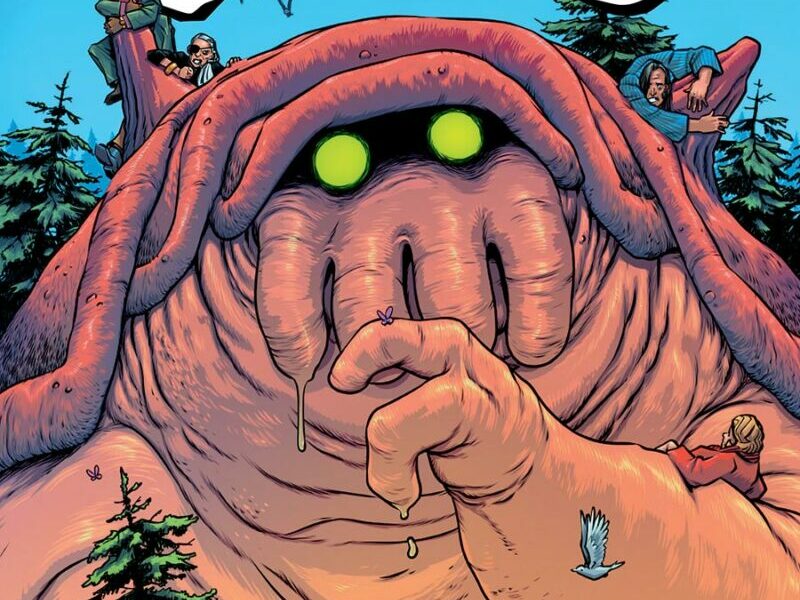
Williams: “Jones” had to be a mix of kind of scary and kind of friendly. A tricky mix to pull off. Nil did a fantastic job designing it.
Vendrell: Well, the thing is, this is not just a kaiju — it’s a baby kaiju. So I did quite a few drawings, some a bit translucent like a larva, or with a head similar to an octopus, but with something similar to baby proportions. I sent them all to Rob and he chose our Jones. I thought it was kind of a silly design but also charming, maybe not what you imagine when you think of a kaiju. But at the same time, it works because of that, with its short arms, no visible mouth, and the fact that, except for being huge, it’s not very menacing.
Bellwoar: One of my favorite moments in the first issue is when the seniors encounter the kaiju for the first time. It reminded me of the famous John Hurt scene in Alien, where it’s been said that the casts’ reactions were genuine (which makes Harry Dean Stanton’s calmness all the more delightful). How was it getting to create that moment?
Williams: I figured stunned silence would be the way … and silent comics panels are a great way of selling that. And then Tyrone, being Tyrone, he says, “I don’t need to piss no more. I shat myself instead.” As our story later states, Tyrone uses humor when he’s scared or insecure, which is pretty much all the time. The story is building these reactions out of character. I think that’s what the heart of Hidden Springs is: character. Making you connect with these people, showing you where they come from, and having them decide where they’re going. They all think their lives are behind them, but this is the moment they have to decide who they really are. Will they make a stand? It’s a story about finding life even when you think your own light went out a long time ago.
Bellwoar: Thanks for agreeing to this interview, Rob and Nil!
Hidden Springs ##1 is on sale now from Dark Horse Comics. Issue #2 goes on sale June 24th.

