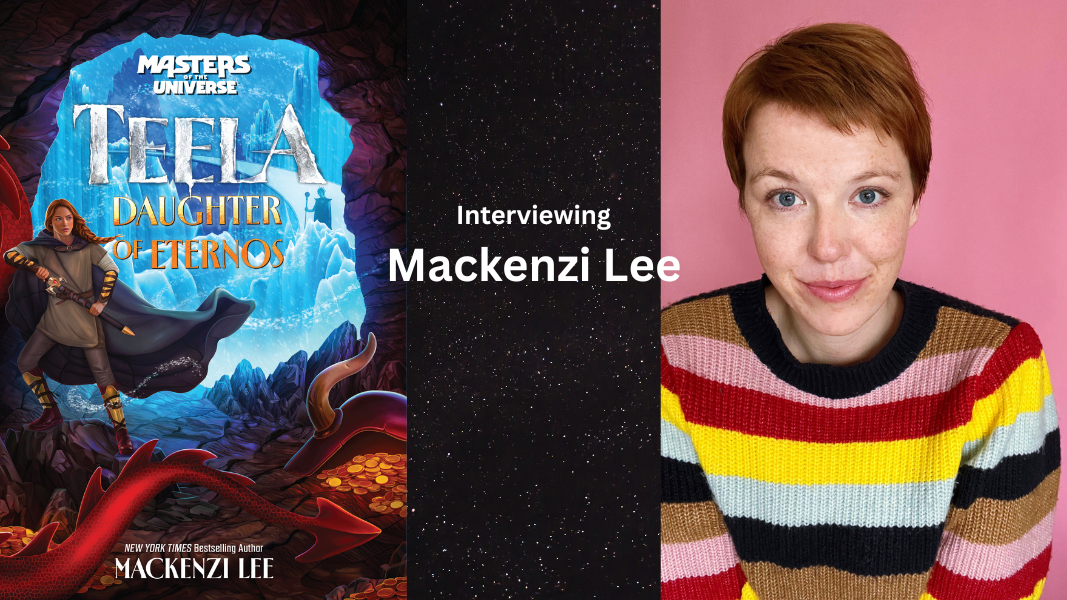
He-Man Week: Interviewing Mackenzi Lee About ‘Teela: Daughter Of Eternos’
by Anton Kromoff
Welcome to the table,
He-Man and the Masters of the Universe inspired multiple generations to truly believe they “had the power.” The 1980s sword & sorcery cartoon (itself based on a toy line) spawned countless action figures, playsets, and a slew of spin-offs and revamps, even a major 1987 live-action film called Masters of the Universe, and again in 2026 with a film by the same name.
One of the most recent pieces of media to come out and be set in the world of Eternia comes from Mattel’s publishing arm, Mattel Press, and is titled Teela: Daughter of Eternos. This YA novel is set directly in the world of the 2026 film and focuses on Teela as she navigates destiny, responsibility, and the weight of what comes with being both the daughter of the realm’s protector and a survivor in a world where the villain has seemingly won. All that is left for those not being ground under his booted heel is to make it to tomorrow.
I recently had the opportunity to sit down with New York Times best-selling author Mackenzi Lee to talk about her take on Teela and what we can look forward to in this upcoming book. You can find that conversation below, and be sure to check out Masters of the Universe in theaters.

Anton: Hello, Mackenzi. Thank you so much for taking the time to sit down with me today. Before we dig too deep into this epic bit of storytelling you have helmed, can you tell our audience a little bit about yourself?
Mackenzi Lee: Hi, thank you so much for having me! So a little about me — I’m the author of twelve fiction and non fiction books, the latest of which is Teela: Daughter Of Eternos, the official Masters Of The Universe film tie-in novel that follows Teela growing up and navigating the world after Skeltor takes over Eternia and Adam vanishes.
When not writing, I work part time as a bookseller at an indie bookstore in Los Angeles. I drink a lot of Diet Coke and have a dog that weighs more than I do.
A: There’s a long history of different interpretations of Teela across cartoons, comics, and toys. Did you find yourself pulling from a specific era or version of the character when writing this story?
ML: When Mattel approached me about this project, we talked a lot about that. Ultimately, the version of Teela in the book needed to most closely align with the character in the new film, and lucky for me, the folks who worked on said film had done a lot of that character synthesizing, so I got to draft off their existing work! Where my creativity and vision came in was getting to explore Teela earlier in her life in moments we don’t see her in the film. I got to take her from kid to adult, and fill in that gap in her timeline. I got to treat the Teela in the film like an end point, and I got to figure out how she got there.
A: Teela has always been fascinating to me because she’s often seen adjacent to the “chosen one” narrative without necessarily being framed as the chosen one herself. What caused you to gravitate towards her as a protagonist?
ML: I wasn’t a MOTU fan as a kid — it was a little bit before my time — but I was a big action figure kid, and loved a lot of nerd things (before it was cool to be a nerd). I grew up with a lot of properties where there was one token female character in a gang of men, and usually she had to adopt traditionally masculine traits in order to be taken seriously both by the other characters and the audience. I initially gravitated toward Teela because she was the kind of character my ten-year-old self would have immediately imprinted on, but as I started to dig deeper, I loved how she turns the trope on its head. Yes, she’s the girl with the sword, but in her relationship with Adam, he’s the one with the more traditionally feminine-coded traits — he’s sensitive and gentle and not great at fighting (and wears pink!) while Teela is tough and better with a blade and not as in touch with her emotions. I loved how the character both played into the archetype I loved as a kid, and subverted it at the same time.
A: One thing I really enjoyed in the way you write about Eternia is that you have captured that feeling that has always captivated me about the place: it is something both ancient and mythological, while also having this pulpy science-fantasy energy people associate with Masters of the Universe. How did you approach balancing those two tones?
ML: Oh it’s my favorite thing too, and part of what really drew me toward this project. Eternia shares so much tonal DNA with so many of my favorite franchises, like Star Wars, Marvel, Firefly, Avatar the Last Airbender, Doctor Who — to name a few. So while I didn’t grow up with MOTU, I had a lot of references. I find myself most excited about projects that toe the line between camp and sincerity and explore the interplay between silliness and seriousness. MOTU does this so beautifully, and Eternia tonally has to not only match but enhance that. The world is big, bombastic, and over the top, but with a real heart to it, just like the story set there. And so much of the book centers around Teela’s relationship to her home, so capturing the way she feels about Eternia for the readers was even more essential. I wanted people to love it as much as Teela does, and understand why it’s so important to her.
A: Franchise storytelling can sometimes feel restrictive to writers, but other creators seem to talk to it like being handed an enormous toy box stuffed with the coolest toys in the world to play with. What was this experience of writing inside the Masters of the Universe universe like for you?
ML: I am in the “look at all these cool toys” category. I love writing my original stuff, but the books that made me a reader as a kid were franchise tie-ins. I loved Star Wars novelizations, and when I was young, I didn’t so much want to be a novelist as I wanted to be a franchise novelist. So I think writing for MOTU is the thing that would most impress my younger self. And, novel writing is such a solitary pursuit. When you’re writing within an existing world, it feels like you’re collaborating with everyone who has worked in that world before you. I trust my own instincts and feel more secure in my own storytelling because it’s informed by the brilliant people who came before me and are working alongside me.
A: Fans of Masters of the Universe are famously detail-oriented. Was there a particular piece of lore or mythos that you were excited to include for longtime readers?
ML: I really loved writing about the Whispering Valley. I won’t reveal how or why that comes into play, but it’s a place that’s only visited briefly in the cartoon, so getting to bring my own details to that piece of the world was fun and challenging.

A: Your writing is always so deeply emotional, and I know this sometimes sounds like a buzzword, but you capture a real authenticity in the emotional storytelling that feels grounded and lived in rather than the over-the-top, almost stage play reactions that we sometimes see in other forms of media. As a reader, this emotional resonance is one of the things I gravitate towards in your stories. For me, that makes your take on Teela so powerful. You ground Teela’s relationship with authority, destiny, and the landscape itself in such a layered way that she feels considered in a way I have yet to see in other stories around her. You have done this in a way that I can safely say this is my favorite version of the character so far, and that is coming from someone who grew up with Masters of the Universe in all its forms.
Can you give us some insight into your process of fleshing out Teela as a character? Because in truth, once audiences get their hands on Teela: Daughter of Eternos, I feel comfortable saying they are going to want seven more from you in this space.
ML: I’m blushing! Thank you so much! I love young adult books because I love coming of age narratives — in so many ways, I think we all feel like we’re constantly coming of age, which is why YA books hold appeal for readers of all ages. With Teela, usual teenage angst is complicated by the fact that the world she was figuring out her place in — the world she had rooted her entire identity and future in — is suddenly gone. Her sense of self is forcibly unmoored by Skeletor destroying the things that she had used to define herself, like her future in the king’s guard, her relationship to Adam and the royal family, even her place in the court of Eternos. So she’s not only dealing with normal teenage questions of deciding who she wants to be, she’s doing it in a new world while mourning the loss of her previous one. It complicates everything, and that emotional core was what drew me to the story, and became the core of her character and journey. These feelings of displacement open her up to be disillusioned, start to see the people around her as people instead of perfect heroes, and to make an alliance with someone she would have never thought she had anything in common with. That common ground with an enemy further challenges her ideas about the nature of good and evil, and gives grayscale to her previous certainty about the black & white nature of morality. She starts to realize no one is all good or all bad, which allowed me to complicate the simplistic morality of the initial Saturday morning cartoon version of her character.
A: Because of the skill and tone of your writing, I’m very curious about this next one. If you could pull any lesser-known Eternia characters into a future story for a major spotlight, who would you choose and why?
ML: I would give anything to write an Evil-Lyn origin story! Mattel, call me, you have my number!
A: Before we wrap up, I want to thank you for taking the time to speak with me. Where can our audiences keep up with you and everything you are working on?
ML: These questions are some of the best, most thoughtful I’ve ever been asked in any interview — thank you for taking the time to read and really understand the book. You can find me on Instagram @themackenzilee and on the internet at www.mackenzilee.com
A: Without getting too spoilery, the book spends a great deal of time swimming through the various tides of legacy, not just the inherited power, but that responsibility and the weight of self-expectation that people can sometimes place on themselves. Was that always the thematic core for you, or did it emerge naturally as you wrote this?
ML: Definitely a thematic core from the beginning. So many of these swords and sorcery type franchises are obsessed with legacy, and collective identity. You have to fulfill the prophecy, you have to follow in your father’s footsteps, you have to uphold the legacy! It’s so intrinsic to MOTU, because it’s such a part of the world and the central arcs for multiple characters. Those themes from the cartoon definitely carry into the movie adaptation as well, and they really stuck out to me when I read the script. I was very interested from the get-go in exploring how the weight of legacy affects a side character like Teela, who isn’t the chosen one like Adam is, but still feels the weight and the responsibility, some of that from the people around her, some from herself. I wanted to explore the tension between what others want of us and what we want or ourselves, as well as forming our own identity separate from an inherited expectation. It’s such an essential part of the franchise, of Teela’s journey, and, I think, of everyone’s teenage years.
A: Thank you again, Mackenzi. You have captured brilliantly a moment in the lore of a generationally-loved franchise in such a way that it feels both impactful, true to the lore, and fresh all at the same time. What is next on the horizon for you?
ML: So glad to hear you say that! I wanted so badly to do right by the franchise and the fans with this book but to bring my own sensibilities to it. It’s a hard balance, so your praise means so much. Next on the horizon — I have a new YA book I’m working on that should be out sometime in 2027 or 2028. It’s a return to my roots as a historical fantasy adventure novel pastiche writer, but I think there’s enough magic and camp in it to make MOTU fans happy too.
A: All my best!
Until next time, this book is really worth your giving it a look, and as someone who grew up loving this world and these characters, this movie and the associated figures seem absolutely rad. All in all, it’s a good time to remember we do indeed “have the power!”