
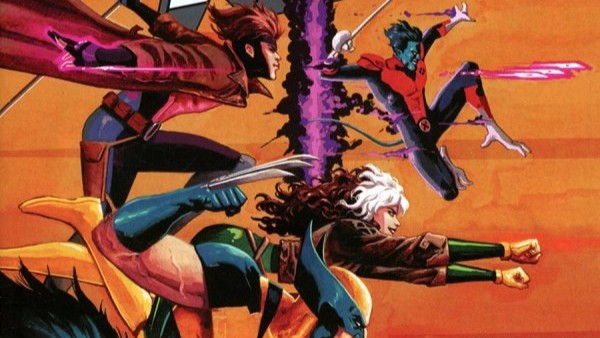
Previously On X-Men: Revealing The Fate Of Graymalkin Prison In ‘Uncanny X-Men’ #29
by Austin Gorton
Some weeks, the collection of X-books published is totally random. Other weeks, there are unintentional commonalties across them. This is one of those weeks: a bunch of books concluding their runs and/or notable story arcs, along with a general sense of “poor attention to established continuity” in a number of titles as well.
Cyclops #5 – Book of the Week
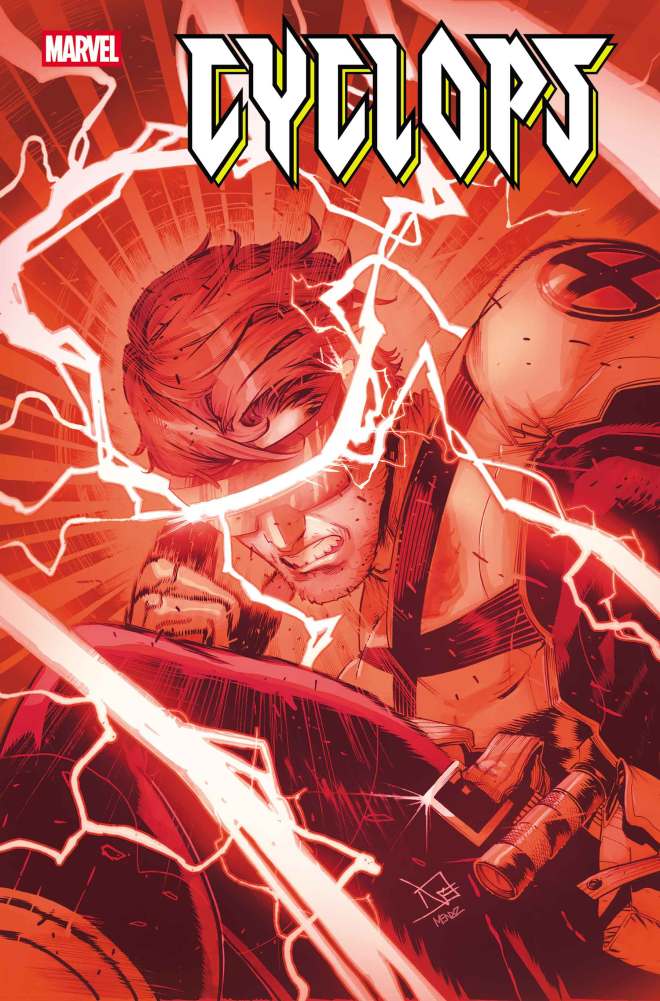
By Alex Paknadel, Rogê Antônio, Joe Caramagna & Fer Sifuentes-Sujo
Cyclops and Mei battle Pierce.
- Cyclops’s son is, of course, Cable; Tearjerker’s question about his age is a reference to the fact that Cable is quite old because time travel, relative to the early 30s-ish Cyclops.
- Uru is made of the same metal as Thor’s hammer, Mjolnir.
- “Island paradises” (Genosha, Utopia, Krakoa) and “Schools for the Gifted” are, generally, the two modes of X-Men homes.
- Mei is continuing to use the “Resist” device to banish her fear enough to enable her to tap into her super-strength.
- Antônio’s art gets a little sloppy in the middle section of the issue, as its difficult to place everyone in space relative to each other as the fight kicks into gear.
- The “housebroken Skunk-Bear” Pierce references is Wolverine (Housebroken Skunk-bear is my new favorite name for Wolverine).
- The Marauder is the Alaskan X-Men’s made mode of transport. Beast, Kid Omega, Magik and Juggernaut are the X-Men we can seen disembark from it.
- Appropriately enough for the final issue, this really hammers home the parallels between Cyclops/Pierce and the X-Men/Reavers, in that Pierce doesn’t value his teammates and (in this iteration at least) is just drafting regular people into becoming Reavers, whereas Cyclops succeeds not just because he’s awesome, but because he relies on Mei and the rest of the captive mutant teens to help him as an ad hoc X-Men team, but then recognizes “mutant superhero” isn’t the life for everyone and gives them his blessing to go live as normal of lives as possible.
When Paknadel was first promoting this series, he talked about wanting to create a Cyclops story that could standalone as a self-contained example of why Cyclops is awesome, akin to the original Wolverine miniseries. I was dubious he could pull it off, but by taking familiar elements of previous solo Cyclops stories (rob him of site, strip away his resources, drop him into a wilderness setting of some sorts) and putting his own polish on them — along with a touch of topical post-Krakoa “state of mutantkind” introspection and a familiar villain recontextualized slightly to make him a thematic antagonistic — Paknadel does. If nothing else, this contributes at least one or two more entrants into the “best Cyclops moments” discussions, and that’s no easy accomplishment.
Storm: Earth’s Mightiest Mutant #5
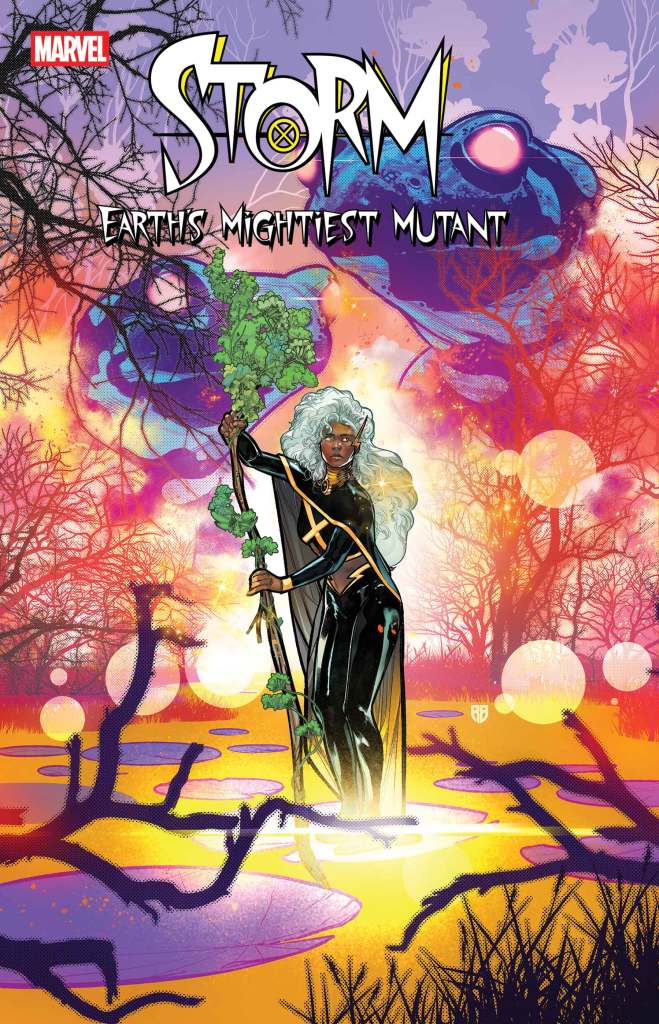
By Murewa Ayodele, Federica Mancin, Travis Lanham, Java Tartaglia
Storm debates Eternity on her way back to her own reality — and the end of her series.
- Storm imprisoned Sango in Storm #10.
- Galacta’s ballyhooed introduction earlier in the series ultimately results in her appearing alongside the superpowered FBI agents carrying a big hammer when they storm Storm’s sanctuary.
- Storm (merged with Eternity) defeated Eegun in Storm #5, then fed him to Maggott, after which Maggott was killed by the FBI in issue #11.
- This issue reveals that Storm resurrected Maggott via dark magic, but because he ate Eegun, this has caused unexpected consequences — the heads we saw exploding briefly earlier in this volume of the series.
- The reference to Storm learning her powers didn’t create new rain but just redirected it from elsewhere is specifically cited as X-Men (vol. 2) #78 (part of the “Psi War” story involving the Shadow King), and that’s generally been shown to be how Storm’s powers worked for years prior to that issue.
- Apocalypse and Jon Ironfire are the only recognizable Arakki shown in the flashes of Hadad leading Death’s army. The zombies they’re fighting consist of Synch, Magik, Wolverine (Laura Kinney), Juggernaut and Nova Corp members.
- They’re joined in one of the closing panels by Zombie Nightcrawler, Mystique, Rogue, Gambit, OG Wolverine and Daredevil.
- X-Treme X-Men #10 does establish the extradimensional power of Storm’s headdress ruby as cited in this issue, although it’s a little more complicated there than what is shown here.
Wow. When this series was announced, there was a lot of confusion between what was solicited (a five-issue miniseries to wrap up the story) and what Ayodele was saying it was (an ongoing series). Whenever Ayodele finally got the memo he only had five issues, it was clearly before he penned this issue, which goes for a metatextual ending to the plotlines (ie “Storm wins because she’s the protagonist of a superhero comic and they always wins, so we’re not even going to show or tell you how) in favor of creating a more vibes-based final issue that tries to tie the series’ (and its predecessor’s) thematic ideas together. Needless to say, it’s deeply unsatisfying, and I remain very curious as to how it came about (willful ignorance on Ayodele’s part, or poor management on the part of editor Tom Brevoort? Given how much of the coordination in “From the Ashes” and “Shadows of Tomorrow” has gone, I’m inclined to lean towards the latter). I continue to find Ayodele’s ambition with this series admirable, but I also question whether this has left Storm in a better or worse position as a character (and whether any of this is ever going to matter/get mentioned again). While I admire Ayodele’s desire to swing for the fences, that doesn’t change the fact that this issue is a big ol’ swing and a miss.
Uncanny X-Men #29
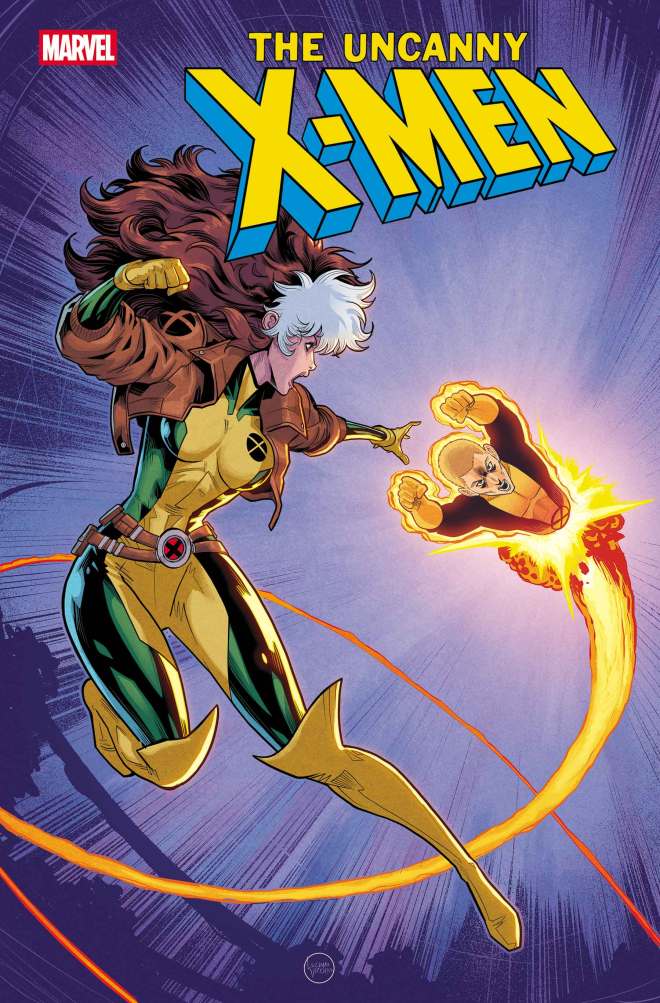
By Gail Simone, Luciano Vecchio, Clayton Cowles & Matthew Wilson
The X-Men battle Perimeter for the fate of Graymalkin Prison
- The quote Warden Ellis attributes to Dostoevsky actually first appeared on the newsletter masthead of a prison right’s group called the Fortune Society.
- In the wake of Graymalkin’s apparently collapse, Ellis is suddenly talking about wanting to build something good and rehabilitation when everything she said and did prior to this sure seemed to suggest she just wanted to punish mutants.
- Rogue’s codename is Sherlock; her mother, Mystique, once operated as Sherlock Holmes in Victorian England. Watson (Monet) is of course Holmes’ long-time partner/chronicler, while Lestrade (Quicksilver) is the name of the oft-bumbling Scotland Yard inspector who crossed oaths with Holmes on occasion.
- I’m not sure Jubilee and Karma have ever actually shared a panel together prior to this issue, let alone that Jubilee somehow knows Karma well enough to be able to read her facial expressions and know she’s about to use her powers.
- It still remains very unclear how/why Perimeter’s constructs are AI as opposed to telepathic constructs (unless we’re meant to think of all telepathic projections as AI?).
- The prisoners under Perimeter’s control include Fawn, Blob, Wild Child and Siryn (all established Trustees), Dazzler (who was arrested in the Hellfire Vigil oneshot), Omega Red and Sebastian Shaw (who were both captured in the Sentinels miniseries), Sarah Gaunt (from earlier in this book’s run), and Johnny Dee (from Son of M), Stacy X (from Joe Casey‘s Uncanny X-Men run) and Tommy (of the Morlocks), as well as some random purple beings I don’t recognize.
- Last we saw Banshee was in the previous iteration of the X-Men Infinity comic. His words translated are, “I’m sorry. Now my dear, your father is here. I’m here.” His line about thinking Siryn wanted him to stay away references their interaction in the Hellfire Vigil.
- Rogue and M were teammates together in the “Fall of X” era Uncanny Avengers (which is also where Monet and Quicksilver’s relationship started).
- If I was Siryn (to say nothing of the other mutants), I’d still be pretty pissed Rogue and the rest of the X-Men let them languish in prison as long as they did.
- While this book ends the Outlier/New Mutants story and, presumably, the Graymalkin Prison story, it leaves a lot of questions unanswered, such as:
- Where were the Outliers during this story? Why were they abducted by Perimeter and replaced with evil New Mutants? Why did he include Mutina, a character whom, as far as we knew, he wasn’t even aware existed?
- At the end, after Wolverine kills the Perimeter-possessed Scurvy, why is Perimeter said to be contained in his cell when it was Scurvy whose power was trapping him there?
- Why was “plant M in the prison as a mole” Rogue’s plan and not Cyclops’s (other than the fact that she is in this book) when her deal in this book is that her team is more ad hoc? Was Cyclops aware of that plan during “Raid on Graymalkin?”
- What evidence, exactly, did Monet and Quicksilver gather that Rogue believes will shut down Graymalkin and prevent it from being franchised? That they were treating the mutant prisoners badly? Seems like that’d be a feature, not a bug, to the people supporting the prison. That they were bad enough at their jobs to let Perimeter, an evil and dangerous mutant, escape? Seems like, again, to the people who support the idea of a mutant prison, that just means they need a bigger, better mutant prison.
As a conclusion to both the Outlier story and the Graymalkin Prison plotline, this is an utter (but very nicely drawn) mess which leaves more questions hanging than it really answers. But the prison plot has been a weight around this series’ neck since it launched, with Simone at her best when writing the furthest away from it, so there’s a sense of relief here to having it finally behind us for good.
Wade Wilson: Deadpool #5
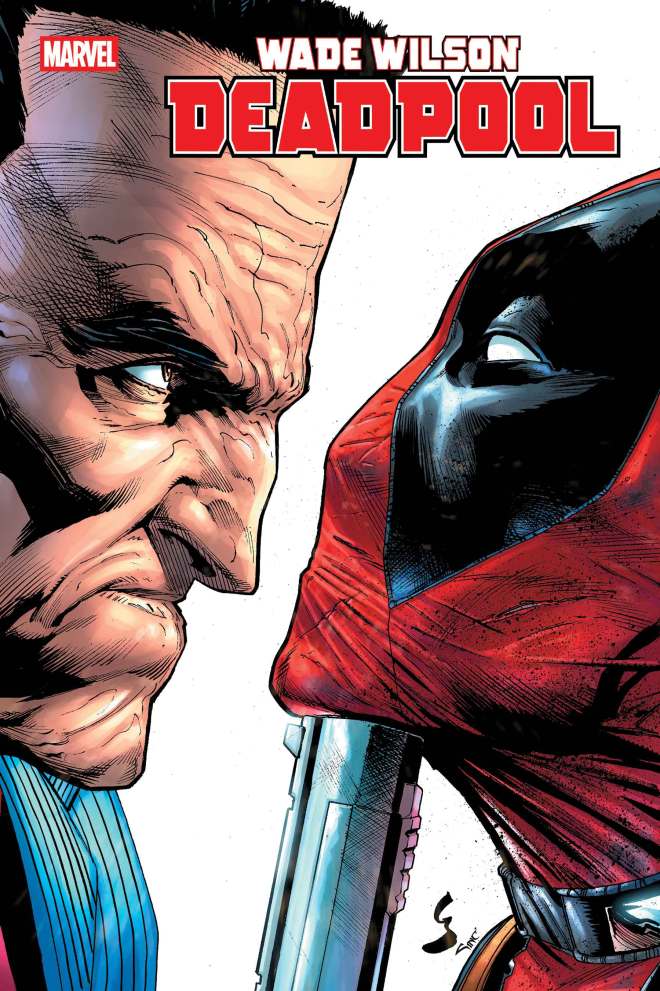
By Benjamin Percy, Geoff Shaw, Alex Sinclair & Joe Sabino
- Last issue confirmed Blind Al as the source of the prophecies, but this issue makes it clear there’s still a mystery as to how/why she’s receiving visions of the future, as she simply says she woke up on New Years Day receiving visions.
- Similarly, while I suspect — and hope — this isn’t the last we hear of Ellie, it seems like Deadpool comes to some measure of peace with her death by the end of the issue.
This smartly walks the (unfortunately necessary) fine line of providing a satisfactory climax to the series’ first five-issue arc that could stand on its own as a complete, satisfying read if the book was cancelled while also leaving enough threads open to help subsequent arcs feel like part of a larger whole rather than just a “series of miniseries.” I’m still not vibing on the art (and don’t love the fridging of Ellie), but the idea of a slightly-humbled Deadpool snarking his way through doing good deeds, directed by a prophetic Blind Al, is a far more engaging setup for a Deadpool book than I’d ever have expected.
What If…? The Uncanny X-Men #1
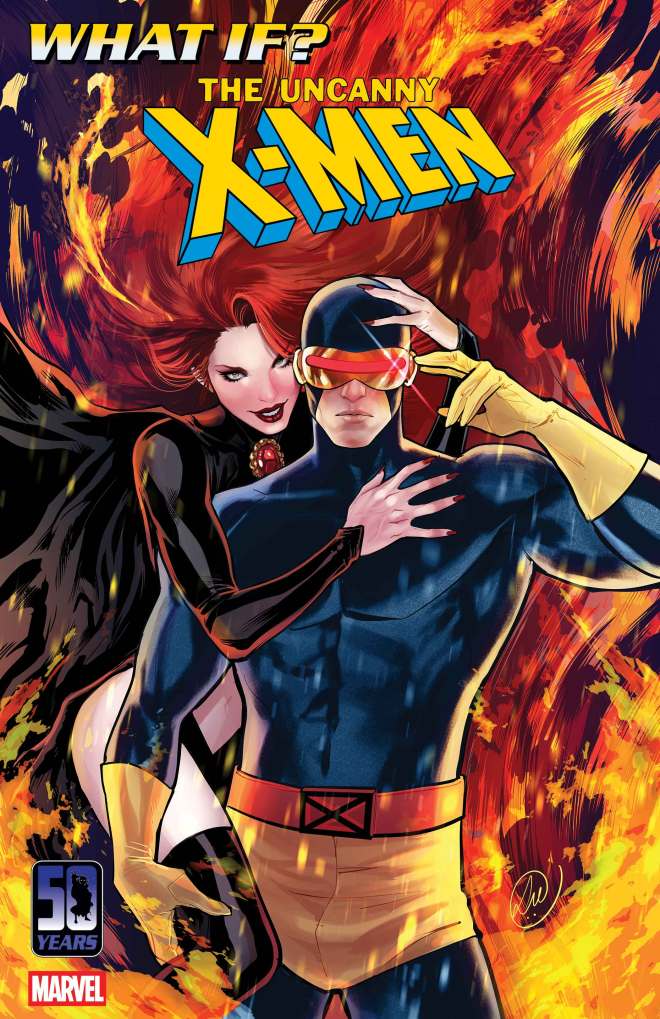
By Gerry Duggan, Jan Bazaldua, Arthur Hesli & Clayton Cowles
One character’s changed decision leads to everyone dying.
- While the subject of this issue is “what if Cyclops had stayed with Madelyne Prior,” it’s official title, per the indica, is “What If…? The Uncanny X-Men.”
- While the central question suggests this will be a story about Cyclops not abandoning his wife and infant son to play with his high school friends and old girlfriend, it’s actually about him staying with Madelyne after the events of “Inferno,” which means it should really be called something like, “What If Madelyne Pryor survived Inferno?”
- Yet even then, it doesn’t even get into the mechanics of how Maddy survives “Inferno”, is made not-evil, etc. Which is kinda the whole point of a What If…? story.
- There’s some weird continuity stuff happening (even within the context of a What If…? issue), where Wolverine and Emma Frost show up in their Grant Morrison/Frank Quitely looks (from the early 2000s) before the events of “Atlantis Attacks” and “Acts of Vengeance” — two stories which happened soon after “Inferno.” Sliding timeline, changed reality, etc. etc. Still, I bumped against the apparent temporal incongruity.
- Relatedly, there are scenes of Scott and Maddy wondering if Nathan will be a mutant … but he was established as being a mutant (something they’re both aware of) in “Inferno.”
- In the full page splash introducing the House of X, they’re battling Pearce and his original Reavers (a group whose heyday was also shortly post-“Inferno”).
- Shortly after Jean Grey’s departure from Earth, the House of X is shown battling the Toad-led iteration of the Brotherhood of Evil Mutants, which originally debuted in early issues of X-Force.
- Rockslide (an early ’00s era character) is visible amongst the dead in the new Mutant Massacre.
- Maddy being impaled on the wall via Harpoon’s harpoon echoes Angel’s similar fate in the original “Mutant Massacre” story.
- More timeline shenanigans: it seems like a young Wolfsbane is amongst the New Mutants, who include Pixie, Glob Herman and Nature Girl, characters who all debuted when Wolfsbane was closer to her mid-20s.
- Cyclops and Maddy’s crucifixion is a visual reference to the cover of Uncanny X-Men #251 (in which Wolverine is nailed to an X-shaped cross) and possibly to the later Chuck Austen “Holy War” story in which the Church of Humanity crucified a bunch of mutants on the lawn of the X-Mansion.
- Colossus snapping Riptide’s neck is an echo of his same action in the original “Mutant Massacre.”
- Most What If…? stories tend to end in one of two ways: everything works out mostly the same as in the original version, or everyone dies. This one obviously takes the second option.
This is kind of a mess. I’m less bothered by some of the temporal incongruities given the alternate history of it all, but it’s not a terribly engaging read. The Watcher always plays a role in these stories, but he seems especially tell-y in this one, not just introducing the story but continuing to MC it, the end result reading more like a collection of vignettes or an illustrated Wiki than a proper story. I’m a huge fan of Bazaldua’s art, but I wish she was working on something better.
X-Men ’97 Season 2 #1

By Steve Foxe, Salva Espin, Matt Mila & Joe Sabino
The remaining X-Men deal with the fallout of E-Day and the scattering of their teammates across time.
- Foxe and Espin were the creative team on the previous volume of this series, which served a similar “half prologue/half dancing between the raindrops” role for the first season of the animated series.
- I don’t think this issue ever spells it out, but presumably the “E” in “E-Day” stands for “Electromagnetic Pulse.”
- Forge was indeed part of the government-sponsored X-Factor team when they were introduced in the original series’ episode “Cold Comfort.” This means the animated X-Factor is developing opposite of the comic book run, which went from Val Cooper to Forge.
- Rusty and Skids are featured in the looks they wore while hanging out with Stryfe’s Mutant Liberation Front in the comics, which they joined after being arrested by the government and being sprung from jail by the MLF (after which they eventually join Magneto’s Acolytes), which seems like the arc they’re on here.
- Pyro, Forearm, Avalanche, Random and Temp are the other mutants captured by X-Factor.
- X-Factor’s lineup more or less matches their appearance in “Cold Comfort” and/or the start of the Peter David/Larry Stroman iteration of the team in the comics, give or take a Quicksilver. That said, they’re all a bit more militantly pro-government here than they ever were in the comics.
- The Alliance of Evil (composed of Tower, Stinger, Timeslide and Frenzy) debuted in the early issues of X-Factor, intended to be a sort of new Brotherhood of Evil Mutants to battle the newly- reconstituted original X-Men. They were revealed to be working for Apocalypse, in his debut appearance, and were a bit low rent for what Apocalypse later became, though much of that owes to the fact that, originally, their master was going to be Daredevil villain the Owl.
- The “loonies” Frenzy left them for are Magneto’s Acolytes (she’s amongst them when they attack the X-Factor convoy at the end of the issue), a group she did join in the comics (though well after the Alliance of Evil ceased to be a thing), before later joining the X-Men as well as the most recent iteration of X-Factor itself.
- Psylocke and Archangel have often been romantically involved in the comics, and both served on various iterations of X-Force (though not usually with Cable).
- The other Acolyte we see in this issue is Katuu, though he has both arms (in the comics, he has just one).
As with the previous volume, I’m not sure we need a tie-in book to support the animated series, but at the same time, Marvel would be stupid not to put one up for sale with the series coming back in a month, so here we are. This is all perfectly fine, clearly setting up what I assume will be a second season expansion of X-teams, with X-Factor, X-Force, and the Acolytes all coming into prominence. Foxe has a pretty decent handle on the voice of animated Bishop, and Espin continues to give this an animation cel-like quality that fits the material.
X-Men Infinity Comic #19

By Steve Orlando, Minkyu Jung, Yen Nitro & Clayton Cowles
Young Cable assembles a team of X-Men from across time to battle the Durisphinx.
- The Durisphinx says it has sampled 198 mutants, which was the number of mutants left cataloged by the government in the wake of M-Day, the Scarlet Witch’s depowering of most of mutantkind, back in the mid-2000s. I assume the number is just a winking reference on Orlando’s part.
- The team Cable assembles are all of course drawn from teams shown encountering the Durisphinx earlier in the series: Storm and Beast from the first encounter, Boom-Boom from the second, and Forge & Wolfsbane from the third.
- That also makes it clear that Storm and Beast are meant to be from further in the past than the ’90s era X-Force and X-Factor encounters, which, again, makes zero sense (just in the context of this chapter, they should have no idea who any of their teammates are).
- Wolfsbane seems a lot more “punch first, ask questions later” here than she is usually characterized.
- I swear to God, after all the buildup and incorrect answers, the actual answer to the Durisphinx’ riddle, when it’s revealed, had better be the best goddamn answer to a riddle ever.
Putting aside the ongoing continuity issues, this is a perfectly-cromulent installment in the “team assembled across time” narrative tradition.
X-Men of Apocalypse #4

Jeph Loeb, Simone Di Meo, Richard Starkings & Tyler Smith
Gambit meets Rogue in the past while the true villain stands revealed.
- In what feels like a broken record at this point (for this series and this week’s batch of X-books), continuity errors abound in this issue. In Rogue and Gambit’s meeting, Rogue has the ability to fly, yet it takes place before her encounter with Ms. Marvel, which is … when she gained the ability to fly. Later in the issue, it’s suggested she has super-strength as well, which, see the previous sentence.
- After Gambit is teleported away by Nate Grey, Rogue and Ms. Marvel start their fight atop the Golden Gate bridged, but that’s where their fight ended, after Rogue ambushed Ms. Marvel (vs. Ms. Marvel seeking Rogue out, as here).
- The era the AoA X-Men land in is the present day (or at least just before the events of Uncanny X-Men #29) when the X-Mansion is Graymalkin Prison, though little actually comes of that here (aside from the X-Men recognizing it as a sign of human oppression of mutants, on which they blame Apocalypse’s ascension in their reality).
- The big twist here (that the goal all along was just to crossover to the 616 universe and conquer it) at least makes sense in the context of how time travel is meant to work in the Marvel Universe (that, as Holocaust says, trying to replace one reality would just create a new reality).
Oh yeah, this is still a thing which exists. That whole detour into the past to meet Rogue does nothing to suggest it’s anything more than a bit of filler to pad this out to the requisite five issues.

