
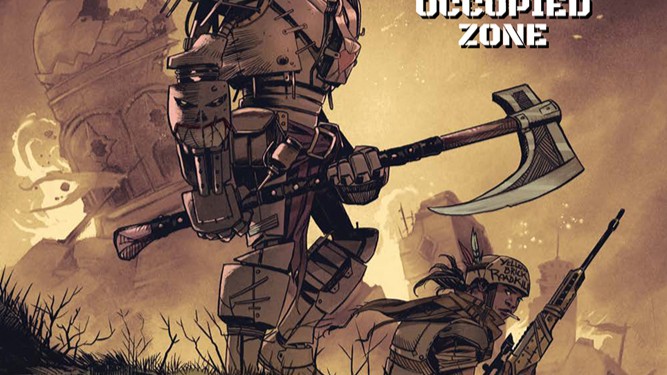
Interview: David Pepose On ‘The O.Z.’, ‘Space Ghost/Herculoids’ And More
by Austin Gorton
Writer David Pepose has made the Avengers savage, reunited the Planeteers, and zoomed Speed Racer into the 2020s. Now, he’s returning to one of his creator-owned projects, launching a Kickstarter with artist Ruben Rojas for the third issue of the post-apocalyptic fantasy series, The O.Z. With its current Kickstarter campaign in full swing, David talked with me about the series’ relationship to The Wizard of Oz, the challenges of creator-owned work, an upcoming crossover between two beloved Alex Toth properties, and more!
Austin Gorton: Let’s start with the elevator pitch for The O.Z.
David Pepose: The O.Z. is like what if Mad Max took place in the Wizard of Oz — The O.Z. follows Dorothy Gale’s granddaughter and namesake, a disillusioned Iraq war veteran who is caught in a tornado and dropped into the war-torn land of Oz. That’s when she learns her grandmother’s stories were not only true, but killing two Wicked Witches and exposing the Wizard of Oz didn’t result in a happy ending — instead, it plunged Oz into a power vacuum not unlike Baghdad. Now leading the Resistance against the evil Scarecrow’s regime, Dorothy must join forces with the Tin Soldier, the Prince of Lions and Jack Pumpkinhead if she hopes to find the all-powerful Silver Slippers and bring peace to the Occupied Zone … or as the locals call it, The O.Z.

Gorton: The Wizard of Oz is kind of having a moment right now — there’s the two Wicked movies, the original film is playing at the Sphere in Vegas; what is it about the story that drew you to it and made you want to adapt and riff on it, and how does The O.Z. fit into that moment?
Pepose: I think you’d be hard-pressed to think of many other stories that are as enduring and instantly iconic as The Wizard of Oz, which is why I think there have been so many different permutations of L. Frank Baum’s classic novels. The [MGM-produced, Warner Bros. owned] film also helped catapult these characters into the public zeitgeist with its trailblazing, eye-catching work as an early pioneer of Technicolor, but the source material was always there, populated with the iconic imagery of Oz and such archetypal characters like Dorothy, the Tin Man, the Scarecrow, the Cowardly Lion, and the Wicked Witch of the West. How could you not want to keep exploring a world like that?
With all that in mind, the high concept behind The O.Z. came by accident — early in my career, I was thinking about different genres I wanted to explore, and I started typing out different fantasy series to draw inspiration. It was when I wrote down “The Wizard of Oz” in all caps, that my computer cursor suddenly froze in the middle of the word “OZ.” That’s when it occurred to me that Oz is short but iconic, and could be used as an acronym — and when I landed on the phrase “Occupied Zone,” the entire concept hit me like a ton of bricks.
As you can see from artist Ruben Rojas’ first cover for our series, the image of Dorothy as a disillusioned soldier, giving us a thousand-yard stare as she sits in the ruins of Oz beside a scrap-metal version of the Tin Man, felt like a perfect way to interrogate the original source material — there are many costs to war, both massive and personal in scale, and sometimes, even your most well-intended plans can have truly unexpected consequences. But it also speaks to a theme that I like to explore in my other work, which is following characters like Dorothy who must grapple with the scars of their past — I think that’s a universal theme that we can all relate to in some capacity. I’ll often have my characters start in a dark place, but once they finally confront their traumas, there’s that redemptive climb that offers them some hope of someday transcending their pasts.

Gorton: The O.Z. includes characters not in the classic film, including Jack Pumpkinhead, and references the Silver — not Ruby — Slippers, so is it safe to assume you’re a fan of the Oz books and/or how much did the Wheelies freak you out in Return to Oz?
Pepose: I did read many of the original Oz novels in college, as part of an English class titled “Adolescent Literature.” And of course, Return to Oz certainly gave me some inspiration as far as how flexible and versatile the Oz mythos could be tonally. But yes, a fun fact is that while the original L. Frank Baum novels are considered fair game legally, the MGM film is not, so certain elements like the Silver Slippers over the Ruby Slippers was the price of admission.
Gorton: Are you a Scarecrow, a Tin Man, or a Cowardly Lion?
Pepose: Boy, that’s a great question … as much as I’d like to say the Tin Man, I think there’s something to be said about the Cowardly Lion. I am certainly someone who wrestles with doubt, but I think that’s become a core part of my process as both a creator and as a human being — you explore those doubts and fears, you interrogate them, and you compile the evidence to refute or accept it. To me, the Cowardly Lion’s core character trait isn’t about experiencing fear, but how you push forward in spite of it.
Gorton: What kind of challenges and rewards come with working on creator-owned, crowd-funded series like The O.Z. compared to work-for-hire work?
Pepose: I love doing projects on Kickstarter, which I think is a nice return to my independent roots after spending the last few years working primarily on Marvel books or licensed relaunches. But with Kickstarter, there really is that sense of community across the platform, but also that sense of connection with your readers — I’ve personally written thank-yous to the nearly 1,700 people who backed our first two campaigns. Where else can I say I’ve spoken with every single individual who’s read one of my titles?
That said, Kickstarter certainly does require a lot more planning and legwork — there’s definitely a learning curve towards figuring out printing and shipping costs, how to navigate a printer, the best ways of packing and distributing your books. This can certainly be daunting — I know it was for me when I did my first campaign! But I think it’s incredibly empowering for creators if you can figure out how to do it. It means not only are you able to produce comics at a level of financial viability that often isn’t possible otherwise at the independent level, but you don’t have to wait for anybody’s permission to create a comic anymore — you can sell your work directly to your readership on Kickstarter.
Gorton: Speaking of work-for-hire, what can you tell us about the upcoming Space Ghost/Herculoids crossover event?

Pepose: Sure! We’ll be teasing our upcoming Space Ghost event in the Space Ghost Annual coming out in July — which is up for preorders now — not only are Jonathan Lau and I wrapping up our second volume there, but you’ll see a first glimpse at a brand-new storyline we’ve got cooking in September … as we introduce Alex Toth’s other team of sci-fi heroes, the Herculoids, into the fold! This is going to be a major, blockbuster event for Space Ghost, Jan, Jace, and Blip — I’ve thought for a long time that if Space Ghost is the ultimate found family story, what might happen if they meet a very different kind of family from the opposite side of the cosmic tracks, who do things very differently and have the muscle to back it up?
Similar to Space Ghost, I watched every episode of The Herculoids’ original run and the ‘80s revival, and we’ve built up a really cool continuity and backstory around the incredible 10-issue run that Tom Sniegowski did with the Herculoids last year. We’re introducing the space barbarian Zandor as a former gladiator of Kyanite, who was given a second chance when he was rescued by Tara, the adopted daughter of the Rock Village’s tribal chief. Teaming up with the star-dragon Zok, the armored battle-beast Tundro, the rock-ape Igoo, and the enigmatic protoplasms Gloop and Gleep, Tara taught Zandor that their homeworld of Amzot still had beauty to explore — and when their son Dorno was born, it gave Zandor a new sense of purpose.
Without spoiling too much, when Space Ghost meets Zandor and the Herculoids for the first time, something has happened that has made Zandor backslide in a substantial way, which will cause plenty of dramatic sparks to fly. Space Ghost is used to being the toughest guy in the room, but Zandor isn’t from around here, and he’s not buying what Space Ghost is selling — especially when he and his team have spent their whole lives metabolizing trace elements of Quasarite from Amzot’s ecosystems, granting them enhanced speed, strength, and durability. It’s the city mouse and the country mouse, not unlike Batman and Superman, and when Space Ghost and the Herculoids finally have their long-awaited team-up, they’ll have to find some common ground between their two different ways of life.
Gorton: How about what’s coming down the pike in Speed Racer?
Pepose: Artist Davide Tinto and I have some really fun storylines down the pike for Speed Racer, kicking off with our “Demon on Wheels” two-parter that’s kicking off in June. In this storyline, Speed is going to be accidentally exposed to an experimental street drug known as V-Gas, which certain shady Formula X drivers have been using as a performance enhancer to increase their aggressiveness and fearlessness.
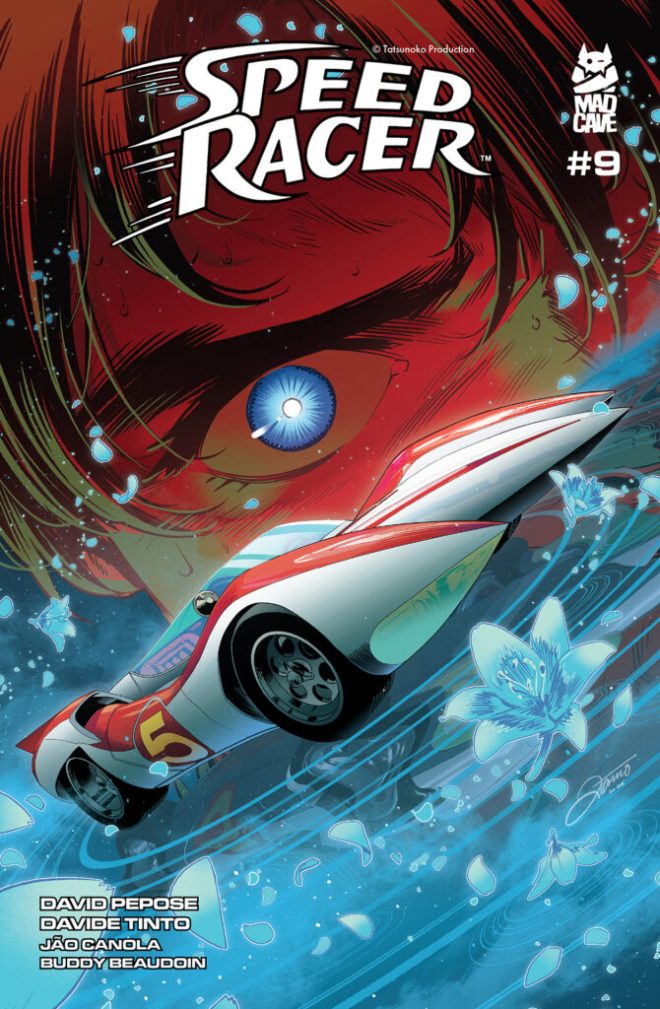
Having taken a faceful of the drug during a race gone wrong, Speed and his team have no idea what’s happened — only that Speed has suddenly started driving with the gloves off. And so this storyline is going to really put Speed’s supporting cast to the test — can they stop Speed from doing something irrevocable while he’s on the tracks? And what connection does the V-Gas have to Racer X’s past? We’ll be seeing a long-awaited rematch between Speed and Racer X in the heart of an active volcano, as we see if Speed can find his moral compass before it’s too late.
Gorton: Finally, what’s the last good thing you read, and what did you like about it?
Pepose: I’ve been really enjoying Tony Fleecs, Carmine Di Giandomenico, Ivan Plasencia and Wes Abbott’s work on Deathstroke the Terminator — Di Giandomenico and Plascencia are delivering some of the best artwork in monthly superhero comics, and Tony’s been doing a killer job with the pacing of it all, packing in a lot of story in a way that doesn’t feel overcrowded, while still making sure readers get their money’s worth. It’s very John Wick, but there’s that heightened ‘90s action movie element with all the gunplay and fires and explosions. Definitely a terrific read.
And I’ll cheat by adding a second book, but I really enjoyed Absolute Green Arrow from my pal Pornsak Pichetshote and artist Rafael Albuquerque — that was a stellar character introduction for Dinah Lance, and I really appreciate and admire the immediacy of her financial situation, which I think we often overlook in today’s superhero marketplace. The serial killer horror elements, Dinah’s unique role as a bodyguard versus being a standard detective, even the real-world Easter eggs of the Greenarrow app as a riff on the real-world Robinhood app, that’s a great way of making Green Arrow reflect a lot of today’s pressing concerns. And that Albuquerque art was sensational — it’s been a minute since his run on American Vampire, but somehow he’s gotten even better juggling action and horror. Certainly a book that lives up to the hype!
The O.Z. #3 is available via Kickstarter at this link. Space Ghost (vol. 2) Annual #1 is on sale July 15th. Speed Racer #9 is available now.


