
Characterization In The Buffyverse — ‘Angel’ Season 2, Episode 20
by Benjamin Hall
This is part of a bi-weekly series concerning the characterization of Buffyverse characters. Arguably the best place to begin reading this series is at the beginning, but that is up to each reader. As a reminder this column will cover major and some minor characters from the shows Buffy The Vampire Slayer (1997-2003) and Angel (1999-2004). Other Buffyverse media, such as the graphic novel Spike: Into The Light (2014) are not pertinent to this series. Also there will be no referencing real world events that have direct relation to either show in this bi-weekly series. Although this series does reference things that have no direct relation to the show in order to examine things such as metaphors and literary analogues.

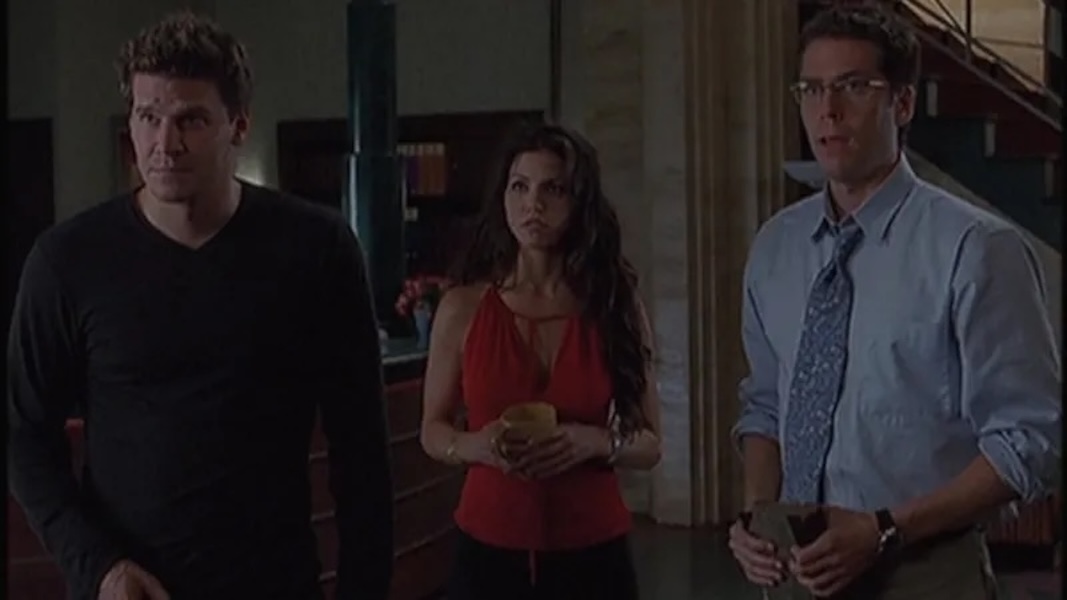
This week: Lorne (Andy Hallett) and Angel Investigations attempt to find a missing Cordelia Chase (Charisma Carpenter). Meanwhile, Cordelia faces demonic trouble in another dimension.
(Warning of spoilers from this point on!)
(Trigger warning for mentions of abuse and slavery)
Angel (David Boreanaz) says Cordelia’s name and talks about her at the beginning like he is in love with her. He also exhibits foolishness by asking if the spell book has batteries. While the spell fails in the club because it lacks a power source, this is purely coincidental to his question. Upon reaching Pylea, Angel goes from being dour to feeling too happy. He also lacks urgency regarding the search for Cordelia after being so insistent about it before the dimension hop. Arguably, his overall reaction to withstanding Pylea’s suns is an exhibition of his narcissism.
Cordelia acts like an idiot at the beginning of the episode, but she at least has the realization that her initial actions are insipid. She also has extreme luck since she transcends her status as a slave to being a queen by the end of this episode.
Wesley Wyndham-Pryce (Alexis Denisof) is the logical sort who provides exposition while slowing a rash character — in this case: Angel — down. Some of his character moments allow for levity, such as continuing the argument over losing the book while a scene ends.
Charles Gunn (J. August Richards) displays defiance in the face of death against the unjust authority figures of Pylea. That said, his reasons for leaving Earth with Angel, Wesley, and Lorne are confusing since the decision-making occurs off-screen.
Lorne is afraid of going back to Pylea in a way similar to what a refugee might feel about returning to their former home. He also is a font of information for Angel Investigations’ trip to his prior dimension of residence.
Winifred “Fred” Burkle (Amy Acker) is mentally ill, but aware of this fact. She provides the exposition font for Cordelia during the latter’s enslavement. Fred displays a certain type of bravery by attempting to contact Cordelia. There is also the suggestion of Fred’s brilliance via her dialogue and the matter of disabling her collar. Additionally, she is resilient after five years of abuse, slavery, and whatever else she experienced prior to this episode
Vakma (Susan Blommaert) is the demon who buys Cordelia. She is a crabby old woman.
Blix (Drew Wicks) is, according to Lorne, a former friend. Whatever bond existed in their past is no more, however, since Blix alerts the town about Angel and the others’ presence while accusing Lorne of treachery.
Agnes Bellfleur or Aggie (Persia White) essentially tells Lorne to face his past in return for her help. She seems clever since she is an actual psychic who provides predictions in a piecemeal manner to paying callers.
Gavin Park (Daniel Dae Kim) is technically replacing Lindsey McDonald (Christian Kane) as an antagonist to Angel. His methodology differs from Lindsey’s, though. It has more basis in the legal world than the supernatural.
Trensiduf (William Newman) and his pet, Seekul (Lee Whittaker), are analogues for a slave catcher and his dog. Although, after first stopping Cordelia, Seekul appears kinder than his historical counterparts.
Silas (Michael Phenicie) and Barshon (Andrew Parks) are priests who oversee the ruling of Pylea. They are clearly villainous political puppeteers.
Constable Narwek (Brian Tahash) is a resident of Pylea upholding their society’s laws. He has some kind of personal loathing when it comes to Lorne.
This episode is weak on characterization. Most of the narrative relys on character moments, exposition, and various amounts of dramatic tension, though. Arguably, the plotting seems like a combination of multiple episode ideas, which results in the characterization becoming thinner than what it could be.
