
The Weekly 2000 AD Prog #2493: It’s Norts V Southers V Dredd In The Oubliette
by Richard Bruton
Taking a look inside the UK’s greatest sci-fi comic, the Galaxy’s Greatest, fast approaching 50 years of brilliance — it’s the Weekly 2000 AD.

All the same this week, meaning there’s more from Judge Dredd in ‘The Oubliette’, as the mega epic continues. Then we have more Brink, oh so wonderful Brink, more nastiness and inevitability in The Fall of Deadworld, more 19th Century strangeness in Nightmare New York, and the final part of the Oubliette-adjacent Judge Anderson tale, ‘The Void’.
Oh yes, jump in — it’s always great, has been for getting on for 50 years now … and it all kicks off this Prog with an Anthony Williams cover for Dredd:

2000 AD Prog 2493 was out in the UK on 29th July. It’s also out in the US and the Americas on 12th August. The first time that you American folk have been able to experience all the wonders of 2000 AD as a weekly. Just for once though, the lateness of this one has nothing to do with me being late. Oh, no, it’s all because the 2000 AD team was having such a fine old time at San Diego Comic Con that they only had the chance to send out the press emails when they came back. So, yes, just for a change, not my fault.
Right then, intro done, time to head into the weekly wonders of 2000 AD …

Judge Dredd: The Oubliette — Part 11 — By Ken Niemand and Dan Cornwell, Colours by Emily Roach, letters by Annie Parkhouse
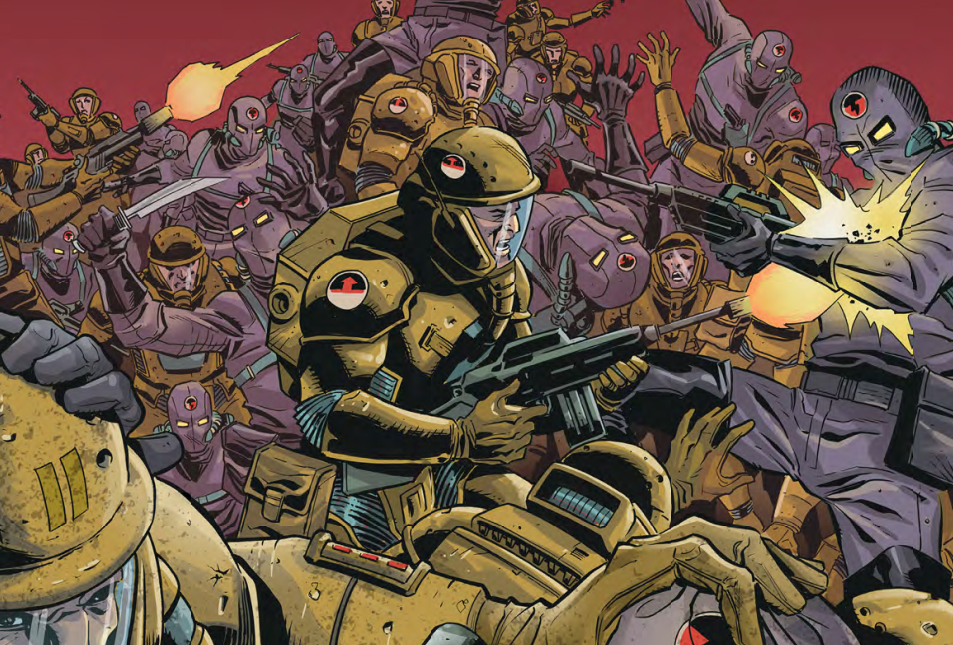
We’re at war in the Oubliette, as Dredd and his newfound Sov pals (again, the enemy of my enemy etc etc) are up on the level where all the weaponry in this nightmare place are held. Unfortunately, all those weapons are held by the combined might of the Norts and the Southers, who are too busy fighting each other to do anything more. And yes, it’s the same Norts and Southers that fight their never-ending war in Rogue Trooper‘s universe (and here in the Oubliette, with it’s nothing ever dies for long rule, it’s really the never-ending war). How did they get to the Oubliette? Well, maybe we’ll find out, maybe we won’t.
Right now though, it’s all about Dredd and the Sovs allying themselves with the Norts, killing as many Southers as they can. Again, Niemand and Cornwell going all in on this one, Dredd with a singular purpose, just wanting to get back to his city, doing whatever it takes to get there. A simple march ever onwards, a chance for an action Dredd, doing what Dredd does …

This is just pure escapist Dredd, a love letter to Dredds of the past. Give him a thing to do, set him off, sit back and enjoy the mayhem. Niemand’s seemingly not got any grand scheme here, no major Dreddverse-changing moments — well, not yet anyway, but never say never. Simply put, it’s a great mega Dredd, doing just what these mega epics have always done.

Brink Book 7: The Call Of The Void — Part 22 — By Dan Abnett and INJ Culbard, letters by Simon Bowland
Oh boy, oh boy, oh boy … Brink really is the gift that just keeps on giving, isn’t it? That’s a rhetorical question. Of course you’re entitled to your opinion; it’s just that on this one, if you don’t ‘get’ Brink, you’re just reading it wrong. As I continue to tell you, it’s not just one of my favourite 2000 AD strips of the last decade, not one of my favourite 2000 AD strips since the comic started, but one of my favourite comics of all time. I really think it’s that good. And if you’re in any doubt, picking up the very first collection should convince you. In fact, I’d bet you simply wouldn’t be able to resist picking up all the collections after that — it genuinely is that good.
So, here we are, everyone on LunaHab, investigating the mysterious Mercury Event where the planet and its surrounding Habs — the off-Earth habitats where what’s left of humanity now resides throughout the solar system — went ‘dark’.
It’s been an underlying idea of Brink that this was all to do with the Sect activity infecting the Habs, something HabSec officer Bridget (Bridge) Kurtis has been investigating right from the start. Except in ‘The Call of the Void’, we’ve suddenly got an option B: that the Sect activity and the Mercury Event are actually the result of some sort of black ops activity by the Interhab Intelligence Agency (IAA), a gov agency continually butting heads with HabSec — a theory Bridge has put forward here.
And then, last episode, we had this…

Oh yes, that’s Cutwell, Chief of Mission Security, HabSec Division Special Taskforce, admitting to being an IAA asset.
Cat amongst the pigeons indeed. Here, it’s the fallout, the interrogation, and the debrief from that moment. Four pages of Brink’s usual talking heads. Four pages of INJ Culbard’s usual brilliance in taking Dan Abnett’s plot and script, full of glorious drama, and giving it the visual drama that not only does it justice but adds so much extra to it, making every page a visual delight.
Cutwell’s been embedded in HabSec for seven years, but the tale she tells here seems convincing enough — talking of IAA’s staunch pro-corp power and anti-migration stance, but also of her department’s fear that IAA has been compromised by Sect thinking, particularly the Tactical Solutions Section run by William Flagg, with Denny Readon reporting directly to him. That’s Reardon/Leedon who’s here on LunaHab right now, getting close to Bridge’s ally Castanada. Cutwell describes him as having a “psychopathic pursuit of the pro-big Corps agenda”. I don’t think she’s wrong. She also reckons Flagg’s section had something to do with the Mercury Event and its aftermath. Although, much to Bridge’s surprise, Cutwell puts forward the theory that even IAA doesn’t know what the hell happened there.

Right now, Bridge finally has a visual on Reardon/Leedon, which she immediately transmits to Reggie Castanada … but will that be too late?
Again, as always, seeing how Abnett and Culbard just drip-feed the info, ramping up the tension all the way through, giving us clues, hints, possibly red herrings along the way, is just a perfect illustration of how comics does this sort of intense visual drama like no other medium is just perfection in four pages. And as for the final page … well, that’s where we shift focus to Reggie getting the intel, and a final page reveal that makes you gasp.
Perfection. But hey, that’s nothing new.

The Fall Of Deadworld: Justice — Part 7 — By Kek-W and Dave Kendall, letters by Simon Bowland
Back to Deadworld now, in the days when it wasn’t, not quite yet, Deadworld. The whole thing with Deadworld is the grim inevitability of it all. We know that this planet will fall, we know the Dark Judges will rise, we know that all life will be extinguished, and we know that the bravery of those fighting against it all is just so futile. But that’s the point here. Yes, we may know the endpoint, but it’s the getting there that drives this one.
We’re leading to that endgame now, as the Dark Judges make their appearances. We’ve had Judge Fear, we’ve had Judge Death, and things look increasingly hopeless for the few brave enough to resist.
That includes young Jessica Childs and Judges Eastwood and Fairfax, allied not with the Sovs who took Mega-City One’s issues as an opportunity to invade. Childs is still hopeful, and it’s that hope that gives the Fall of Deadworld its poignancy … sure, we know the fall is inevitable, but you can’t help but share the hope, vain hope as we know, when Childs says things like this:

They’re pinning their hopes on nukes now, last hopes perhaps. Like I say, between them, Kek-W and Kendall have created a post-apocalyptic tale of inevitability and forlorn hopes that just gets better and better as we get closer to the end, with Kendall’s artwork bringing the required grime to it all, the artwork suitably nasty for this dark, dark tale of a fall that just can’t be avoided.

Nightmare New York — Book Two — Part 6 — By Kek-W and David Roach, colours by Peter Doherty, letters by Annie Parkhouse
Mixing things up now, after the sci-fi of what’s gone before, we get a historical fantasy from Kek-W and David Roach, taking over on art duties after the sad passing of series co-creator John M Burns, and doing a damn fine job of it as well.
Young Lil has discovered both her special supernatural powers and her family’s connection with dark forces. She’s found sanctuary in a bakery, itself no stranger to ancient magicks, and made friends with young firedrake Mose. Both of them are now in big trouble in Professor Praetorian’s Dime Museum. Again, intriguingly, they’ve found mention of Wyrms, referencing Kek-W and Burns’s The Order strip. This is in addition to the reveal a while back that Older Lil has been meeting with Inspector Mucha from Kek-W and Roach’s Saphir … all promising that there’s a whole Kek-W universe developing here.
Anyway, back to the now, and Lil and Mose trapped, and Lil getting a glimpse into the past… memories of overheard conversations on a staircase …

Again, the family ties run all the way through Nightmare New York, revealed slowly to Lil, who’s gradually piecing things together, not altogether welcome revelations about her mother coming through.
Here in the Professor’s Museum, she and Mose discover the horrors paraded as a freakshow, revealing dark secrets behind the carnival barker’s facade.
There’s a bigger picture evolving in Nightmare New York, one where every episode reveals just that little bit more, with Kek-W and Roach playing it all out and giving us just enough each episode to make the next episode essential.

Anderson Psi Division: The Void — Part 6 — Final Part — By Liam Johnson and Rob Richardson, letters by Rob Steen
Okay then, we’re here at the finale of ‘The Void’, the Anderson tale playing out adjacent to the main Judge Dredd tale of ‘The Oubliette’/’The Black Tower’, the BIG Dredd mega-epic happening right now.
Here, it’s been all about Anderson as one of the few active Psi-Judges left active post the Black Tower’s incursion into Mega-City One, doing what she can to get to the bottom of what the hell is going on.

So it’s Anderson against one of the manifestations of The Shift, with Johnson doing the difficult task of telling a tale wherein he’s not able to really say or do anything that directly impinges upon the bigger tale. Yet, within those constraints, he’s done a fine job. Of course, as I keep saying, it’s all been elevated by Richardson’s artwork and colours, always stylish and dramatic, always something I really love to see. All I’d like now is to see Richardson be given a major series to really let loose. Maybe soon. He’s too good a talent not to get that big break soon.

