
Characterization In The Buffyverse — ‘Buffy The Vampire Slayer’ Season 5, Episode 22
by Benjamin Hall
This is part of a bi-weekly series concerning the characterization of Buffyverse characters. Arguably the best place to begin reading this series is at the beginning, but that is up to each reader. As a reminder this column will cover major and some minor characters from the shows Buffy The Vampire Slayer (1997-2003) and Angel (1999-2004). Other Buffyverse media, such as the graphic novel Spike: Into The Light (2014) are not pertinent to this series. Also there will be no referencing real world events that have direct relation to either show in this bi-weekly series. Although this series does reference things that have no direct relation to the show in order to examine things such as metaphors and literary analogues.

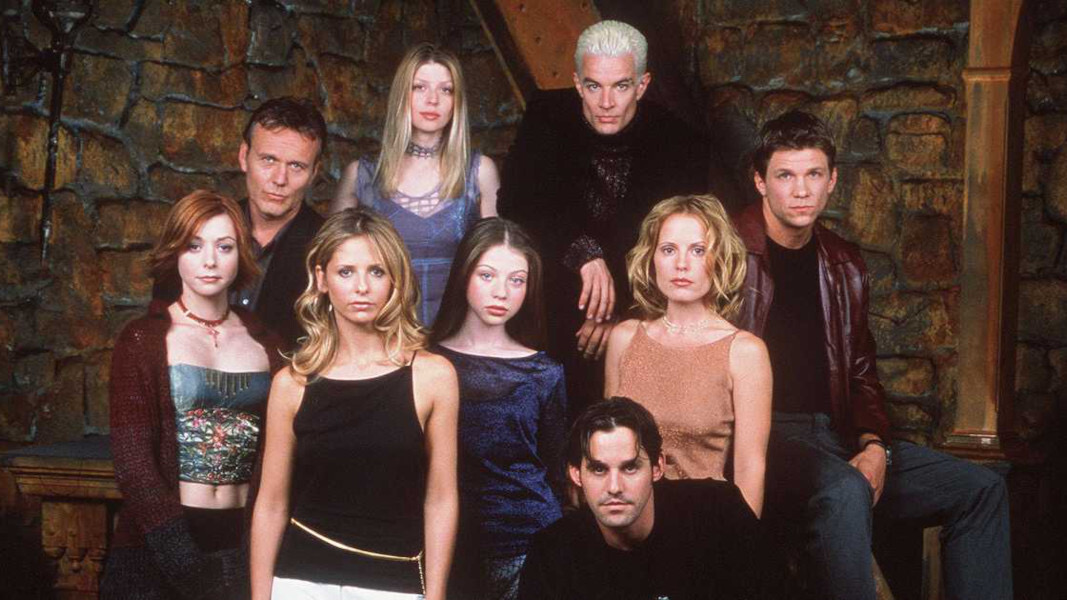
This week: Buffy Summers (Sarah Michelle Gellar) faces off with Glory (Clare Kramer). Meanwhile, Spike (James Marsters) attempts to fulfill a promise.
(Warning of spoilers from this point on!)
(Trigger warning for talk of suicide)
Dawn Summers (Michelle Trachtenberg) primarily is the damsel-in-distress while looking like a princess in a tower because of her costume and situation. She also negatively affects Spike’s attempt to rescue her by helping alert Doc (Joel Grey) to the vampire’s presence.
Buffy is obviously still mourning her mother when she tells an unknowing Giles she has a death wish. When talking to Spike in her home about the threat level Glory poses, though, she arguably tells him and he apparently understands. Realizing her own death will save Dawn and the world occurs after the death wish surfaces. Thus, no matter if it is her or Dawn that dies to close the portal, she apparently is going to commit suicide. As for Buffy inviting Spike back into her house, it is a way of demonstrating she trusts him while getting him to make his promise. In a way, one can argue that Buffy not sending a message asking for Angel (David Boreanaz) to watch over Dawn displays that the elder Summers trusts Spike more
Benjamin Wilkinson (Charlie Weber) is unwilling to accept death and, to some extent, his connection to Glory until he has no choice. He also fails to see himself as evil despite his actions throughout his life. As for Glory, she is overconfident throughout the majority of this episode. Although both play a factor in Buffy dying, they do not fully create this result. The final words Ben says to Glory could imply that they are one-and-the-same as well as two separate entities.
Tara Maclay (Amber Benson) gets little to do except be a conduit to the spell that heals her and weakens Glory. Still, she sees via her ability to read auras that Rupert Giles (Anthony Stewart Head) is planning to murder either Dawn or Ben depending on what will save the world.
Willow Rosenberg (Alyson Hannigan) comes up with a very efficient spell to fix Tara’s mind, yet we never see her working on it. This, and the telepathy, suggests Willow is becoming less reliant on learning spellwork and more able to make her own.
Spike expressing his belief that Buffy will not at any point feel adoration for him exhibits his growth as character. It also makes his promise to protect Dawn even more selfless since he expects nothing in return.
Xander Harris’s (Nicholas Brendon) marriage proposal to Anya (Emma Caulfield Ford) is obviously occurring for all the reasons she states (Season 6, Episode 16, “Hell’s Bells”). His belief that the world will not end is why he is asking for her hand — which is also is true, at least during the proposal. When it comes to brainstorming on how to defeat Glory, his suggestion to kill Ben is useful. The very idea is something Giles does not even think of beforehand. By putting the thought forward, Xander saves the Scoobies and a lot of random people from Glory’s wrath in the wake of Buffy’s death. Additionally, Xander distracting Glory with a wrecking ball helps Buffy in the fight. Seemingly, he is taking inspiration from Anya and Buffy via their respective previous suggestion and tactic (Season 5, Episode 20, “Spiral”).
Giles seeing Buffy as a hero and not a killer is a point of view. It is true to an extent, but his statement fails when one considers what a Slayer often has to do. Also, the zookeeper, Dr. Weirick, dies because of Buffy’s actions (Season 1, Episode 6, “The Pack”). So humans are a part of her kill count despite her attempts not to do so. Ultimately, he comes around to his way of thinking because of his paternal feelings for Buffy and partly having to detach himself in order to kill Ben.
Anya may come across to some viewers as a little out of character when she is apparently enthusiastic about brainstorming how to defeat Glory. Yet, if one considers that she flees the late Mayor’s ascension out of fear (Season 3, Episode 21, “Graduation Day, Part One”), one can easily perceive the brainstorming as a coping mechanism. Also, despite coming up with useful suggestions that will be effective against Glory, Anya fails to bring up wishing. This is probably because the episode happens to occur as a series finale before becoming just a seasonal one. However, making a wish via a vengeance demon is something she should be suggesting for multiple reasons, including the fact that it is her former power.
Doc may come off a bit like a deus ex machina since he only gets the prior episode (Season 5, Episode 21 “The Weight of the World”) to set-up that he worships Glory and is a threat. Arguably, the difference between his ability to defeat Spike and lose to Buffy is a case of Doc having plot armor only in the first fight.
Murk (Todd Duffy), Minion #1 (Craig Zimmerman), plus the other minions and mentally unwell humans make up Glory’s defensive force. Despite being a small army, they are really just cannon fodder to fill the screen and create a sense that the battle is epic rather than mostly just against Glory and Doc.
The teen (Josh Jacobson) and the vampire (Tom Kiesche) service the opening as reminders of the small scale premise that Buffy The Vampire Slayer began with. Thus, these two are very much stock characters in every way imaginable.
This finale uses the characters to about the fullest the run-time allows. Yet, by doing so, there is a compression of the story just so that this can happen, and this in turn rushes the character moments.