
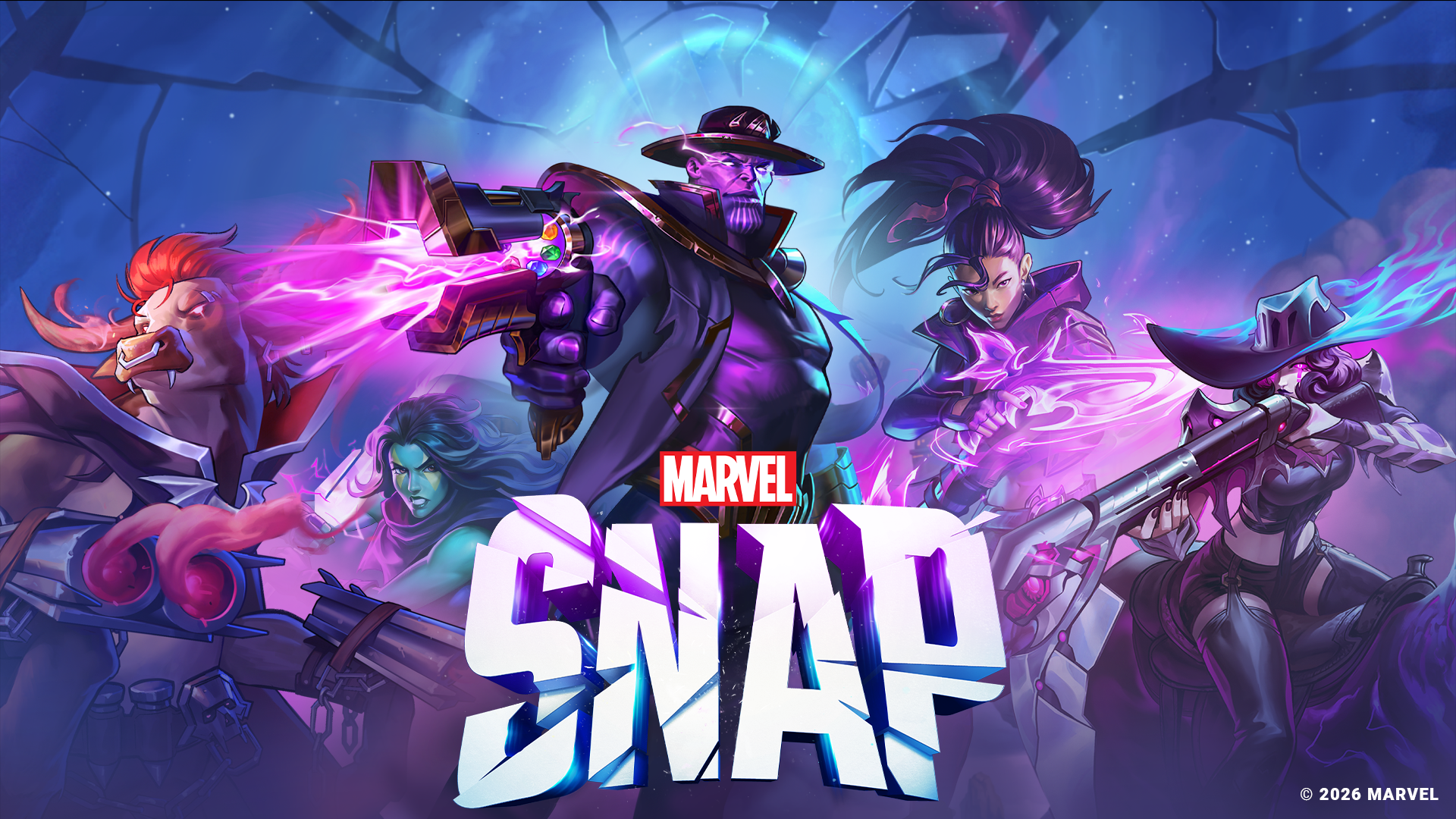
Snap Into Marvel: The Comic Book Origins Of ‘Fractured Frontier’
by Austin Gorton
Sorry, that title is misleading. Because the answer is, there is no comic book origin for this season’s “Fractured Frontier” theme.
After mixing new-to-the game character with original-to-the-game versions of characters in previous seasons (including the beach season earlier this summer and the “Origins of Apocalypse” season before that), “Fractured Frontier” is the first season of Marvel Snap in which all the cards are original to the game.
That means they are (with one exception) all characters who are already in the game, reskinned with new abilities built around a narrative that isn’t inspired by any comic book stories. The one exception is Red Wolf, a relatively minor Marvel character who has yet to appear in the game. But of course, not in his “Fractured Frontier” appearance.
Generally speaking, I haven’t minded the Snap developers’ penchant for revisiting existing characters in new versions, even ones they’ve made up (like a bunch of the Horsemen) particularly as the number of cards released per season has climbed to stratospheric numbers. This ensures new characters getting added to the game.

This season, however, feels like it’s taking the concept a little too far. There are so many notable comics characters who haven’t made it into the game, it feels like a waste to continue to hold them back in favor of more cards featuring characters already in the game. Even if the developers wanted to do a Western-themed season and/or introduce a new version of Thanos where he “shoots” the Infinity Stones to varied ends, Marvel has a plethora of existing Western characters they could have tapped into.
Why not give Two-Gun Kid, Kid Colt Outlaw, or the Phantom Rider cards with the same abilities as the Fractured Frontier versions of Psylocke, Jane Foster and Doctor Octopus?
At any rate, rather than write about nothing this month, I’ll take this opportunity to offer some background not on the Fractured Frontier versions of the character — because, again, no such versions exist in comics — but on the “main” comic book counterparts of this season’s cards, since they’ve all been in the game for longer than I’ve been writing this column.

Thanos: Making his first appearance in a random Jim Starlin-helmed issue of Iron Man in 1972 (Iron Man #55, which I can tell you from personal experience makes assembling a complete run of Iron Man annoyingly expensive due to an issue whose expense has little to do with Iron Man), lover of death Thanos would arguably serve as Starlin’s signature villain for decades, despite being killed off in 1977 and only returning in 1990 for his signature story, Infinity Gauntlet (as well as its sequel miniseries).
Though certainly one of Marvel’s “Big Bads” thereafter, the character’s profile was never higher than when he served as the central villain of the first three phases of the Marvel Cinematic Universe. The role of the Infinity stones in both those films and Infinity Gauntlet drive the character’s Marvel Snap abilities, both OG Thanos and this new Western-themed one.
Jane Foster: Debuting in 1962’s Journey into Mystery #84, Jane Foster began life as a character as one of the civilian love interests of a book’s central hero, a common archetype at the time. While Jane would, over time, gain significant nuance and depth of character beyond that archetype, her biggest glow-up came in 2014’s Thor (vol. 4) #1, which introduced a new version of Thor who would shortly be revealed to be Jane; that is the version of the character to which Marvel Snap looked for inspiration.
Rather than riffing on her existing card’s “summon the hammers” ability, the new Fractured Frontier version of Jane Foster is instead leaning on the hammer Mjolnir’s traditional limitation of only being wielded by those determined to be worthy of it for its ability.
Psylocke: A stalwart member of the X-Men since the mid 1980s, Psylocke is also one of comics most delightfully-complicated characters in terms of her history. First appearing as Betsy Braddock, sister of Captain Britain, back in 1976’s Captain Britain #8 (part of Marvel’s UK imprint), she made her US debut and received the name Psylocke in New Mutants Annual #2 before joining the X-Men shortly thereafter. In 1989, the character underwent a transformation at the hands of Chris Claremont and Jim Lee from a Caucasian Brit to an Asian ninja; intended to be a brief, story-long transformation, the iconic “bathing suit” costume and overall design of the character under superhot artist Lee’s pen led to that version of the character sticking around.
Eventually, over the course of many retcons and re-retcons, it was established that British Psylocke didn’t transform but rather had her mind swapped (and merged a bit) with a ninja assassin named Kwannon. Ultimately, both characters’ mind ended up back in their original forms, with Betsy serving as Captain Britain for a time while Kwannon remains with the X-Men.
Marvel Snap has never made it terribly clear if the Psylocke in the game is meant to be the current Kwannon-version or the older Betsy-in-Kwannon’s body version, though it’s most likely the latter (and ultimately probably doesn’t from a gameplay perspective, but if they want to keep doing new versions of existing cards, I wouldn’t mind of “Betsy Braddock: Psylocke” card in her old armor or a version of her as Captain Britain, nor a dedicated Kwannon card). At any rate, her Fractured Frontier version seems like a case of desired effect getting added to a character, vs. something tied particularly to the character’s pre-existing card or comic book narrative.
Doctor Octopus: The delightfully-named Otto Octavius debuted in Amazing Spider-Man #3 (July 1963) and quickly claimed the crown of the newly-minted Spider-Man’s toughest foe. Though others, like Green Goblin and Venom, would challenge Doc Ock’s supremacy, he has remained a steadfast member of Spidey’s Rogues Gallery ever since, helped in part by the fantastic visual of his four robotic arms.
A particular feather in his villainous cap came via a late 2012 story which saw a dying Ock swap minds with Spider-Man, allowing him to headline a thirty-three issue Superior Spider-Man series starting in 2013 in which Ock, in Spider-Man’s body, set out to prove he could be a superior Spider-Man. In Marvel Snap, Doctor Octopus’ original card is built around the idea of his arms reaching out and grabbing something (ie a card from your opponent’s hand). That’s more or less riffed on here, with Fractured Frontier Doctor Octopus moving cards around in your own hand instead.
Red Wolf: The only new character to enter the game as part of this season (albeit in an alternate form that doesn’t appear in any comics), Red Wolf is one of the first Native American superheroes introduced by Marvel, debuting in Avengers #80 (Sept. 1970). Over time, the Red Wolf mantle would be given to multiple characters across different eras, including multiple “present day” and “Old West” versions of the character. Often accompanied by a wolf named Lobo, Red Wolf unfortunately has fairly generic powers and/or skills typical of Indigenous characters in comics, including superhuman strength and senses, enhanced fighting abilities, skills at hunting and tracking, etc. As with Psylocke, Red Wolf’s Snap ability seems like a fairly random association.
Death: Well, Death has always been around, right? But at least in terms of the Marvel Comics personification of Death, she (that version of the character typically presents as female) first appeared in Captain Marvel #26 (June 1973). She would appear periodically off and on throughout the years, often in stories alongside the personifications of other cosmic/primal forces/concepts, like her twin Oblivion or brother Eternity. Perhaps most famously, she served as the primary motivator for Thanos’ actions in Infinity Gauntlet; as opposed to his MCU counterpart’s obsession with balance, comic book Thanos wiped out half the life in the universe to prove his love for Death. The Fractured Frontier version of the character has an ability that would be just as appropriate for the character’s “main” card, resurrecting destroyed cards instead of having the cost reduced by each death.
Hellcow: AKA Bessie, Hellcow is a vampire camp. Debuting in the pages of Giant-Size Man-Thing #5 (1975) at the height of Marvel’s 70s horror boom in a story featuring the satirical Howard the Duck, Hellcow seemingly died in her first appearance. But thanks to vampire logic, she was resurrected in a 2011 story starring the also-satirical Deadpool, and has lingered on the fringes of the Marvel Universe (usually in Deadpool stories) since. Once a staple of the early Discard meta, the Fractured Frontier version of the character recasts her as an Affliction and Destroy combo, though “taking power from other cards” is more in keeping with her vampire nature than her original Discard ability.
Red Hulk: Like Jane Foster, Red Hulk’s alter ego dates back to the earliest days of Marvel. General Thunderbolt Ross debuted right alongside the Hulk in Incredible Hulk #1 (May 1962) and was established right from the get-go as one of the Hulk’s central antagonist, leading the military charge against the Hulk while stymieing the efforts of Bruce Banner to romance Ross’ daughter Betty. So it went for decades, until a new, red, Hulk debuted in Hulk (vol. 3) #1 (Jan 2008); while his identity was initially a secret, in a few years’ time it would be revealed that Red Hulk was Ross, having been transformed into a Hulk by the criminal organizations AIM and Intelligencia, in order to better battle the Hulk.
The Fractured Frontier version is interesting in that it seems to be the one card with a notable disadvantage in not being played when it’s drawn (ie on “Quickdraw”). When it is played on Quickdraw, it mimics the original Red Hulk’s “gain more power based on the opponent’s actions” schtick.


