
Talking With Doug Wagner And Daniel Hillyard About Their New Graphic Novel ‘I Love Apocalyptic Zombie Misfits’
by Olly MacNamee
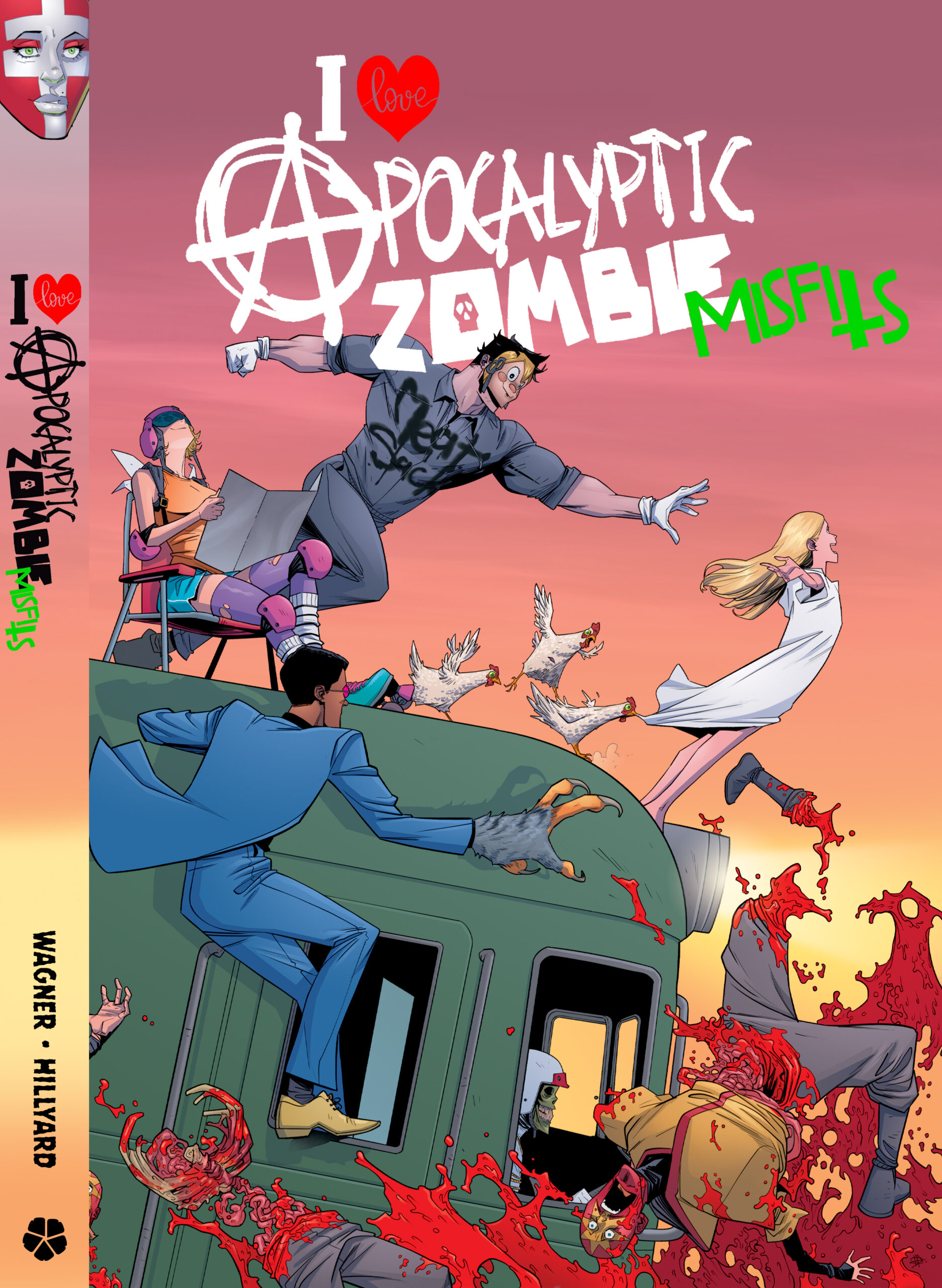
Two creators who seem to love comics and their collaborations, especially if they include serial killers, are writer Doug Wagner and artist Daniel Hillyard. And in their latest collaboration, on the new graphic novel I Love Apocalyptic Zombie Misfits, crowdfunding on Kickstarter now, there are plenty of killers. And murder chickens. A tour-de-force of dark humour, the coming of the apocalypse, and at the heart of it a fun character-driven odyssey across the backwaters of America, fighting enemies and more along the way. Anyway, this new release was enough of an excuse to interview them once again. So, let’s get stuck in and start with those murder chickens and take it from there, shall we?

Olly MacNamee: So, erm … murder chickens?
Wagner: I can’t help but laugh every time this comes up. The murder chickens actually came from a Dungeons & Dragons campaign I was playing with some friends. I was playing a character who could talk to animals, and at one point, I rescued a flock of chickens from being slaughtered. In return, they swore a life oath to my character and became my loyal companions.
Somewhere along the way, those loyal companions evolved into a full-blown army of murder chickens, and I absolutely loved them. I told a good friend about it afterwards because I couldn’t stop laughing, and he said, “You have to put those in a comic.”
Turns out he was right.
Now they’re loose in I Love Apocalyptic Zombie Misfits, and somehow, they’ve become fan favorites. Honestly, they’re a pretty good introduction to the book itself. AZM is completely comfortable embracing the ridiculous, but it always treats its characters seriously. Even the murder chickens end up having personalities, relationships, and moments that readers genuinely care about. That’s the balancing act Daniel and I were chasing from page one.
MacNamee: Now, having read I Love Apocalyptic Zombie Misfits, it feels like a story on an epic scale. An odyssey through the hinterlands of America, with plenty of freaks, creeps and monsters crossing our heroes’ paths along the way. How did such a huge story come about? And how do you both approach such a Herculean task?
Wagner: From the very beginning, I knew I wanted this book to feel like one long road trip. A chaotically insane road trip, but a road trip nonetheless. I wanted readers to feel like they’d climbed into the truck with Cecil, Pavla, Yoel, Mosi, Tuck, and the gang and experienced every bizarre mile right alongside them. That meant the story couldn’t be rushed. Every stop along the way had to introduce another strange corner of this world, another unforgettable character, or another emotional beat that made the journey feel worth taking. I wanted readers to get invested not just in the chaos, but in the journey.
Honestly, for me it never felt like a Herculean task. I’m not sure you fully understand the depth of my daydreaming. (Laughs.) When a new story gets its hooks into me, I become completely obsessed. I’ll spend hours just living in that world, imagining scenes, conversations, twists, and constantly asking myself, “What happens next?” I genuinely love that part of the process. AZM completely took over my brain. I spent weeks thinking about it, and during the twelve-hour drive home from San Diego Comic-Con a couple of years ago, I worked out almost the entire story in my head. By the time I pulled into my driveway, I knew who these characters were, where they were going, and how the journey ended. It made twelve hours disappear.
Hillyard: For me, from a visual standpoint, I wanted the group to feel a bit like a punk band going on some insane and chaotic tour. I wouldn’t say that I have a visual in mind when starting exactly, but more of a feeling that I want to convey. It’s hard to describe, but it’s almost like I’m making sound effects while sitting at the desk doodling until the images match the sounds coming out of my mouth. From there I might have a few goals in mind, things I want to improve on from our last book or techniques that I want to explore, but other than that I mostly go in blind. Doug and I talk a lot about the story and characters before jumping in fully, so I have an idea of where we’re headed, but other than that rough image of the story in my mind I feel like I’m experiencing everything alongside the characters. I think that way Doug and I get to live in the world moment to moment as we move through the story scene by scene.
MacNamee: As for the eponymous zombies, you have a very unusual and original take on the undead, mixing conventional reanimation tropes with supernatural powers. X-Men meets The Walking Dead, if you will. The Uncanny Z-Men, maybe? Can you explain the origins of this fresh new take on zombies? And how much, Daniel, did you have a hand in creating such an imaginative array of characters?
Wagner: That’s actually a tough question because I never sat down and thought, “I’m going to reinvent zombies.” In fact, the title came first. It literally had the word “zombies” in it, so I figured I’d better have some zombies.
What I really set out to create was a group of supernatural misfits caught in the middle of a war between Heaven and Hell. Once I had that premise, the characters started revealing themselves one by one. Cecil came from wanting to write a serial killer unlike any I’d written before. Then I happened across a short film about reincarnation, and suddenly those ideas collided. Once Cecil existed, Yoel’s origin immediately clicked into place.
That’s honestly how I write. I wish I could tell you I have some giant master plan from day one, but I don’t. Most of my stories are discovered rather than designed. Ideas find me in little pieces — a road sign, a newspaper article, a random reel online, a game of Dungeons & Dragons — and eventually those pieces start connecting until the world feels real enough that I can finally write it.
Hillyard: Uncanny Z-Men; love it. When it comes to figuring out how these characters look, it’s more like a conversation with pictures. Doug and I have a pretty good back and forth as we start putting it all together. Sometimes I’ll have an idea for a design that will immediately land; other times Doug will know exactly how they should look, and other times we find them together. Take Cecil, for example; I originally had him like some mix of the Punisher and the Terminator from [the original film]. But stepping to the side of that and adding in a little Mickey Mouse (yes, you did read that right), we ended up with the giant murder Frankenstein you see today.
MacNamee: With this being set very specifically in rural America, and with no mention of what year it is even set in, the whole saga feels akin to The Hills Have Eyes, or The Texas Chainsaw Massacre. America’s a big place, but this seems to be a very different America than we’re used to. Am I right in thinking the solely rural setting was designed to give readers an off-kilter vibe to proceedings? It does feel like the apocalypse could already have happened.
Wagner: Remember when I said I figured out most of the story on the drive home from SDCC? Well … I kind of left out the fact that the drive to San Diego is where I discovered the missing piece.
I’d never driven from Salt Lake City to San Diego before. Once you get past Las Vegas, you’re suddenly surrounded by miles and miles of the Mojave and those endless stretches of desert. Strange rock formations. Tiny forgotten towns. Abandoned buildings. Places where you could drive for what feels like forever without seeing another soul. It was unlike anything I’d experienced before.
About two hours into that drive, it hit me. I wasn’t just driving through the Southwest anymore — I was driving through I Love Apocalyptic Zombie Misfits. I knew immediately this was where the story belonged.
So, when you say the setting gives the book an off-kilter feeling … you’re absolutely right. That’s exactly how I felt on that drive. There’s something about those wide-open, isolated landscapes that makes you feel like absolutely anything could be hiding over the next hill. That feeling became the DNA of the entire book.
MacNamee: It also feels like the classic Universal Monsters film of the thirties are something of an inspiration too. You have your Frankenstein monster as our lead, Cecil, and Tuck, their driver, certainly seems to be channelling The Mummy. What other inspirations, other than those listed so far, have been working on both your minds when writing and designing this graphic novel? I do know you both love your horror.
Wagner: Oh, jeez … there are so many. I’m not even sure I could name them all. Horror has been part of my DNA for as long as I can remember, so inspiration came from all over the place.
Just off the top of my head, I would of course have to throw in the Classic Universal Monster films. Those are always part of any story I do. Then there’s Friday the 13th, Carrie, The Ring, Christine, Nosferatu, The Shining, The Keep, Legion, and Skinwalker Ranch. Some influenced the atmosphere, some inspired individual characters, and others simply reminded me why I fell in love with horror in the first place.
… And then there’s Bubble Boy.
I know! That one tends to catch people off guard. But believe it or not, Bubble Boy’s cross-country road trip, oddball characters, found-family heart, and bizarre roadside encounters all helped convince me that AZM needed to be a road trip story. That’s kind of the magic of creativity. Inspiration doesn’t care what genre it comes from. It just waits for the right story to wander into.
Hillyard: Olly, you know us well. Some things you just can’t help but be inspired by. You said it yourself: how parts of the story or characters give you a feeling of this or that horror movie. Just as horror is a part of Doug’s DNA, it’s a part of mine as well; I think that is part of the shorthand we have. Using a reference for a character or channelling a type of atmosphere is something I think we lean into pretty well and something that I think other fans of horror enjoy seeing from us. It’s almost like a game seeing how niche we can get with some of them.
I did not expect Bubble Boy, but hey, I threw out Mickey Mouse earlier so …
MacNamee: As this is a Kickstarter, it would be silly of me not to ask what kind of rewards can fans back?
Wagner: We really tried to build the kind of campaign we’d want to back ourselves. Obviously, there’s the prestige hardcover graphic novel, but we didn’t want to stop there. We also created a companion book packed with scripts, layouts, concept art, and behind-the-scenes material so readers can see how the book came together from the very first idea to the finished pages.
Then there’s the slipcase edition for collectors, exclusive covers, and probably my favorite reward of all … the Murder Chickens card game. What started as a joke by Hank Kanalz at Clover Press somehow escaped into the real world, and now people can actually play it.
We didn’t want the campaign to feel like you were simply buying a book. We wanted it to feel like you were joining us on this crazy adventure.
Hillyard: I admit I never knew I wanted to have a card game of Murder Chickens until we started making it, and now it’s one of the things I can’t wait to get my hands on. I hope that people will enjoy the added extras that can come with the book. I will say the behind-the-scenes featurette kid in me is also super excited about the companion book.
MacNamee: One last question. With both of you being highly prolific at the moment, where did you even find the time to create this original graphic novel? Has Clover Press Publisher Hank Kanalz kept you locked up night and day with only basic food and water to keep you going?
Wagner: I’m not really sure how to answer this one. The truth is, we both love making comics. We keep our heads down and create new pages every day except Saturday. I don’t know if that’s truly prolific or not, but it’s what Daniel and I love to do.
The truth is creators always find time for the projects they’re most passionate about. Daniel and I had wanted to build something this ambitious together for years, so every time we finished another assignment, we’d ask each other if this was that time. Well, this was that time. It wasn’t something we had to force ourselves to work on. It was the project we couldn’t wait to do.
As for Hank … I’ll neither confirm nor deny the existence of a Clover Press basement. But I can tell you the Pop-Tarts and Sno Balls were surprisingly good.
Hillyard: Hank does make a good cheeseburger, but the handcuffs around the radiator can get a little hot in the winter.
MacNamee: Have devoured this graphic novel like a zombie devours brains, I would wish you all the best of luck, but I don’t think you’ll need it. It really is a fun, freaky and very cool graphic novel you both have on your hands.
Wagner: Thank you, Olly. As always, you’re amazing.
Hillyard: Thank you, dude!
You can check out the Kickstarter campaign for I Love Apocalyptic Zombie Misfits here now.

