
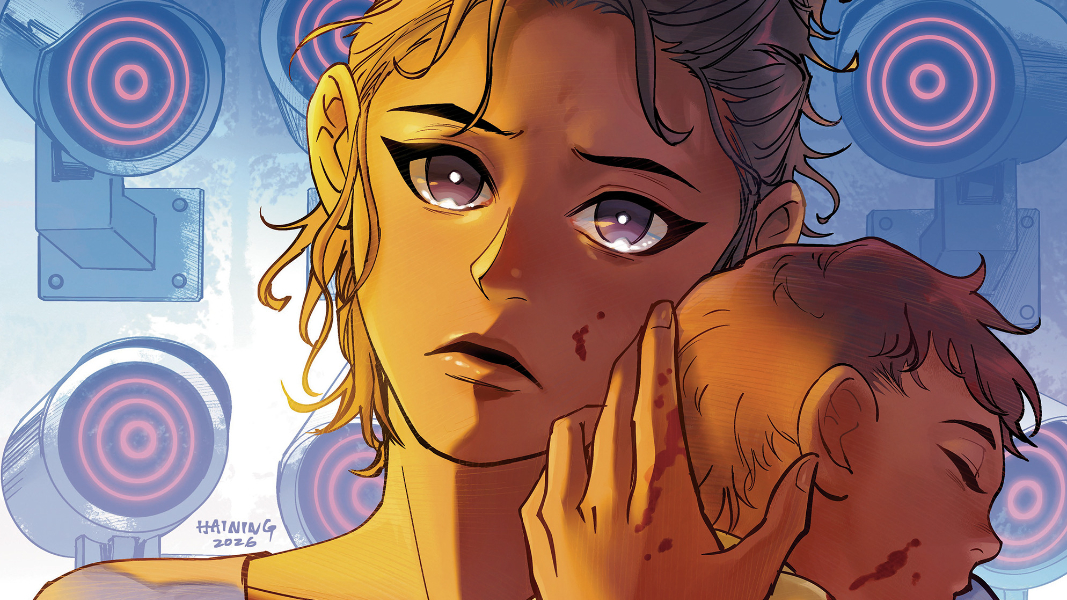
Behind Not So Closed Doors — Reviewing ‘Neighborhood Watch’ #4
by Scott Redmond
Overview
An all too obvious suspect puts their name fully onto the mystery as the hard life of Jill-Cassie is further explored in the fourth issue of ‘Neighborhood Watch.’ Far too relevant and topical discussions and traumas are explored within this story, as characters must face the harsh realities that they see and those that were hidden.
Overall
9/10Reality is a harsh thing, especially when one’s private painful situation moves from isolated to something far more institutionally widespread. This psychological thriller takes a turn as a clearer picture is painted in regard to the attempted murder of Willow Haven and Open Arms leader Jill-Cassie.
Lore is dropped, tough subjects like police violence and domestic abuse are examined, and confrontations abound in Neighborhood Watch #4, the penultimate issue of this series from Sarah Gailey, Haining, Rebecca Nalty, and Jodie Troutman.
-Spoilers Follow-

I’ll begin this with a bit of a warning. If depictions and discussions of domestic violence are any sort of trigger, this is an issue to be careful with or skip over. What was heavily hinted at before becomes talked about reality within these pages.
Gailey does not shy away from the bruises that are left by domestic violence, and many other types of violence, that includes the mental and emotional alongside the seen physical bruises. Jill-Cassie has a story that is far too common, highlighted by the issue itself, as the wife of a police officer who unleashes their rage and power upon their spouse and often children. It, as predicted, wraps into the threads surrounding why Jill-Cassie’s daughter Aurora was hidden at Open Arms, why Jill-Cassie was coming back and forth, and why she was seemingly ready to make the leap to Open Arms.
Despite Jill-Cassie knowing what is happening is wrong, she finds mental ways to survive and — in a way — wave it off, as many victims and survivors end up doing. Only when Val, unknowingly, drops so many statistics on her about the prevalence of violence among cops, specifically male cops, does she begin to realize how bad her situation truly has become. Even her hidden relationship with Bianca makes more sense now as she found something better but had to keep it hidden out of fear but also a learned protective measure.

As usual, there is a lighter feeling to everything on the page, no matter the context, mixed with a purposeful heaviness. Haining’s artwork is so dense with detail and feeling that it wants to leap off the page and take on a life of it’s own. Every bit of emotional energy is tangible as character’s faces, bodies, and presence emote with ferocity. There is no mistaking how people feel in any given moment and that makes the overall narrative so much more powerful. We’re observers right in the middle of this whole predicament — both the past and the present segments — able to interact with everything to a degree.
There are numerous scenes that are characters having conversations, some of them tense, while others are informative. It would be easy for Haining to just have these be a lot of static shots where the dialogue bounces around. Instead we get something far better. There are panels that depict motions or actions over whole profile shots, such as abusive cop husband Erik gripping a wine glass tightly as it spills over his hand. Or a cell phone buzzing and displaying texts of warning that are going unheeded, or the big moment that we find out what actually is in shed number 5 that seems to confirm Jill-Cassie’s found file suggestions.
Bold bright colors swirl around the page in a way that compliments the lighter more natural tones that create the overall space aesthetic. It all blends naturally with the work that Haining is delivering, as Nalty matches it beat for beat while sprinkling in a unique seasoning of energy. These colorful tones shift both between moments but also between the two competing neighborhoods and their specific situational vibes. Additionally, these elements find a way to shift and enhance the mood and evoked emotional impact as the story becomes tenser and harder.

We have a lot of dialogue and information to sort through within this issue. That’s the territory that comes with issues where the lore and background need to be dispersed before the story reaches a conclusion. With practiced ease, Troutman makes sure it all spreads through the pages with parsed ease for simple reading and impact. She never loses the emotive capacity that the words must have innately, but instead enhances that as it resonates through the issue. Great lettering often goes “unseen” as it’s taken for granted, which is a quality which needs to be respected a lot more.
Like other visuals, it’s not the job of the lettering to be the star of the show, but to be a part of the star ensemble. Troutman handles that deftly and each portion of the lettering visual energy matches the rest of the issue, creating a perfect balance, with just a few modifications and switches to the various bits of lettering here or there.
Neighborhood Watch #4 is now available from BOOM! Studios.
