
‘Wizard Of Oz’ But Stranger: Reviewing Radiance’s ‘Malpertuis’
by Rachel Bellwoar
It’s one thing for Jan (Mathieu Carrière) to turn down his shipmates’ invite to join them, as they use their time in port to acquaint themselves with the locals. It’s another for those same shipmates not to seem to realise Jan’s from the area and wants to use his shore leave to find out what’s happened to his family. Singled out as a loner from the start, little does Jan realise that he’s being watched, and despite his determination to avoid Malpertuis, the home of his uncle, Cassavius (Orson Welles), it might not be his choice to stay away.

What is Harry Kümel‘s Malpertuis? Adapted from a novel by Jean Ray by screenwriter Jean Ferry, it’s definitely a vibe film. Radiance’s Blu-ray includes two cuts of the film – the much-discussed and disowned Cannes version, which was edited by Richard Marden in order to premiere at the festival and the version edited by Kümel a year later for the Flemish dub, which more closely adheres to his original vision but had to use some second-choice takes.
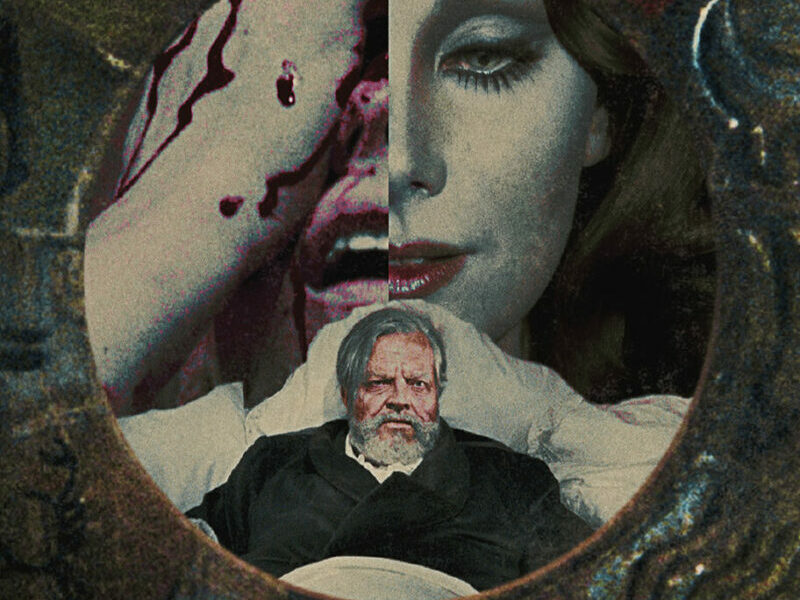
Immediately, the two films differ in how they approach the opening titles. Kümel’s begins with blood red text over images from Alice in Wonderland, and the comparison drawn by that choice fits. With its labyrinthian hallways and doors that open to strange rooms and art, Malpertuis is very much a Wonderland world, making Jan the film’s Alice. “Wizard of Oz but stranger” would be another way of describing Malpertuis. Like Dorothy’s trip to Oz, Jan’s arrival at Malpertuis is sudden and raises questions about whether he’s really there or if it’s all a dream. The film also has a number of actors (specifically Susan Hampshire) take on multiple roles, not unlike Dorothy’s family in the MGM movie.
Outside of an interview with film historian Jonathan Rigby, the majority of the bonus features on Radiance’s Blu-ray are with members of the cast and crew in archival documentaries or new content with the film’s director, Kümel. The commentary, for instance, is by Kümel and assistant director Francoise Levie (whose father was also one of the film’s producers, Pierre Levie).
A lot of attention is paid to Welles’ casting (and I’d be lying if I said his involvement in the film didn’t initially perk my interest, so mission accomplished), but if you’re watching this film solely for him, it’s going to be a disappointment. Cassavius only appears for a few scenes and in the director-approved version he’s dubbed, so it’s not even Welles’ voice. Lying in bed the whole time, actors have gotten Oscars with less screen time, but once Cassavius dies, his absence isn’t felt. He doesn’t haunt the rest of the movie as he should.
While plot is not Malpertuis’ strong suit, what plot exists revolves around Cassavius’ inheritance drama. Essentially, he wants Jan to take his place, but when that pitch falls on deaf ears, he designs it so that there are a bunch of people who could inherit his fortune, but in order to get it they have to stay in Malpertuis or forfeit their claim. Last person standing wins.
Now, given his earlier denouncements of the place, one might assume Jan would leave and not bother trying to inherit anything, but human psychology isn’t this movie’s strong point either.
Rather, the reason to watch Malpertuis (and I would highly recommend this movie) is for its surreal aesthetic. If you can get on this film’s wave length and not try to solve its probably unsolvable plot the visuals are simply out of this world in that deliberately stylized way (think Black Narcissus but more painterly).
One of my favorite anecdotes from Erik Martens’ 2005 documentary Malpertuis Archive is when cinematographer Gerry Fisher talks about a set painter who was responsible for a lot of the film’s optical illusions, like making a two-story staircase look much grander by painting a canvas. I tried to use IMDB to confirm the name Fisher was saying (it sounded like Viton or Ritan), but the man sounds like a genius.
Kümel’s cult vampire movie Daughters of Darkness is probably his more celebrated work, but I’d rank Malpertuis higher. Radiance has released a standard Blu-ray, but if you can still find the limited edition, it comes with an essay booklet. The writings include one from Maria J. Pérez Cuervo, which covers the film’s eye motif, and Willow Catelyn Maclay discussing Malpertuis as a post-war film (with an alarming reveal at the end of a director who’s been said to have liked the movie).
