
Characterization In The Buffyverse — ‘Angel’ Season 2, Episode 22
by Benjamin Hall
This is part of a bi-weekly series concerning the characterization of Buffyverse characters. Arguably the best place to begin reading this series is at the beginning, but that is up to each reader. As a reminder this column will cover major and some minor characters from the shows Buffy The Vampire Slayer (1997-2003) and Angel (1999-2004). Other Buffyverse media, such as the graphic novel Spike: Into The Light (2014) are not pertinent to this series. Also there will be no referencing real world events that have direct relation to either show in this bi-weekly series. Although this series does reference things that have no direct relation to the show in order to examine things such as metaphors and literary analogues.

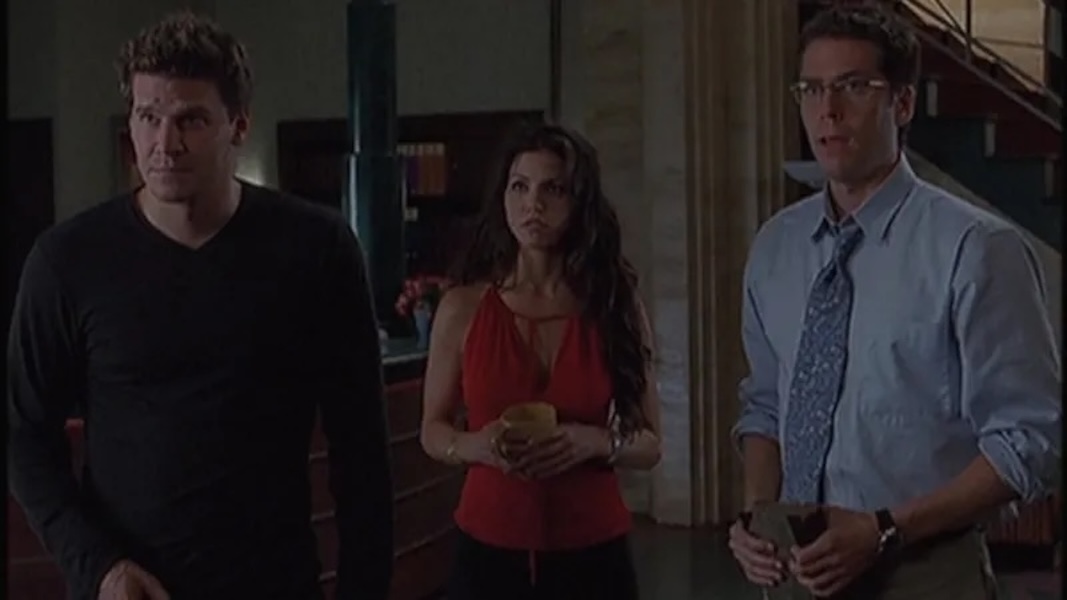
This week: Cordelia Chase (Charisma Carpenter), Lorne (Andy Hallett), and Fred Burkle (Amy Acker) are in dire need of help. Luckily, Angel (David Boreanaz), Wesley Wyndham-Pryce (Alexis Denisof), and Charles Gunn (J. August Richards) are acquiring assistance to rescue them.
(Warning of spoilers from this point on!)
(Trigger warning for mentions of slavery)
Angel appears to be a worse fighter in Pylea than on Earth. At least, this seems to be the case during his fight with Groosalugg (Mark Lutz). Whether or not it’s the way the different dimensional laws are affecting him extends to his fighting while in human form is unclear. What is clear: he seems melodramatic about the harm he is capable of in his bestial form versus his other personas, such as Angelus. One could even argue that his soul curse may be at play with making him feel guilty about the bestial form and the harm he commits while in it (Season 2, Episode 21, “Through the Looking Glass”). This guilt may also be the reason he comes back to human form mid-fight. Lastly, he continues to act extremely vain in a more obvious way than usual.
Lorne helps the rest of the protagonists by relaying some exposition. Yet, the majority of his role this week is as a comedic MacGuffin who talks to other characters.
Cordelia arguably does not have the amount of development in this season finale that one might expect for her. This lack of growth occurs despite her being a central figure in this season-ending story. Still, she is involved in actions related to the plot that are relatively separate from being a damsel-in-distress. An example: she makes Angel and Groosalugg realize they are both trying to help her. There is also the matter of her assisting Lorne’s detached head, which leads to the result of him later regaining his body. Unfortunately, these events occur because of plot requirements and prompting by others, such as Lorne, so she is, unfortunately, a puppet.
Wesley and Gunn are secondary players in this story. The duo primarily assist main players Cordelia, Angel, and Fred by helping lead a revolution of Pylea’s human rebels.
Fred brings comedy through her stereotypical insanity. Still, she is helpful in a variety of ways while displaying knowledge that suggests a brilliant mind.
Silas (Michael Phenicie) and Barshon (Andrew Parks) are demons and figurehead rulers of Pylea via their priesthood worshipping the Wolf, the Ram, and the Hart. They seem to represent a metaphor for theocracies and how that type of governing can mess with the minds of a populace.
Lorne’s nameless mother (Tom McCleister) allows for the housing of her helpless son during this time. Nevertheless, there is no love lost between the two and this results in Lorne’s homecoming seeming rather pointless.
Groosalugg acts as a witless tool for Silas and the rest of the demon priests. Luckily, being their living weapon is no longer his fate after he learns what they have in store for Cordelia and how they are using him.
Landok (Brody Hutzler) transports Lorne’s head to the latter’s family home, and thus he makes Angel’s group aware of Lorne being alive. Despite this action being good information for Angel’s group, it is arguably unnecessary.
The rebel leader (Adoni Maropis), rebel #1 (Danan Pere), and rebel #2 (Jamie McShane) are nameless humans who live in Pylea and are a part of the revolutionary forces. They exist to provide help to Angel Investigations, but also serve as a way to further develop Wesley’s leadership skills.
Marelda (Whitney Dylan) is a slave who serves Cordelia during her time as the leader-in-name only of Pylea. She assists Cordelia by giving the other woman her potato sack clothing, which allows Cordelia to sneak down to the mutilation room.
Markello (Alex Nesic) is both a slave of the demon priests and a spy assisting the rebels. His importance to the narrative is debatable since he could easily see replacement via a little more exposition or Marelda taking his place.
The captain (Lee Reherman) is a member of the Pylean imperial guard. Arguably, he is just an individual Angel fights and kills with little-to-no actual importance to the narrative.
Willow Rosenberg (Alyson Hannigan) appears as a bearer of bad news about Buffy Summers (Sarah Michelle Gellar) to Angel and Cordelia (Buffy The Vampire Slayer Season 5, Episode 22, “The Gift”). Her presence is a requirement since there is not enough runtime left in the episode.
The entirety of this episode works as a metaphor for revolution as well as the idea that one cannot go home again. In the case of the first metaphor, Angel Investigations leaving right after the revolution displays their collective lack of follow-through. Reconstruction is an idea that has yet to see completion after any revolution. The latter metaphor applies to both Lorne and Angel Investigations: both see unhappy homecomings. These two metaphors take up the narrative space that the characterization and character developments should occupy. For example, Lorne realizing Pylea is not his home could just occur through the easier route of self-reflection.