
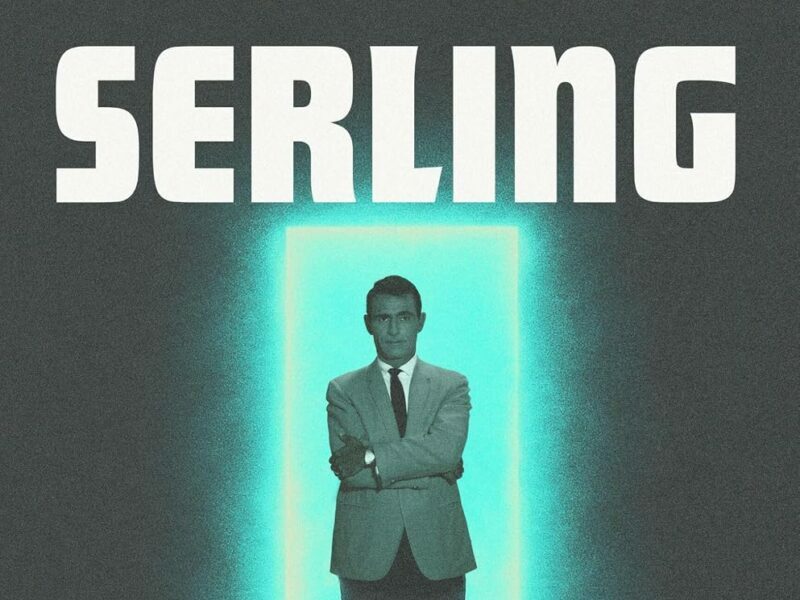
Beyond ‘The Twilight Zone’: An Interview With ‘Serling’ Author Alan Sepinwall
by Rachel Bellwoar
With movies, attention tends to be paid to directors, not screenwriters, but on television, writers are sometimes shown a little more love. In the case of Rod Serling, though, it wasn’t just that he was responsible for writing some of the greatest anthology episodes of all time, but that he would be appear on those programs as their host. Serling was a writer who people recognized, much in the same way that striving TV critics will be familiar with the name AlanSepinwall from his days working for HitFix, then Uproxx, Rolling Stone, and most recently his newsletter What’s Alan Watching? Sepinwall’s reviews have been a longtime inspiration, but Serling is his first biography, and it was a privilege to be able to ask him some questions about it:

Rachel Bellwoar: How has the experience of writing a biography been different from the other books you’ve done on specific shows (like The OC) or television as a whole?
Alan Sepinwall: I’ve never done anything like this before. I’m a critic by nature, and I’d like to think I’ve become a pretty good interviewer over the years. But this required a whole other set of muscles. I had to watch lots of TV episodes and teleplays and movies I’d never seen before (some of which I’d never even heard of before). I had to spend lots of time going through library archives, watching and reading and listening to old Serling interviews, ordering out-of-print books and magazines, etc. And that was on top of interviewing the few surviving people who knew Rod when he was alive, and then talking to all the fans of his work — both the famous ones like J.J. Abrams and Steven Spielberg, and the everyday Twilight Zone viewer — about what his work meant to them.
Bellwoar: As a TV critic, your work requires you to provide your opinion. With a creator like Rod Serling (on whose work I’m sure you have many opinions), is it difficult limiting how much you share your own thoughts on certain episodes?
Sepinwall: Oh, I didn’t hold back on my opinions in this book. To me, there’s no way to write about anything if I’m not offering my perspective in some way. Most of that stuff in the book is me praising Serling’s work, because most of it is brilliant. But from time to time, I’ll point out when I feel he misstepped. He was generally not a great comedy writer, for instance, even though he was a funny guy in real life. And there’s a Night Gallery story he wrote, “The Nature of the Enemy,” that climaxes with the image of a giant mouse hunting astronauts on the moon, that is among the dumbest things I’ve ever watched in my career — and I once reviewed a show called Homeboys in Outer Space.
Bellwoar: While The Twilight Zone is arguably his most celebrated project (or the one that’s most synonymous with his name and presence as the host), how important was it to you to make sure Serling’s other credits, like Night Gallery, The Loner and Requiem for a Fighter, got equal attention?
Sepinwall: It was hugely important. Twilight Zone is the main thing Serling is remembered for now. But that means that most people have no idea that he was already very famous when that show debuted, and for a completely different kind of writing. With stuff like “Requiem for a Heavyweight” and “Patterns,” he was basically Aaron Sorkin before Aaron Sorkin — celebrated for writing thoughtful sociopolitical dramas for television. And I don’t think you can appreciate the full picture of his life if you don’t look at the professional disappointments like The Loner, or the shows with complicated legacies like Night Gallery.
Bellwoar: When you’re dealing with figures and shows that have been covered as much as Serling and The Twilight Zone have, does that make it more difficult or more helpful to have so many resources and perspectives available?
Sepinwall: Well, it was a lot more time-consuming than if I were writing about a modern storyteller whose shows produce 2 or 3 seasons of 8 episodes apiece. But the sheer volume of material — the episodes, the interviews, all of the correspondence that he saved — was enormously helpful. It made me feel like I knew him, even though he died before my second birthday.
Bellwoar: In watching and reading Serling’s work, have there been any favorite discoveries?
Sepinwall: I knew of the live teleplays from the ’50s, like Requiem, but had never seen them. Some are very much products of their time, but a lot of them are great! Among the great joys of the project was finally having a professional excuse to track that stuff down and watch it.
Bellwoar: Serling used genre as a means to tell the socially conscious stories he wanted to tell. Do you think that’s one of the reasons his series have remained so popular, while others have been forgotten?
Sepinwall: Charlie Brooker, who created Black Mirror — and who was unabashed in acknowledging how much that show was influenced by Twilight Zone — put it best to me, I think:
“If he hadn’t had that rock for the river to flow around, would the stories feel so resonant now? Or would we have only read about them in academic books about the history of television? ‘Oh, there was a timely teleplay about a social issue in 1960.’ Would it now feel dated and irrelevant? Because he was forced to enter the world of metaphor, it’s the thing that gives him a superpower.”
Bellwoar: Television was (or at least became) Serling’s medium of choice. Why do you think his writing suited the small screen so well, and at the same why do you think it’s proven so difficult to replicate The Twilight Zone‘s success, despite multiple attempts?
Sepinwall: Rod was a really efficient writer, and the short story form suited him really well. Some of his longer teleplays were great, but many of them tended to repeat the same points a time or two more than necessary. The same is true of the fourth Twilight Zone season, when the episodes expanded from a half-hour to an hour. But give Rod Serling 25-odd minutes in which to tell a complete story? My goodness.
As for the difficulty of replicating its success, it comes down to Rod himself. He had that special something that allowed him to combine these tales of the fantastic with the larger points he wanted to make about contemporary society, in ways that made the medicine go down easy and made the monsters and aliens feel more resonant. I’ve watched a lot of the various Twilight Zone reboots. There are some good episodes in there, but even they feel less like “The Twilight Zone” than like a good sci-fi story that could appear on almost any anthology show.
Bellwoar: If you had to recommend one episode of a Rod Serling TV show to someone new to his work, which one would you choose?
Sepinwall: “The Monsters Are Due on Maple Street.” It’s not only one of the most timely episodes of Twilight Zone, with its talk about tribalism, misinformation, and prejudice, but it wraps those ideas up into an incredibly tense and entertaining package. It’s my favorite episode of that show and the one that most neatly captures the big ideas behind it.
Bellwoar: Thanks for agreeing to this interview, Alan! Reading your reviews is one of the reasons I wanted to become a writer, so it means the world.
Serling: A Journey Into ‘The Twilight Zone’ With TV’s First Visionary goes on sale October 13th from Grand Central Publishing.
