
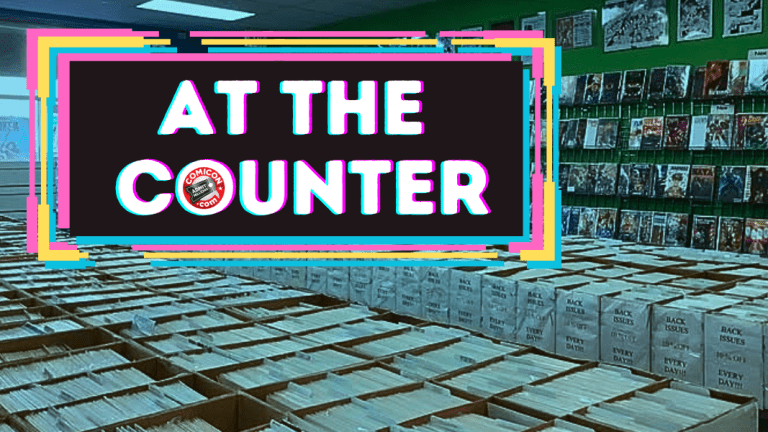
At The Counter #18: Accessibility In Geek Spaces
by Tony Thornley

Welcome to At The Counter, in which Comicon’s features editor Tony Thornley sits down with veteran comics retailer Greg Gage. Marking a year in which Tony and Greg have been doing the column, we decided to do a little meatier topic that’s not just comics relevant, but relevant to — and often ignored by — all small business owners, with a special guest joining us to chat about it.
Yes, that does mean that we’re skipping the most important holiday of the year — Batman Day on September 19th — but it’s just that important to talk about. (Sorry, I had to get one joke in before such a heavy and important topic)
Tony Thornley: Hey Greg, as always, it’s great to sit down and chat. But this time, we’re doing things a little differently and are being joined by Anton Kromoff, one of Comicon’s staff writers, who has a bit of a different topic for us to chat about!
Greg Gage: That’s great! I always like to mix it up a little bit. Hey, Anton!
Anton Kromoff: Hey Greg, thank you for letting me be a part of the conversation, though I myself am not sure how exactly this is going to translate on the page.
I guess I will start off with a bit about what has brought us together today. Out of the gate, I’m a full-time wheelchair user with a degenerative disability that makes it nearly impossible for me to stand without some kind of mobility aid. That being said, I do all my shopping from a seated position, and while my chair is a small manual model whose width is smaller than my shoulders, I have found that, recently, more and more public spaces have become mostly inaccessible to me.
- Longboxes too high
- Records unable to be flipped through
- Second stories with no ramp, lift, or elevator
- New comics on high shelves
- Counters that obscure the product unless you are standing
- Inaccessible restrooms
Inaccessible shops make it impossible even to read weekly books, and with online stores shutting down, you can’t even order single issues to read regularly without a heck of a lift, and it’s not like drug stores and grocery stores have spinner racks anymore.
Tony: Which brings us to the store Greg. The nature of a comic book store can make some of this difficult to work with. How do you manage these sorts of things for your differently abled customers?
Greg: Well, you really hit it on the head there. The nature of a shop makes it hard to have everything in a spot that is easy to just grab for everyone. The main thing I always do is to be sure the ADA requirements are met. Three feet throughout any of the open areas. That allows wheelchair access. But that only does so much, I realize. We have to be open to assist however necessary. By that I mean, available to reach things higher up, help flip through back issues, whatever is needed.

Anton: As a wheelchair user, I’m always interested in how shops think about the height of their displays. When you’re arranging comics and collectibles, how do you decide what goes on higher shelves and what stays within easier reach?
Greg: That’s a great question. My store’s a little different. Everything’s alphabetical, so it starts with A on the top left, then goes from there. The unfortunate thing about a retail space is that you have to utilize as much of it as possible, which means items have to be a little higher on the wall so as not to waste space. The reality is, we’re paying for every inch of space in here, but I do try to keep things at a level that’s as accessible as possible. My back issues are low enough that most customers that utilize a wheelchair can get to a good number of them.
Anton: I have loved comics all my life. As I’ve transitioned from using crutches to using my chair full-time, I have found myself cut off from flipping through long boxes. How do you approach the height and placement of your back issues so customers can comfortably flip through them?
Tony: And to go with that, if you have someone like Anton who may not be able to access those, how do you help accommodate those customers?
Greg: As I said before, we’ll do anything we need to do. We’ll pull things off the top shelf, help pull back issues, grab graphic novels for customers so they can take a look at them. We also recommend opening a hold, so we have a list of their wants and can have them ready at a moment’s notice so you don’t have to browse as much.

Anton: This whole conversation started because an antique mall I frequented whenever I was in town moved the Dungeons & Dragons section to a second floor that has had a broken elevator for years now, effectively limiting my ability to shop the toys, comics, and D&D offerings and making the store just one more inaccessible place for me to visit. Most local shops that are still open tend to be inaccessible, and it makes shopping very difficult, as you can’t get your hands on single issues online without serious difficulty since TFAW shut down.
How do you maximize display and storage space without losing room for customers to browse comfortably?
Greg: Well, first off, that’s not the way to do business. Any public building that has more than one floor has an obligation to make sure people can get up to that second floor. That seems wrong to me not to keep a whole portion of your property inaccessible to not only differently abled people, but anyone older that can’t handle stairs. I mean, I just had knee surgery, and that situation would have prevented me from going up there, too. That’s a very short sighted way to do business.
As far as maximizing display space, I try to keep back issues in the middle of the store, but also use as much wall space as possible to attempt to keep the store as open and easy to move through as it can be.

Anton: As someone who uses a wheelchair, I can sometimes find that a display is technically visible but difficult to get close enough to really look at. In a landscape where you have to wait for someone to come unlock the deodorant, asking someone in a busy comic shop to come over and pull an issue down for you to flip through is not exactly conducive to a fun shopping experience … honestly, it makes things feel awkward when you don’t want to grab the book, and that in turn makes you want to check out newer titles.
Is there a flow to the way you shelve new books to make them easier for everyone to see, or are they stored up high?
Greg: They’re top to bottom on our new racks. There’s not really a way to make them all at one level, unfortunately. On the other hand, though, it’s the employee of the store’s responsibility to be available to help. You shouldn’t have to feel awkward or like you’re intruding. That is their job. These days, I notice a lot of people that don’t put that personal effort into their jobs, and that’s a shame. The shopping experience needs to be just that. An experience. It’s a store’s bottom line that’s at risk if it’s a bad one. More importantly, everyone deserves dignity and respect when they walk in. We owe you for coming into our shop, not the other way around. We’re here to help, and that should be the end goal every second of every day.
Anton: While the entrance is obviously the first part a customer encounters, narrow entrances or steps up inside can make a whole shop off-limits, not just to someone like myself who uses a chair, but to parents with strollers, people with mobility aids, or those who just went too hard at the gym. Is that something you consider at your shop?
Greg: You bring up a great point. Many people don’t consider the fact that accessibility is for everyone. Every single person, at one point or another, has needed a little extra help. We have designated accessible parking right next to a ramp, so everyone can shop. Again, that’s how it should be, both morally and legally.
Anton: I’m not sure if me asking these questions have been super helpful, or spread any awareness, but I appreciate you talking to me about this kind of stuff as it is super important to a larger chunk of the purchasing population than most people realize and I am constantly struggling to even find a place that I can pick up single issues of new titles or back issues without having to pay unhinged prices on eBay.
Greg: I appreciate the questions! Sometimes such important insight can be gained from what seem like simple questions, but if it makes someone think and realize the reality of the situation so many people find themselves in, it’s a great service. And let me tell you that if you need a place to handle your comics, we have a hold system, and I ship out all the time. We’d be more than happy to help you with them.
Tony: And picking back up from me — Anton is asking quite a bit about accessibility for wheelchairs and other mobility devices. I haven’t been shy out there that I have a developmentally disabled child, and I myself have a few chronic health conditions that are disabilities. Are there ways to ensure accessibility for those — and I hate this term — invisible disabilities?
Greg: I don’t think there’s that much of a difference. Every differing ability needs to be respected and accommodated. One thing I would say, though, is please be vocal about it. If I or my staff don’t know that something extra is needed, we can’t provide that specialized assistance. Let us know, and we’ll be more than happy to help out in whatever way we can. You should never feel like you can’t share what you need to ensure a great experience.

Tony: And that’s not something that’s unique to you. Under the ADA, business owners are legally obligated to make reasonable accommodations for accessibility (and yes, I italicized reasonable on purpose). But also, these business owners don’t know if you don’t ask. In the case of my kid, all I really need is patience, and it’s unreasonable for me to expect businesses to allow my child with autism and ADHD to just run around the store and potentially do damage to stock and fixtures.
Anton’s questions were very much about some of the day to day operations perspective. But you also frequently do large store events, such as signings, sales, Free Comic Book Day, and even especially busy Wednesdays for big releases.
What lessons have you learned about making sure those events are open to all? How do you ensure accessibility in the space even at those times?
Greg: Well, first off, if someone utilizes a wheelchair, or a walker, or the like, they get in first. And if someone doesn’t like that, then they can just go elsewhere. It’s no different than being at Disneyland, or boarding a plane, or anything else. You can wait for a few more minutes until the person that needs a little more accommodation gets it.
Tony: And I think this is the most important question — why is it so important to make sure everyone, no matter their ability, their background, their identity, has access to geek spaces?
Greg: Because that’s a basic, fundamental right. It’s easy to get bogged down in regulations and explanations, and so on, but what you should never lose sight of is that we’re talking about people. Not hypothetical situations, not walking wallets, but people. I appreciate Anton’s questions. It made me think about a few new things, and I’ve been doing this for almost a quarter of a century. You can never stop learning. You’re also limiting your customer base, and why would you do that?
Again, thanks for talking about this. It’s an important thing to discuss. It was a pleasure!!
Tony: Of course, thanks for taking the time for this topic!
Black Cat Comics is on the web at https://blackcat-comics.com/ and via all the usual social media channels. If you live in or are visiting the Salt Lake City area, you can visit the store at 2261 Highland Dr, Salt Lake City, UT 84106, or call Greg and his team at (801) 461-4228.