

Review: Nick Maandag’s ‘Betas’ Deserves More Discussion
by Koom Kankesan
-
- 8.5/10
8.5/10
Summary
Nick Maandag’s new book from Drawn & Quarterly, Betas, follows three guys who live together and work in a restaurant as they contend with the culture wars. Drawn and written with Maandag’s characteristic absurdity and wit, the book is extremely funny, but stumbles when trying to wade into a more serious dramatic and political mode. Well worth reading and discussing.
Overall
8.5/10
Nick Maandag’s new graphic novel, Betas, is his first full book-length story. For this reason alone, it requires more attention and discussion than it’s currently receiving. Maandag’s previous two books from Drawn & Quarterly, The Follies of Richard Wadsworth (2019) and Harvey Knight’s Odyssey (2023), each featured two extra stories besides their titular stories. Betas features the main characters from Maandag’s self-published Streakers (Xavier, Doug, and Tim) as they navigate the dating scene processed through today’s culture wars. Although the principal characters in the new book are familiar, their situation and cultural context are different. The earlier title sees the guys forming a very fringe club of individuals trying to keep the waning trend of streaking alive. Xavier insists that streaking is about politically disrupting the establishment and status quo while Doug simply enjoys flashing people. Tim can’t work up the nerve to actually streak.
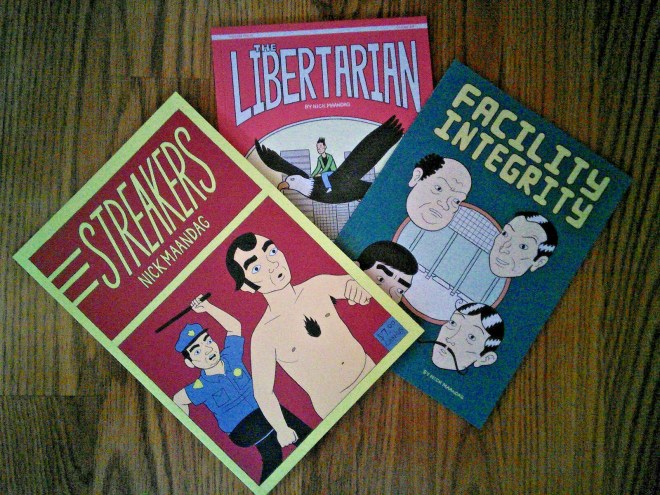
Streakers was relatively short, somewhat odd and insouciant, and characteristic of Maandag’s work — that is, it’s deeply absurd and funny. It touched on politics without really being political. It featured the kinds of losers and misfits Maandag likes to return to and absurd situations skewering toward the surreal and absurd. Betas is a much more involved tale which hardly mentions streaking. The three guys now live together in an apartment and work at the same restaurant, Crusty Jack’s. Xavier and Doug are line cooks while Tim — always the worst loser in these tales — cannot escape the dishwashing pit. People who just started working there and are clearly incompetent are promoted over him. Much of the book involves the three principals trying to get some semblance of a relationship going with a woman, any woman, and failing. Doug even tries to attend church so he can pick up someone there in the hopes they’ll be “anti-woke” like him. All of the guys’ escapades take place against the backdrop of an exaggerated, satirical society that is both inane and deadly serious about enforcing language, behaviour, and attitudes.
Their place of employment is a locus for much of this dynamic. The manager must continually meet with the Diversity and Inclusion committee made up of minority employees and engage in performative behaviour to show he is aware of newly coined words (for example, “blacknowledge”) as well as promoting those suffering from systemic oppression. The first ever White Atonement Day means that he must go about his duties for a day on his hands and knees to symbolically show the extent to which black people have suffered due to anti-Black racism. The manager hopes corporate will kibosh the idea, but they’re only too happy to get press for being ahead of the curve and participating in the politically correct endeavour. Ridiculous and humiliating things ensue.

On the home front, the relatively confident Xavier is having his third date with a woman he’s seeing. Since she’s at his place, he purges his shelves of any books authored by people who have been mired in scandal or criticism, replacing them with “culturally approved” and diverse books. He takes DVDs that he wants to keep and puts them in the cases of DVDs that will pass the appropriate litmus test. She approves of what she sees and they proceed to kiss and get physical. However, his date wishes to use a new Consent App on her phone which electronically instructs them, step-by-step, what is appropriate, sapping any natural feeling or chemistry out of the encounter. Doug and Tim fare even more poorly. One of the funniest scenes in the book has all three visit a club called Libertine’s where lots of jiggling and scanty clad flesh is on display, but an overzealous bouncer militantly enforces a No Touching/No Staring policy. Xavier actually hits it off with someone at the club who feels similarly, but due to the club’s rules, they cannot kiss.
Betas is funniest when dealing with relationship (or lack of relationship) scenes and the quirks and flaws of its various characters. Maandag has an excellent facility for humour and timing. His simple, straightforward drawing style (which often uses a standard six panel grid but not exclusively) keeps the narrative humming. His books in general often depict people struggling against powerful institutions like corporations and cults. They try to get ahead, usually resorting to slightly ridiculous ruses, using performative or bad faith actions that only end up backfiring. For this, Maandag is somewhat the inheritor of the style of storytelling which made Joe Matt an incredibly funny and readable cartoonist. Like Matt, Manndag deserves at the very least, a cult following. Also, like Matt in the early stages of his career, the author is working hard, playing in comedic and satirical territory he’s carved out for himself, and regularly puts out work. Truth be told: there aren’t many cartoonists who exclusively focus on humour — it’s a skill and art that when done well, like Maandag does, should be read and discussed.

A reason Betas isn’t being discussed more might be what’s perceived as problematic content within its pages. The title itself is loaded terminology, denoting someone who is a “simp” or a “cuck”, someone not alpha: a loser. The criticism and send up of political correctness is what might make people uneasy or hesitant to enjoy the humour, and perhaps even debate it. At Crusty Jack’s, the climate is so fraught that a comment about broad noodles being uncooked can be deemed an offensive statement about women not wanting to cook and Xavier ends up being brought in front of a human rights tribunal. The server at the restaurant, Lauren, who makes the complaint is sick of the flirtatious “banter” Xavier throws at another server, Chloe, whom he horses around with in-between work. Around this point in the book, the tone switches abruptly from humorous to serious.
The satire still remains within the realm of absurdity. Xavier is not provided with legal counsel while Lauren is; the tribunal decides what penalty he must pay even though he’s already been effectively let go from his job. But the writing is no longer comedic. As all the arguments and conditions are stacked against Xavier, Maandag demonstrates an awareness of all the reasoning that has led to terms like toxic masculinity, colonial repression, truth, and reconciliation, and the politics surrounding these debates. He just doesn’t believe in it.
It’s when the book staunchly enters this polemical space that it loses its charm and chemistry. It could be argued that through the earlier humourous episodes, Maandag was setting up the dire threat of political correctness spiraling out of control. However, the end chapters feel too heavy handed, disingenuous, and misguided for the arguments to be anything but straw-men. Even though the principal characters are flawed, we feel for them early in the book. Towards the end, Xavier has become so embittered by the judgment of the tribunal that he falls into watching videos from the manosphere and hatches a plan to get revenge on Lauren. Improbably, it is Doug (with the help of Chloe) who saves Lauren from her fate. Xavier ends up going to jail while Lauren seems to express her gratitude to Doug by dating him.
Is this dark satire? Revenge porn? A vindictive statement against political correctness and how it’s ruined male/female relations? The book plays in these waters (and for taking a partial stab at that, should be commended, as should publisher Drawn & Quarterly for not flinching and putting the book out there) but doesn’t have a clear message or outlook to offer. It takes too much of an abrupt turn towards forced drama and darkness late in the narrative. Whereas the principal characters are lampooned for their bad faith actions earlier, the narrative itself takes on a more trenchant tone and makes bad faith moves of its own. It’s not an equal opportunity satire so much as a screed of frustration.
I found it difficult to see Xavier attempt to go ahead with his plan after Lauren effectively apologises to him (she’s been feeling guilty for what she’s enacted in his life) and says she’ll withdraw the complaint the next day. Xavier believes Lauren is only saying this because she’s intoxicated. It’s especially painful to see where Lauren ends up. It is not so much her getting ‘saved’ as her face is rubbed in her ignorance. She’s subservient and gets her comeuppance while Doug, mostly due to circumstance, “scores.”

Criticisms aside, I do believe this book should be read, as should all of Maandag’s work. For humour chops alone, his cartooning stands out. There was an earlier time in alternative comix when such satire would immediately be consumed as standard, prompting discussion. Besides the three books he’s put out with Drawn & Quarterly, Maandag has published other smaller works including a short work called The Libertarian (2012). This particular story has more in common with Betas than Streakers does. In it, an avowed young libertarian chucks aside all his values and persona in the attempt to pursue an ultra-left vegan-socialist-feminist called Tangerine McDonald. The libertarian, who has the equally absurd name Rod Vanderbranch, goes to extreme lengths putting up with Tangerine’s social circle, dressing differently, and changing his lifestyle and home in order to deceive her that he’s an ally. The Libertarian feels like an equal opportunity salvo fired at all quarters of society. By the time Maandag has arrived at Betas, he’s become angrier, shooting more involved and sustained fusillade at woke culture and how it overemphasizes, performs, and generally runs to excess. The only time that politics is earnestly discussed is when Doug tells his date, early in the book, that he believes government should have as little impact on people’s lives as possible, suggesting a libertarian outlook. He attempts to convince her that they’re not so different since both of them resent tyranny and oppression. She’s not convinced but submits to a walk in the park with him and disaster ensues. These early parts are immensely entertaining and funny as hell.
