
Art For Art’s Sake #387: Celebrating 50 Years Of Captain Britain (Part 3)
by Richard Bruton
This month sees the 50th anniversary of Captain Britain’s creation, something very special to me. Which is why I’m hijacking Art For Art’s Sake for a few weeks …

Okay then, so far in this potted and personal history of Captain Britain, we’ve seen the creation of the character, US-led, and then the continued adventures, both in Hulk Comic and Marvel Superheroes (covered in part 1), culminating in me joining the party, very late, with Marvel Superheroes 388, a terrible moment to join to be honest, as Alan Moore and Alan Davis spend five pages of The Graveyard Shift completely and utterly destroying the good Captain (again, covered in Part 2). Here’s that final page of The Graveyard Shift once more …

You see what I mean when I say it’s a terrible time to join the Captain Britain saga? The Captain dies at the hand of The Fury, falling into the grave of Captain UK … so, who the hell is Captain UK? And who’s that woman shivering a universe away? And when will I get to read more of Moore and Davis’s Captain Britain?
The thing is, young me, in August 1982, 11 years old, was hooked. It’s no exaggeration to say that it’s Moore and Davis’s fault that I’m still here, writing about comics all these years later. It genuinely transformed my reading of comics, with Moore taking everything established by Dave Thorpe and Davis in Marvel Superheroes and first destroying it, then expanding it, transforming it, and making it into a truly magnificent example of the superhero genre.
I didn’t have to wait all that long before I’d get the next chapter, with the promised ‘A Rag, A Bone, A Hank Of Hair’ coming in January 1983, in the pages of The Daredevils issue #1. I can still remember the thrill I felt, stopping off at the local newsagents and seeing the blue cover with that yellow logo, featuring Paul Neary’s versions of Daredevil, Captain Britain, and Spider-Man. Over 11 issues, Daredevils became a comic that, still to this day, fills me with joy, a perfect example of everything that was new and exciting in comics for me at the time. There have been better comics since then, certainly, but it’s both a nostalgic treat and a great read that is always a pleasure to come back to.
Although the ongoing adventures of the Captain were the main draw to me, the comic was so much more, with editor Bernie Jaye crafting something far more mature and varied than Marvel UK had done to that date. Aside from the brilliance of the Moore & Davis Captain Britain, highlights have to include my first introduction to Frank Miller’s Daredevil and the excellent Moore Night Raven text stories (with some beautifully done Davis artwork), complete with a hell of a lot of extra material, much of it authored by Moore, including fanzine reviews and articles on comics. Yes, this was, by no small measure, a comic with a difference. Perhaps not as revolutionary as the other major monthly in the UK at the time, the Dez Skinn-helmed Warrior, but when The Daredevils advertised itself with the tag line “It’s been a long time since comics were as good as this”, they really weren’t exaggerating at all.

However, for young me, the main event in The Daredevils was always the continuing adventures of Moore and Davis’ Captain Britain. Both were committed to the strip, even going so far as to expand the page count as the series went on, with no extra reward for doing so. Moore, it could be argued, was already making work of an incredible quality, but Davis was never far behind, and it’s in these issues of Daredevils where his work goes from good to amazing. What had, at times, been cramped and panel-heavy suddenly transforms with expansive, open page layouts, spectacularly large panels, even splash pages and double pages at times, all to the benefit of the story.
The 11-issue run of Daredevils can easily be split into two distinctive parts: effectively a rebirth and rediscovery in part 1, in issues 1-4, and a complex, multiverse-spanning epic adventure in part 2, issues 5-11.
Here’s a little of what we got in the rebirth and discovery phase, art, of course, from Davis … first of all, from The Daredevils #1, where we get the whole rebirth, as Merlin and Roma put Captain Britain back together, although this was far from the wonderful, father-like Merlin that Captain Britain thought of; this was a cold bastard, cruelly manipulating the hero, positioning him for the challenges that Merlin knew were to come. He wasn’t even the Arthurian wizard the good Captain had thought. No, Moore, always one for manipulating his character’s origins, just as he did later with Swamp Thing, as he’d already done with Marvelman, adapted, shifted, and completely changed the Captain Britain origin. Instead of Merlin the magician, we had Merlin, along with daughter Roma, extra-dimensional beings, capable of appearing in many different, often completely alien, forms.

And then, one short month later — although, for young me, a long month of waiting — Daredevils #2, underneath a Paul Neary cover …

Once resurrected, Captain Britain begins his life anew. The first few strips are simple things, but all function to give us the idea of Brian Braddock as the fractured man, wanting nothing but a simple life, an intelligent buffoon, an intellectual and ineffectual snob, a man incapable of dealing with the ridiculous and nightmarish world that his superheroing brought him into contact with. It’s something that will come up again and again in Moore’s writing of the character; he’s very much the least interesting character in his own adventure, a big red, white, and blue anchor to allow Moore to craft stories around.
The good Captain goes back to his ancestral home, after a page of prologues teasing many of the storylines yet to come, only to find it is now the bombed-out shell he thought it was… all thanks to the sentient computer program of Mastermind. But first, the triple prologue, all teasing what’s coming …


Then, onto issue 3, Moore and Davis taking us back to an old adversary, Slaymaster, not to mention the reunion of the Braddock siblings, as Betsy Braddock gets re-introduced, with Moore bringing back the idea of her psychic powers, introduced way, way back in the original Captain Britain weekly and then promptly forgotten about …


Then onto The Daredevils #4, under a Neary cover once more, albeit with the Captain’s uniform colours all kinds of wrong …

Here we had the finale to the Slaymaster storyline and more about where Betsy’s been — on the run from S.T.R.I.K.E, Marvel UK’s version of S.H.I.E.L.D., now infiltrated by the criminal espionage group headed by The Vixen, who, utterly bizarrely, used Arcade (the weird Marvel US villain who featured in Marvel Team-Up issues #65 & #66 from 1978) to provide assassins, including Slaymaster.
Imagine the surprise of me reading this one, turning to that final page and getting all this …

But no, it’s one of the only frustrating moments in this whole Moore/Davis run, as Arcade shows up for a single page and nothing more is heard about him.
Thing is, you can’t complain too much about this one strand of possible future Captain Britain tales coming from Moore and Davis, as next issue saw things take on a WAY bigger theme …

From here until the end of The Daredevils, Moore moved from the grounded state of the first four episodes and went cosmic, taking the Captain to the stars, really building on the multiversal ideas that Thorpe and Davis had already introduced, not to mention eventually bringing back The Fury and Mad Jim Jaspers to it all. Yeah, from here on in, we just didn’t get a moment to breathe for quite some months!
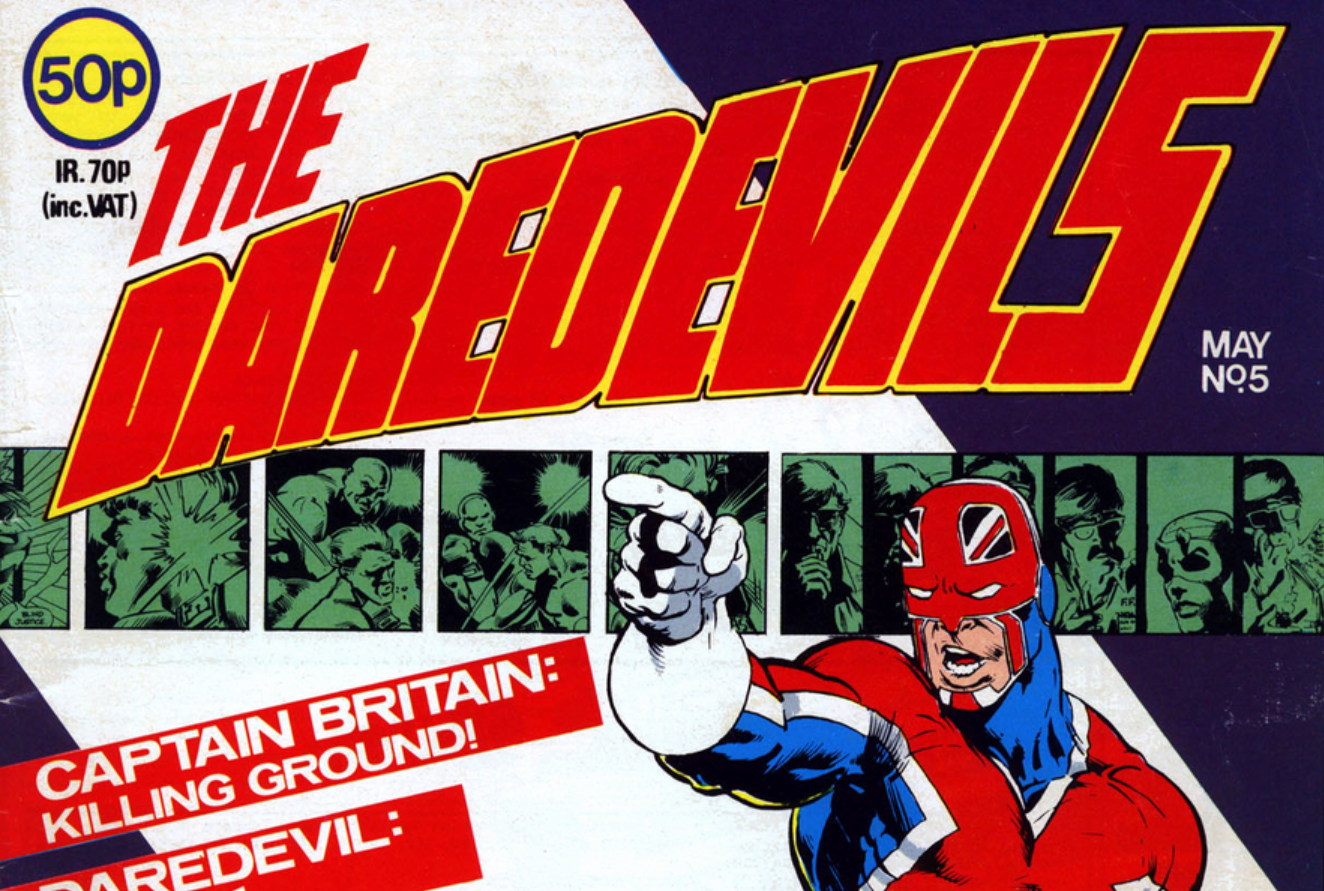
So, it was the debut of this lot … well, sort of … The Special Executive … (and yes, I had the poster up on my wall, of course I did!)

Moore had been kicking around ideas for The Special Executive over in his early back-up strips for Doctor Who Monthly, where he, John Stokes and David Lloyd told the tales Star Death, 4-D War and Black Sun Rising, featuring Wardog, Cobweb and Zeitgeist of the group, with Steve Dillon supplying additional character designs for more.
And if you’re after the tale of their creation, here’s Moore himself writing in this issue 5 of The Daredevils about that very thing …

It also serves to give you an idea of the quality of the non-comics material we’d get in The Daredevils, a hell of a lot of it done by Moore. Just this issue alone, you had 10 pages of Captain Britain written by Moore, drawn by Davis, plus Davis contributing the cover and the poster, and Moore giving us 9 pages of articles on comics. Way, way above what they were meant to be contributing, and, so the story goes, way, way more than they were being paid for.


And from this point on, things get big very fast. Captain Britain, always incapable of dealing with much outside his small version of the world, is catapulted into a tale of multiverses, of multiple Captain Britain versions… Captain Albion, Captain England, all the rest. Poor Brian. He’s just not made for these times. And it’s all because he’s needed at the kangaroo court presiding over the trial of Saturnyne, the cold, beautiful, ex-Multiverse ruler who left the poor Captain to die at the hands of The Fury on the twisted world of Earth 238. During the trial, this mad, reality-warped world of Earth 238 is ruled as simply too dangerous to exist and is completely destroyed, all except The Fury, who won’t be stopped by such a trivial thing as having your entire reality wiped out.
It’s all part of the classic Moore playbook of the time: build them up, break them down, that deconstructionist method he’d use on Marvelman and Swamp Thing, as Moore seemed intent, in the early issues, to completely bring Captain Britain’s life crashing down — and it was eye-opening to young me. What happens for the rest of this Moore/Davis Captain run is just, still, something very special for me. Watching us head to otherworlds, the multiple Captain Britains, the Special Executive, the Fury, the fascist state under Jim Jaspers, persecution of the heroes, dark political times and the sense of something different to standard superhero fare were completely intoxicating. Even as he brought his hero back, he was already, seemingly, plotting his demise at the hands of the perfect killing machine, The Fury, still alive, a multiverse away, sure, but we knew their paths would cross again, and the smart money was never on Captain Britain.
After his adventures off-Earth in The Daredevils #5-#7, it was back home for a showdown with The Fury, and the appearance, finally, of Captain UK, Linda McQuillan. But not before seeing just a bit of the nightmares Captain UK had suffered, both with the Fury and with Mad Jim Jaspers …


And that’s really the rest of the Captain Britain/The Daredevils run … as The Fury lands on Captain Britain’s Earth, everyone gathers: Captain Britain and his extended family, The Special Executive, even, eventually, Captain UK, the poor beaten figure we saw, ever so briefly at the end of Marvel Superheroes. It’s an epic story, huge scenes, big superhero action done exactly right, yet Moore and Davis are presenting it in these short episodes, widescreen comics certainly, but at times, it was widescreen comics shoved into 10 or more panels on the page.
In this second half of The Daredevils, despite the overall arc of the story being the relentless pursuit of Captain Britain by a killing machine, unbeatable, unrelenting, and our hero desperately attempting to escape death a second time, there’s an unabashed lightness to it all. The throwaway moments, the comedy of the Special Executive, the sarcasm, the silliness, the guest cameos thrown in (Including Moore/Davis doing terrible things to someone looking a hell of a lot like Terry Wogan) — all of it makes this run of Captain Britain simply the best superhero romp, Moore and Davis really enjoying playing around with superheroes.

It’s also got the reappearance of the wonderful Jim Jaspers, although not the same one we saw on Earth 238. No, this one’s a politician, Tory of course, but he does have the mind powers, and he’s pushing a distinctly familiar right-wing, superheroes-out agenda that Captain UK recognises as identical to what happened on her world. Here he’s just a shadowy figure building his political base, his powers never better illustrated, so simply, with the classic changing the wine sequence. In truth, in the Daredevils run, he’s a background figure, his appearances and mentions merely a prelude to the nightmare and insanity that will come in the Moore & Davis Mighty World of Marvel years, when Jasper’s impact delivered some of the darkest Captain Britain to date. And I’ll be covering that in part four of this indulgent bit of Art for Art’s Sake.


By the end of The Daredevils‘ far too short run, we reached a suitable pause in the Captain Britain tale, with our heroes victorious. But it’s a downbeat, hollow, miserable victory… echoes of what’s to come in the next arc resonating through those final pages. It ended with Moore and Davis producing one of the best superhero romps I’d read, and still is one of the best I’ve read.
Now, I’ll end with just a few more bits of Alan Davis’s artwork. First, a couple of spectacular double-page spreads that opened The Daredevils issue 10, just so bloody spectacular…


And then, from the finale, and the final issue of The Daredevils, sadly finished well before its time, it all opens with that iconic cover from Davis …

Then we get page after page of the two Alans giving us Captain Britain and The Special Executive doing everything they can to beat The Fury.
They do. But it’s only temporary, and they all know it, leading to this ultimate downbeat end to it all …


Finally, anything on The Daredevils and how important it was, how well put together it was, has to make mention of Bernie Jaye, Marvel UK’s Editor-in-Chief from 1980 to 1983, taking over from Dez Skinn. Basically, she was the one who put all this together and made it all possible. Without her … etc., etc …
So, to end, a couple of tributes to Bernie Jaye, who left Marvel with The Daredevils, a couple of pieces from Moore and Davis. (Although that bit about marrying Prince Andrew hasn’t exactly aged well) …


Oh, and if you want more from The Daredevils, including some of the other strips and articles, I took a look through it with A4AS 200 back in 2023 for the 40th anniversary of that particular comic.
