
An Interview With ‘Don’t Be Scared’ Creators Saadia Faruqi And Shadia Amin
by Rachel Bellwoar
Riz’s dad’s dream might be for his son to become a doctor, but that’s not the future Riz sees for himself in writer Saadia Faruqi and artist Shadia Amin‘s graphic novel Don’t Be Scared. With the help of his friends from film club, Riz hopes to prove directing is a viable career, but for more on Don’t Be Scared, check out this interview with Faruqi and Amin below:

Rachel Bellwoar: Starting with the cover, I love the range of expressions and how closely (or not) Amy, Max, and Riz appear to be adhering to the title, Don’t Be Scared. It’s such a cool way of establishing the characters early. How was it coming up with that image?
Shadia Amin: The team wanted to emphasize the friendship of our group as well as highlight the mansion. All three kids have such unique personalities that I wanted to highlight them, but most especially Riz’s love for ghosts.
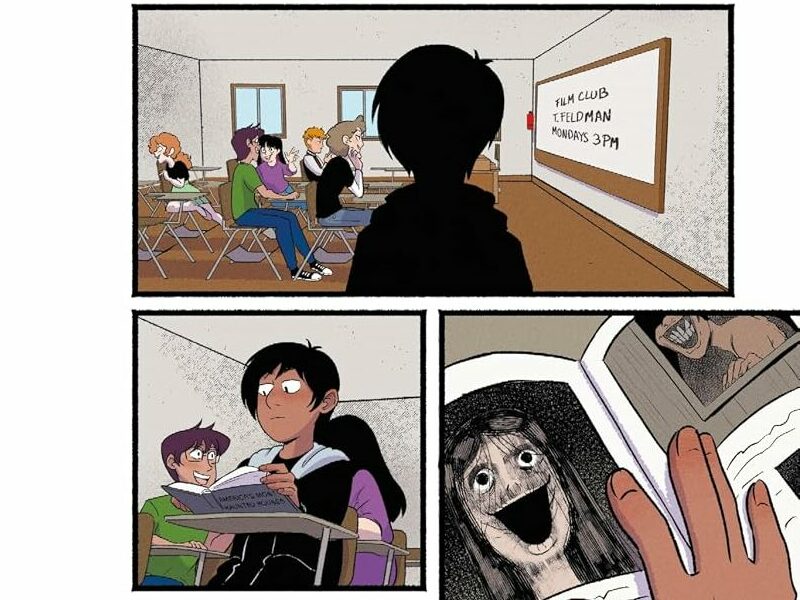
Bellwoar: Amy, Max and Riz first meet-up at their school’s film club. When did you know horror would be the genre they’d bond over (and might Max get his wish to direct a romcom if there’s a sequel)?
Saadia Faruqi: I loved horror growing up, and so writing this story with multiple levels of scares was a no-brainer for me. I think horror is a really cool genre, and there’s so much to explore emotionally as well as physically in a ghost story. I really wanted to explore all these nuances in Don’t Be Scared. If there is a sequel, Max might get his wish to direct a rom-com but I’d definitely include horror elements in that as well. Maybe a supernatural love interest?
Amin: Horror is surprisingly underappreciated, so I’m not surprised they bonded over it. We see this in how so many theme parks embrace it with special events like Halloween Horror Nights.

Bellwoar: From Bly Manor to Hill House, horror is full of iconic haunted houses. How did you go about setting Hollister Manor apart from the rest?
Amin: For Hollister Manor, it reminds me a lot of the old historic houses in my hometown of Savannah, GA — full of distinct architectural character, history, and an atmosphere that naturally lends itself to a classic ghost stor
Faruqi: The most interesting part is the location in a small Texas town. We’re not really known for our haunted mansions, and the few famous creepy sites we boast are hotels and graveyards. I wanted to set Hollister Manor apart in terms of the Texas history, culture and the way it’s placed front and center in the town.
Bellwoar: Riz and his dad disagree strongly when it comes to film as a possible career path. It’s a relationship that’s very real but also doesn’t always get resolved or a happy ending. Why was it important to you to show these differences don’t have to be insurmountable, even if it can be incredibly frustrating and difficult to keep trying?
Faruqi: As an immigrant, I’ve witnessed countless such arguments between parents and children about career choices. It’s definitely a very real concern for first — and second-generation kids — and one of the ways they feel a disconnect with the older generations. I wanted to assure readers that while common, these differences in opinion are not impossible to resolve, if you talk about them rather than keep the hurt bottled up inside. I also thought it important for kids to see their parents’ perspective. Sometimes it takes something drastic like ghosts to bring families closer together!
Amin: I think Riz’s dad, like many parents — especially immigrant parents — comes from a place of misguided fear and a stubbornness toward trying new things. I think a parent should always support their kid’s dream, doing the due diligence to guide them and look into the subject matter to support them while keeping them on a straight path to ensure it’s not misguided overindulgence.

Bellwoar: One of the ways they eventually connect is through ghost stories. What was it like getting to explore ghost stories from different cultures and show that there’s more than one to depict ghosts?
Faruqi: Ghost stories are universal in their power to bring people together. I always enjoy reading supernatural tales from different parts of the world to see how they are alike, as well as how they are different. When I wrote the story, it made sense to have these tales be a way for Riz to connect with Max and Amy, and once they start talking, to realize they have many other things in common too. And of course, the ghost stories from Pakistan are what bring Riz and his father together. Plus, I had an incredible time researching the various stories from Mexico, Korea, Pakistan and elsewhere!
Amin: It’s always so much fun to see the way each culture has its ghosts — what it is about the culture that separates them, but also the universal motif of unfinished business and wanting to look for peace. Whether that peace is found, finding a loved one, being guided, or, unfortunately aiming around wastefully while looking for meaning in distractions like an eternal party or the resentment of a life taken too soon, leaving us with a lack of resolution.
Bellwoar: Don’t Be Scared takes place in Texas, where Riz has to endure more than one racist remark for being Pakistani. How important was it to you to show both sides of Texas: the diversity but also the prejudice that exists there?
Amin: I have never been to Texas, but I have been the subject of racism and even colorism within the Latino community as I was born and raised in Colombia. It’s important to understand that while the world is not perfect and there are folks with hate and ignorance in their hearts and brains, there are more people who are willing to lift each other up no matter who or where they are from.
Faruqi: Texas is a state full of contradictions: we have smaller, rural areas with conservative-minded people who dislike outsiders, and we have large urban cities teeming with residents from all countries and ethnicities, where differences are celebrated. I live in Houston, which is probably the most multicultural city in the US, but when I drive outside city limits, I sometimes feel intimidated and uncomfortable. I thought it was essential to bring these differences to light so we can all see how immigrants are treated outside of urban areas, and hopefully readers can try to be more welcoming.
Bellwoar: Thanks for agreeing to this interview, Saadia and Shadia!
Don’t Be Scared is on sale now from First Second.
