
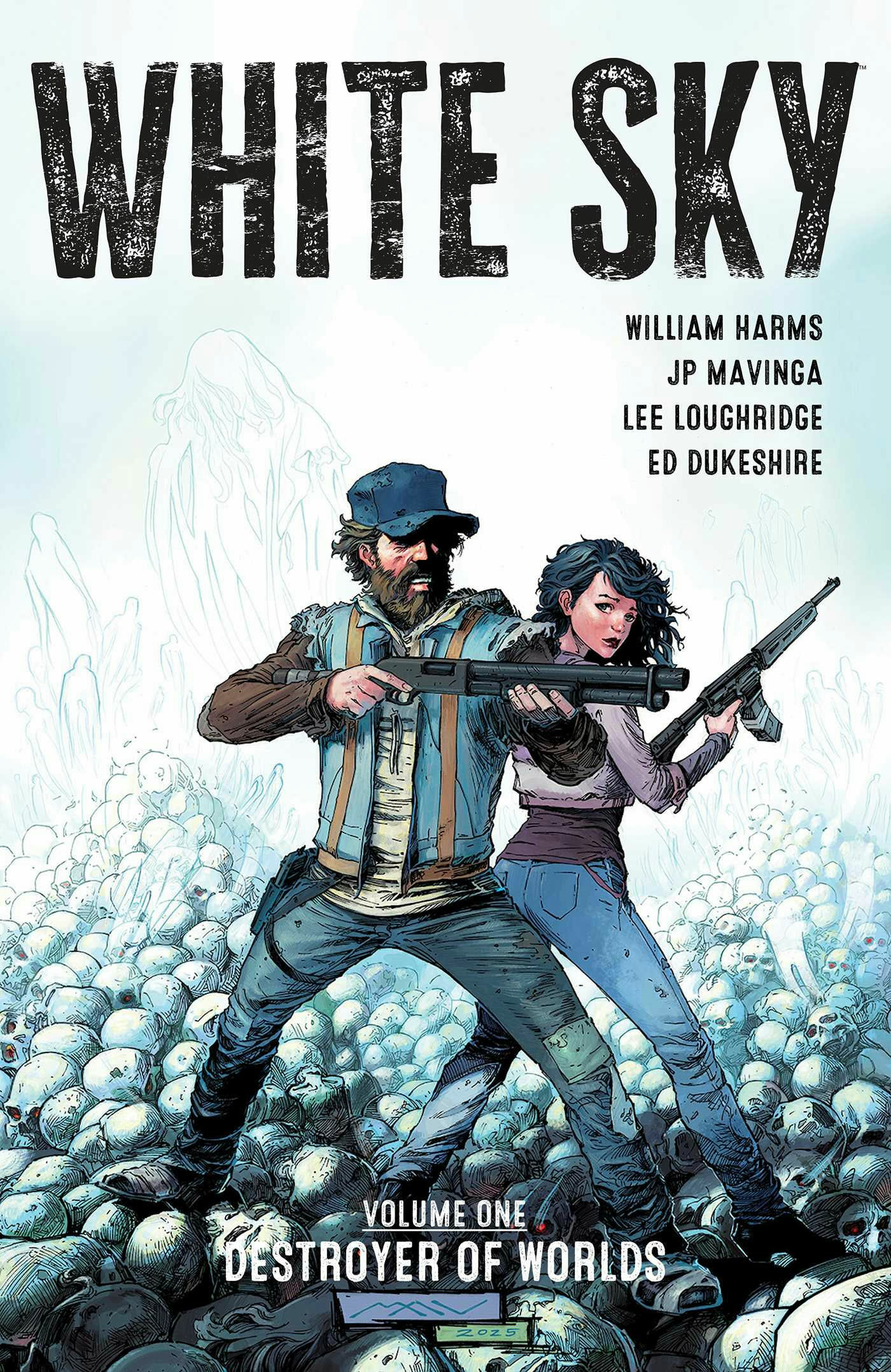
Review: Answers Elude Readers In ‘White Sky’ Vol. 1
by Tom Smithyman
Overview
Collecting the first six issues of this ongoing series, this volume tells the beginning of the story of survivors of some apocalyptic event. Even six issues in, we still don’t know enough about what happened or why, or even about the apparitions attacking those remaining. And that is the biggest issue with the story.
Overall
8/108/10
What would you do if the sky suddenly turned white and the world descended into a nightmare populated by deadly apparitions? That’s the unsettling premise behind the post-apocalyptic horror series White Sky. Collecting the first six issues into a single trade paperback, this volume delivers a creepy atmosphere and some striking visuals, even if the storytelling doesn’t always live up to its considerable potential.

The story follows Violet and her father, David, as they struggle to survive in a world forever changed by an unexplained catastrophe. Separated early on, the two find themselves on different paths through the devastation. Violet travels with Walter, a mysterious psychic medium, while David falls into the hands of dangerous scavengers. Their parallel journeys provide the emotional backbone of a story that continually raises questions about the nature of the apocalypse and the creatures now stalking humanity.

Writer William Harms understands that horror thrives on uncertainty. The early chapters establish an effective sense of dread, gradually introducing the rules of this strange new world without explaining everything at once. Unfortunately, the distinction between a compelling mystery and an unnecessarily confusing narrative becomes increasingly difficult to maintain. As the series progresses, exposition occasionally overwhelms forward momentum, while new revelations generate more questions than answers. Even after six issues, the larger story feels as though it’s still waiting to begin in earnest.

Fortunately, J.P. Mavinga’s artwork gives readers plenty of reasons to stick around. His depictions of a devastated San Francisco and its surrounding landscape establish a convincing sense of desolation. The apparitions are particularly disturbing, and the compositions effectively communicate the scale of the catastrophe. Lee Loughridge’s restrained color palette (he doesn’t have much choice since the sky is white) reinforces the bleak atmosphere, although the muted tones sometimes make individual scenes less visually distinctive.

Reading these six issues together does have its advantages. The trade format allows the separate storylines to flow more naturally, and readers can follow the accumulating clues without waiting a month between installments. That continuity helps, but it can’t entirely overcome the uneven pacing or the shortage of satisfying answers.
White Sky is an atmospheric horror comic with impressive artwork and an intriguing central mystery. However, its storytelling struggles to maintain the momentum necessary to turn that mystery into a truly gripping narrative. There’s enough here to encourage readers to see what happens next, but the series needs to deliver more substance alongside its unsettling imagery.

White Sky Vol. 1 is now available in comic book stores and on digital platforms from Image Comics.

