
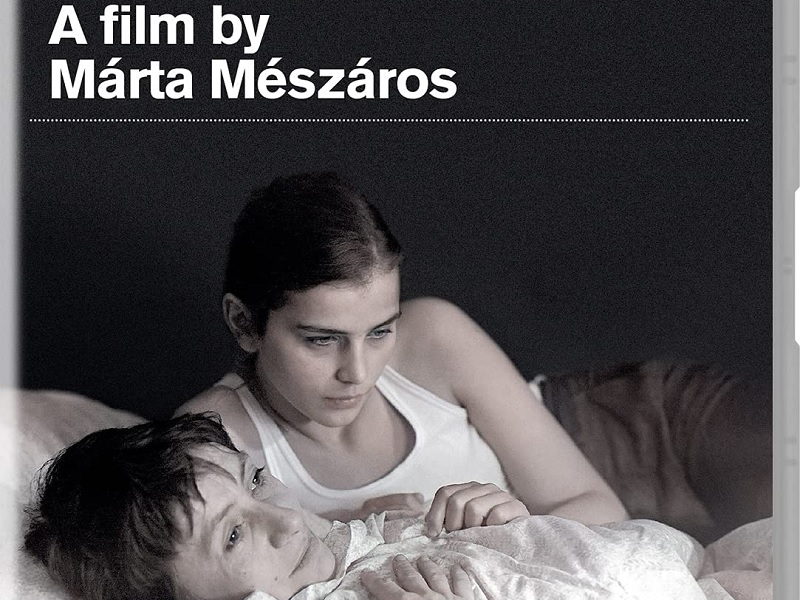
For Fans Of Agnes Varda: Márta Mészáros’ ‘Adoption’ Reviewed
by Rachel Bellwoar
What would you do if a person you only knew by sight asked if they could use a room in your house to have rendezvous with their boyfriend (Péter Fried)? Would it have been better if Anna (Gyöngyvér Vigh) had tried to befriend Kata (Katalin Berek) first, even though it would’ve all been so she could ask Kata a favor? And what does it say that the only person Anna felt she could go to for help was a stranger?

Márta Mészáros’ Adoption is the first film directed by a woman to win Berlinale’s Golden Bear award in 1975. It’s also about a woman named Kata who decides she wants to have a child and initially goes to her boyfriend for help. Jóska (Lászlo Szabó) is married and while Kata isn’t looking for him to get a divorce and is fine with being a single parent, he doesn’t want to have another child.
It’s at this point that Kata meets Anna, who lives at the institute nearby. While boarding schools don’t have to have a negative connotation, Anna’s parents don’t want anything to do with her and that sense of being abandoned by your parents seems to be shared by most of the girls there.
It’s another girl at the institute who convinces Kata to help Anna. Unfortunately, I’m not sure what the actor’s name is – quite a few actors are listed on IMDB but without any character names or photos – but she appears at the 1:03 minute mark in the trailer. She reads a letter she wrote to her mother aloud to Kata and the next day Kata shows up at the institute. One niggling question I will always have about this movie is why Kata doesn’t try to help her, in addition to or instead of Anna. While she acts as the catalyst for Kata’s efforts, she doesn’t get to reap the benefits, which doesn’t seem fair. In the end, though, Anna’s directness works, as it ensures that when Anna and Kata do become friends it’s because they’re fond of each other, not because Anna wants something from her. It’s the maturity of the relationships in Adoption that set this film apart and Berek’s performance is one of quiet dignity and emotion, as Kata figures out what’s best for, not what society thinks would be best for her. Fans of Agnes Varda should definitely consider familiarizing themselves with Mészáros’ work.
Second Run’s Blu-Ray includes a brand-new introduction by Mészáros and an interview that was filmed in 2009, where she shares her opinion on Hollywood blockbusters and not making movies for money, as well as the challenges of raising funds in Hungary. While Mészáros’ English is impeccable, I wish one of the interviews could’ve been recorded in Hungarian, so there wouldn’t be a language barrier. I also would’ve loved to know why she chose to use extreme close-ups in Adoption. Carmen Gray’s booklet essay is stupendous and goes into Mészáros’ background and why her filmography needs to be revisited in the same way Varda’s and Věra Chytilová’s has.
Adoption is available on Blu-Ray now from Second Run.
