
An Interview With The Editors Of ‘The Lizard Prince And Other South American Stories’
by Rachel Bellwoar
Previous volumes of the Cautionary Fables and Fairy Tales series have covered folklore from Africa, Europe, Asia, Oceania, and North America. Now, for their final anthology, series editors, Kate Ashwin and Kel McDonald (along with guest editor, Alberto Rayo), have collected the work of thirteen South American artists and writers. The result — The Lizard Prince and Other South American Stories — comes out this month, and Ashwin, McDonald, and Rayo answered some questions about it:

Rachel Bellwoar: Having already successfully edited five volumes in this series, is there anything you’ve learned since working on the first book (The Girl Who Married a Skull and Other African Stories) that’s changed how you approached this one?
Kate Ashwin: Since we started the Oceania volume, me and Kel have been working with co-editors from the regions in question to contact creators who’ve grown up with these stories. This has been an excellent direction, as it’s allowed us to meet some amazingly talented folks and put together some unique, beautiful, and authentic books with them.
Kel McDonald: The first one was actually Nixie of the Mill-Pond which was published as just Cautionary Fables and Fairytales: Europe Edition. Kate and I self-published that back in 2012 and then put out a volume every other year. Our deal with Iron Circus started because keeping the books in print was proving complicated.
So, we definitely learned a lot as things evolved. Nixie was my first time organizing an anthology. Because of that, it has the least amount of stories and most of them are by people who I talked to every day at the time (mainly because, if it all fell apart, these were people who would understand it wasn’t because of malice). Girl Who Married a Skull had the benefit of Nixie’s proof-of-concept and proof that Kate and I would follow through. It let us invite people we didn’t know as well. The whole series was a learning experience on the organizational side of things and building the trust of both the artists in the book, and the customers buying the book.
Once the series was picked up by Iron Circus, it turned into a lesson in scaling up properly and what works in the bookstore market compared to self-publishing. For example, they were all originally going to be titled “Cautionary Fables and Fairytales: _____ Edition.” Iron Circus’s distributor told us that would confuse bookstores because of how the word “edition” is used in the book market.
Bellwoar: What was the selection process like for this book? Was there an open call for submissions or did you already have certain creators in mind that you wanted to pitch?
Alberto Rayo: I’ve had my eye on a lot of Latino-American comic creators that I just knew would rock in American comics. I’m glad most of them replied and were interested in the anthology!
Ashwin: Alberto was vital in putting together an all-star list of talent from all across South America to pitch to us, and as a group we decided who to invite from there.

Bellwoar: Were there any fables, going into this project, that you knew you wanted to see covered, or stories that surprised you the most?
Rayo: More than specific fables, I wanted to see certain regions’ fables represented. I’m glad we had a few Amazonian and Andean stories in the book.
McDonald: To make sure the artists are enthusiastic about what they are drawing/adapting, we don’t assign stories or go in with specifics. It’s always a joyful surprise to see what folks want to do.
Ashwin: Being from another continent, they were all new to me, yet still quite familiar to the sort of stories I grew up with. That’s a huge part of why I’ve loved working on this series; seeing how each region puts their own spin on these similar themes. We all love to tell tales about epic destinies, fated love, smart people tricking the bad guys, and kind people putting their trust in new friends.
Bellwoar: How did you choose Lore Vincente’s The Lizard Prince to be the title story for this volume?
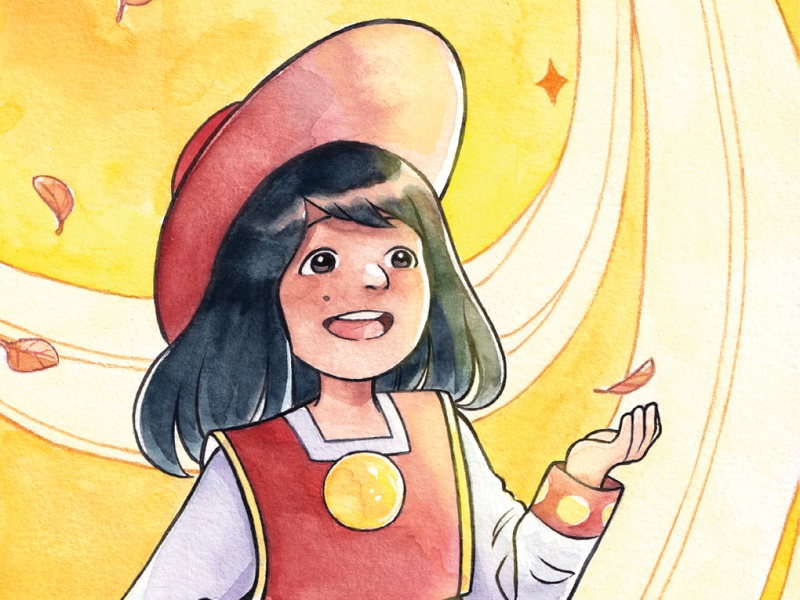
Ashwin: The story is so sweeping and great, it kind of has it all, doesn’t it? Bravery, love, and adventure! Evil witches! A hat I really want to own! It was so immediately striking as an exemplary, epic folk tale that anyone can enjoy and connect with, and with Lore’s vibrant, detailed art we knew it’d make a great centrepiece for the book.
Rayo: I think Lore’s story had a recognizable main character and one of the biggest page counts. Also, it sounds cool!
McDonald: When the book was halfway done, we took the stories closest to completion and picked what we thought would be most compelling on a cover. I mean, that little lizard guy is very cute.
Bellwoar: What do you think is the biggest misconception people have about what editors bring to a project?
Ashwin: Ooh, good one. I wonder if people think that editors are horribly overbearing controllers, or perhaps they think they’re just there to pick up on spelling mistakes? The truth is in the middle, of course; as experienced comic makers (me and Kel alone have been working in comics for decades now!) we’re all pretty good at knowing the little tricks of the trade that ensure a story reads smoothly and conveys its intended message, and we’re here to help our contributors do just that. Our job is also to ensure the intended tone and audience for the book is clear and consistent, to offer technical advice and help where needed (for example, I did some lettering work on this particular book for folks who found it helpful) and to quite simply assemble it all into something we can send to the publishers.
McDonald: An editor isn’t there to just tell the writer they are brilliant and puff up their egos. And what an editor brings to a graphic novel vs. an anthology are different. For an anthology, it’s a lot of organization and logistic work. Getting 15 people to do something on time and sent to the right place is like herding cats; people disappear, people misjudge how long things will take, or something huge happens in their life that eats up their energy.
Rayo: We don’t design the book! I’ve had a few people contact me to do that for their books. We’re also not the publishers! (Except when we are).
Bellwoar: How did you divvy up the workload or was it all a collaborative process?
Rayo: It was pretty collaborative. All the stories were read in each step of the process by the three of us. Thanks to that, we can ensure a level of consistency for the book while keeping each of the authors’ visions.
McDonald: Alberto made the list of artists to approach. Kate sent out the emails which Alberto would translate into Spanish. I made sure stuff was in the right place for Iron Circus. We would all read people’s stories on our own, then discuss them before sending notes to the artists, to ensure we are all on the same page.
Ashwin: These things are largely a collaboration, though it usually happens that you fall into particular roles. This time, I did a lot of the emailing and contacting our contributors, Alberto was a massive help with translation, and Kel is remarkably good at dealing with the actual nitty-gritty of bringing the pages to the publisher and getting our contributors paid! And of course, we’d all take a look at the pages as they came in and make sure they read well, and offer art or writing suggestions where needed.

Bellwoar: The Lizard Prince and Other South American Tales was originally announced as the final anthology in this series. Does that statement still stand or is there a chance it might continue someday?
Ashwin: Who knows where the future may take us, but for now we’re very happy to have completed our aim of visiting every (inhabited) continent.
Rayo: I think we ran out of continents! I think a new thing is in order; I would love to edit another anthology.
Bellwoar: Iron Circus Comics has an amazing track record when it comes to crowdfunding campaigns. Do you have any tips for comic book creators that might be considering the crowdfunding route?
McDonald: Prepping beforehand is key. Having a promo plan, images for social media, and a video are all super important.
Rayo: Plan and be consistent! Get ready beforehand and follow your plan.
Ashwin: Iron Circus are true pros! Their process is so refined by now it’s practically an art, which can look a little daunting to anyone just starting out. But speaking as someone who has also crowdfunded ten volumes of my webcomic Widdershins as an entirely solo endeavour, it’s very possible to do it on your own! The simple things are to make sure to get a quote from your printers ahead of time and work out your shipping costs accurately, to offer a digital version of your book for backers who prefer that, and to make sure you don’t overload yourself on extras! If things are going well, it’s very easy to get excited and start offering variant covers and posters and special edition vinyl toys, but for your own sanity’s sake, keep it simple. Look at other crowdfunding projects – both successful and unsuccessful, fulfilled and abandoned – and you’ll be able to spot the patterns that lead to a winning campaign and a happy audience.
Bellwoar: Thanks for agreeing to this interview, Alberto, Kel, and Kate!
The Lizard Prince And Other South American Stories goes on sale April 12th from Iron Circus Comics.
