
‘Buffy The Vampire Slayer’ Meets ‘Veronica Mars’: Writer Erik Palicki Discusses ‘Black’s Myth’
by Tom Smithyman
Ahoy Comics’ Black’s Myth is back June 21 with a new miniseries subtitled The Key to His Heart, written by Erik Palicki. In a Comicon exclusive, Palicki discusses his creation, werewolf private investigator Janie Jones “Strummer” Mercado, as well as why he wove in some Brazilian folklore into the sequel.
Tom Smithyman: So Strummer is a werewolf who solves crime with a djinn partner. How many genres are you trying to mash together in these stories? And why do you think they work so well together?
Palicki: The broad strokes idea for Black’s Myth came to me after watching The Maltese Falcon and wondering what the movie would look like if it had monsters. Put another way, Black’s Myth is the marriage of Buffy the Vampire Slayer meets Veronica Mars. But in particular, a werewolf has certain abilities to give them an advantage as a P.I. Strummer has enhanced hearing and a bloodhound’s nose. What else would she do with those advantages, especially in the first volume, where we find her having abandoned the supernatural side of herself and working cases for normal humans?
Smithyman: Without giving too much away, why did you subtitle this story The Key to His Heart?
Palicki: Janie Jones “Strummer” Mercado inherited two things from her father, her unfortunate habit of turning into a wolf and a nickname borrowed from her dad’s favorite band. I knew I wanted to subtitle this volume to reference Joe Strummer or The Clash in some way, but nothing from the band’s catalog really resonated with the story I wanted to tell. I ended up landing on a song from Joe’s first band, the 101ers, The Keys to Your Heart.
In terms of what it means in context of the story, it refers obliquely to Strummer (the werewolf’s) sometime-client Rainsford Black and his past, as well as too the legendary grimoire, The Key of Solomon, which will drive the case our detectives are working this time around.
Smithyman: There’s a lot of talk in this issue about purity, sex and, of course, unicorns. What do you want readers to come away with after reading this miniseries?
Palicki: Oh, no! I don’t want readers to think I’m proselytizing. The first volume of Black’s Myth was all about Strummer finding her place in the world and growing comfortable in her own skin. This new volume is about Strummer trying to shepherd others along on that same journey. But neither happy endings nor everything working out okay in the end are typical hallmarks of noir fiction.
Smithyman: What is your working relationship with artist Wendell Cavalcanti like? Do you work out the plot together, or do you maintain strict writer/artist swim lanes?
Palicki: I try to start each project by asking the artist what they would like to draw. Wendell and I have been working together for well over a decade now, and he knows he can be as involved as he likes. In the second issue of this volume, for example, I was able to fold in some Brazilian folklore, at Wendell’s request.
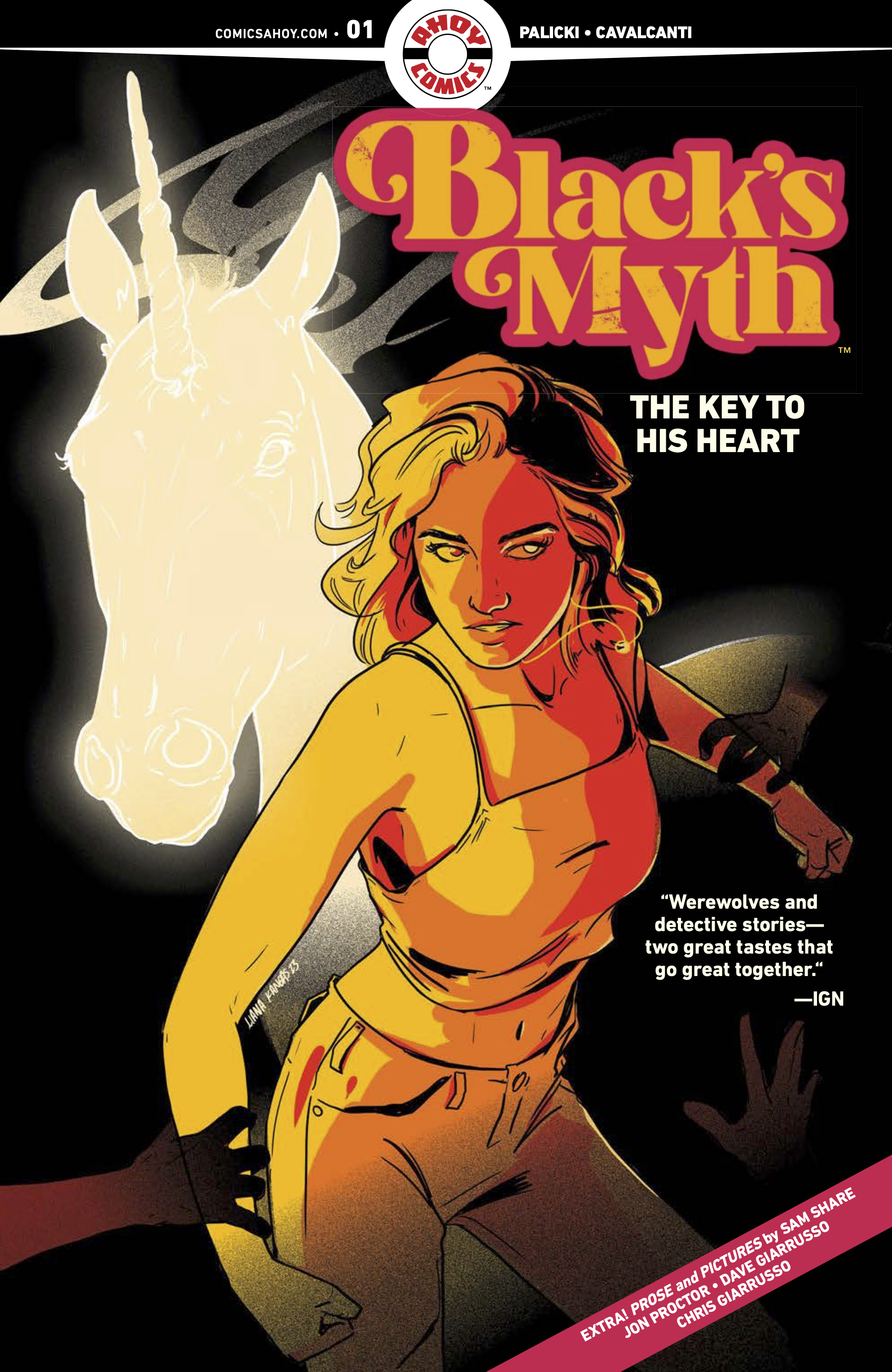
Smithyman: Liana Kangas draws the main cover as well as the logo. It seems like she’s everywhere right now, doesn’t it? What level of collaboration do you have with her since she is only working on a single – albeit important – image each month?
Palicki: I love Liana! I encourage everyone to check out the two volumes of Dead Beats to see our earlier collaborations. She illustrated the story I wrote The Interview for the first volume and then wrote a sequel for Dead Beats: London Calling. Liana and I have known one another, and been dear friends, for a while.
Liana’s approach to the covers has been to make them look like pulp novel covers, but with a splash of her signature neon color palette. I love them. She has carte blanche to do what she wants, as far as I’m concerned, and any reining in is done on the editorial side, but I think the Ahoy braintrust are impressed with what she’s doing.
Smithyman: As with the first series, these issues have short prose stories after your tale. Why did you make the decision to keep including those stories, and are you at all involved in telling them?
Palicki: Those are a hallmark of Ahoy’s publications. I’m not at all involved in putting those together, but they fill out the story in a way to give readers a richer experience than just 20 pages of comics. I think it’s a lovely way to maximize the entertainment you’re getting for your comic book dollar.
Smithyman: The first issue deals with Strummer potentially taking on an intern who is more than she seems. Did you have an internship? And since it’s intern season now, do you have any awful memories from that experience?
Palicki: I did not! I was scheduled to have a co-op semester as an engineering student but changed majors too early. My college roommate had an internship though, and as an observer, I could see how managing spreadsheets did nothing at all to prepare him for the realities of the real world.
Smithyman: Managing spreadsheets does not sound fun at all! Thanks for the time, and best of luck with the new miniseries.


