
A Unique Take On The Supernatural — Discussing ‘Night Wolf’ With Writer Robert Multari
by Tom Smithyman
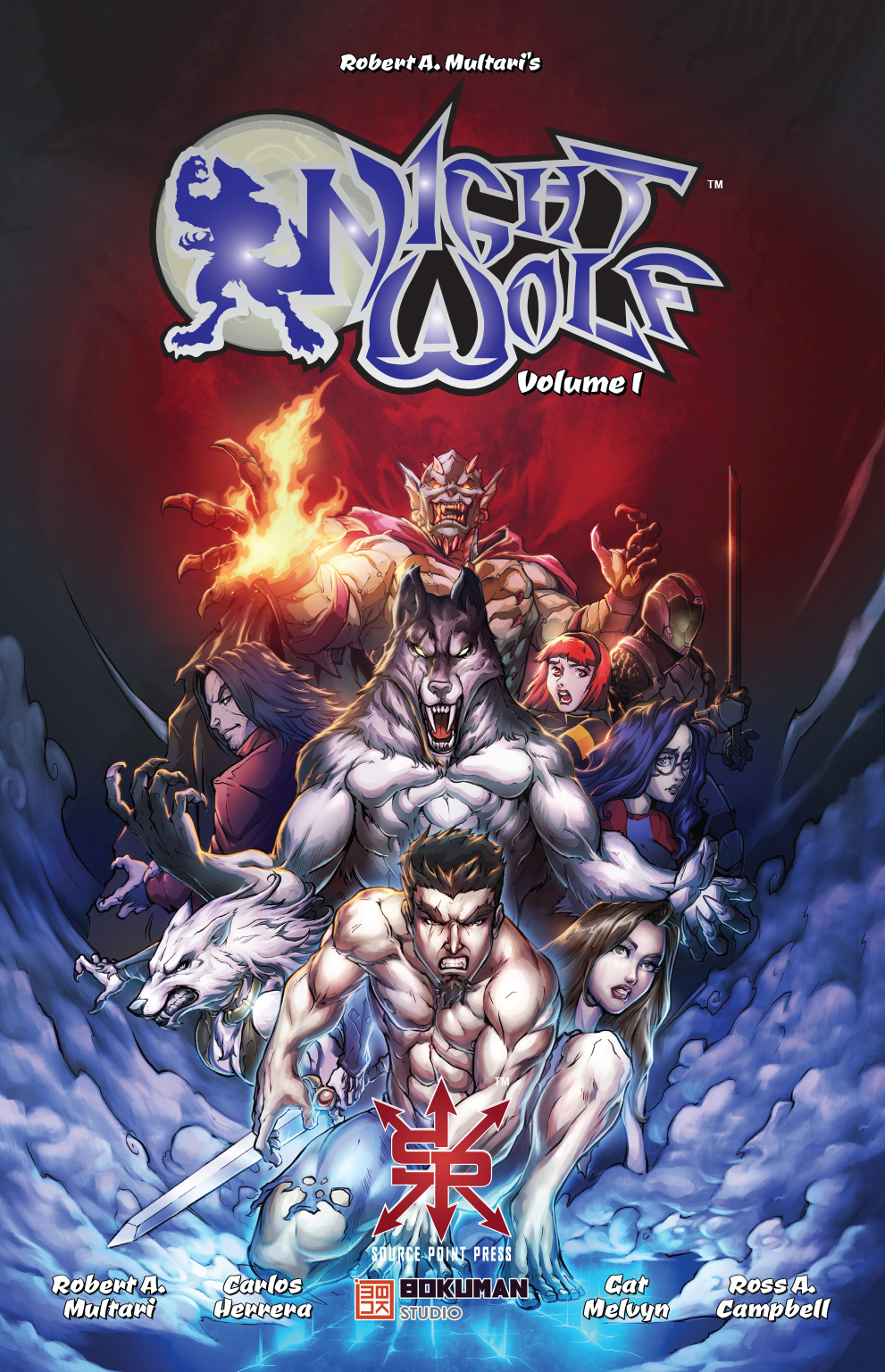
Werewolf stories have been around for about 4000 years, so it’s difficult to come up with a new take on them. Credit writer Robert Multari for taking that challenge head on with his 12-part series Night Wolf. The first four issues are being collected into a new volume, which will be available August 12th from Source Point Press. In an interview with Comicon.com, Multari discussed the rich history he’s created about these furry creatures as well as what makes a good story for lycanthropes.

Tom Smithyman: So werewolves vs. vampires. Seems familiar. How do you differentiate a horror story like Night Wolf from all the other ones out in the market?
Robert Multari: It’s not exactly werewolves versus vampires. There are good and bad of both kinds. My comics have a unique take on the supernatural, theology, mythology, horror, and fantasy. Specifically, I dive into my own version of werewolf mythology, but not right away. I let the story build up and offer more lore as it goes.
In the mythology I’ve established, lycanthropes are a race of naturally born creatures, who have been around since long before written history. There are lycanthrope packs hidden all over the world, each with a unique breed and culture, much like humans, and worship my version of pagan gods. Like most cultures throughout history, there is an outcast breed of lycanthropes shunned by the other breeds because of religious beliefs. Their pagan cousins distastefully call them the Monoki, meaning “one god” in lycanthropian tongue.
The origin of this outcast breed goes back to just before the birth of Christ. There was a black-hearted lycanthrope named Kallarious, whose hatred for mankind impressed the devil himself. Kallarious believed humans were a disease that must be cleansed from existence. Impressed by Kallarious and his dark ambition, Lucifer sought out the cruel creature to use as a pawn in one of his malicious schemes. Kallarious was offered the power to create an army of loyal drone lycanthropes to destroy mankind, but in return, Lucifer demanded his complete obedience as well as the souls of the humans turned drone. Kallarious then became the first of the Mongrels, the evil members of the monoki breed.
The surfacing of Night Wolf’s lycanthropy in Issue #2 reveals that he is unlike any other member of his breed. He displays traits that are not entirely Purebred, nor entirely Mongrel, but something else altogether with a pelt gradient from black to white. This represents that in these modern times good and evil aren’t as simple as white and black. There is a grey line in his morality from being raised in today’s society.

Smithyman: What are the elements of a good werewolf story – and what new elements does Night Wolf introduce to readers?
Multari: There are many stories about werewolves in many different countries and languages. Legends say that werewolves are wicked men cursed with lycanthropy, forced to live in a feral rage, feeding off the flesh and blood of humans, and come out only on nights when the moon is full. Even in ancient Greece, there were myths about the lukanthropos.
In my opinion what makes a good werewolf story today is having your own version of where they come from and how they interact in your established world. I personally prefer werewolves who have a specific aesthetic, which is a perfect mixture of man and wolf. Not like how a lot of movies and TV shows depict them where they are hair guys with claws and teeth and most media represent werewolves as mindless beasts or villains. I wanted to create a character who was born a werewolf and not cursed, who can change at will, keep his own mental faculties, and fight with weapons as well as claws.

Smithyman: Carlos Herrera drew the covers and interior. How did the two of you work together? Did you work separately or was there more collaboration?
Multari: I first met Carlos back in 2013 on DeviantArt.com while searching for the perfect artist to take my original character designs and elevate them to the professional level I was looking for to bring my story to life. So, I messaged him about the project, and he messaged back saying that he loved the concept. Carlos was also working fulltime job, so it took some time, but he produced 20 gorgeous character designs, a front and back cover spread for issue #1, and the first six pages for me doing both the illustration and coloring.
Unfortunately, during that time he started a new job working for Myths and Legends producing art for their trading card game. They paid better than me and he no longer had time to finish my project. So, the artist hunt began again until I found Oscar Choquecota Ale to take over illustration and Ross A. Campbell to do the coloring to finish the first issue of Night Wolf.
When it was time to produce issue #2 Oscar was on board, but Ross was picked up by DC Comics and was unavailable. Oscar is also the owner of Bokuman Studio, which is a Digital Art provider for comics, animation, illustration, and art assets for video games. He offered to have one of his colorists to take over for Ross, so the whole issue was done under the Bokuman Studio banner. I liked the art that they produced, but I wasn’t 100% on board with the coloring.
When I was ready to produce issue #3, I approached Gat Melvyn, who I had been following, about coloring the issue. It turns out he had been following me and Night Wolf as well, so he was excited to work on the project. Oscar was supposed to be the illustrator for the book, but the style changed slightly. Which led me to believe that he was having one of his Bokuman team members doing the art instead, so he could work on other projects.
That led me to reach out to Carlos again. I thought since time has passed, he might be available again to at least work on the illustration for issue #4. Sure enough, Carlos had a steadier job where he could do the illustration for the book. Now he is vested in the project and is in for the long haul, so for the foreseeable future Carlos and Gat will continue to work on Night Wolf as my amazing artists.
I set up a Trello board with my script, then Carlos does a draft for each page that I approve before he finalized the line art. Then I hand it off to Gat for the colors. Gat and I have a similar process. Once approved, I take the finished page and letter it. My script is very detailed based on my vision, but both Carlos and Gat are free to improve upon my ideas, and we collaborate by and forth until we have a great issue.

Smithyman: You mentioned that you lettered the issues as well as writing the story and script. Since you went to the Art Institute, were you at all tempted to draw the book as well?
Multari: I know my strengths and weaknesses, I’m OK with drawing and can get my point across with it. However, my style and ability at the time wasn’t what I was looking for with Night Wolf. I also didn’t have the time to train my hand to be better. By the time I was ready to produce Night Wolf I already had started a family and was working a full-time job. Since it was my story I knew I had to focus on the scripting and then hired a team to produce the art. And since I’m a graphic designer by profession, I decided to do the lettering and book production on my own. Sometimes, if I miss a mistake during the art phase, I will go back in and fix it myself. So, I guess you can call me a touch-up artist as well.
Something I like about being the letterer for Night Wolf is since the first story arc of 12 issues was finished back in 2013, as the letterer I can also make edits to dialogue or if Carlos changed something in the panels or on the page I can adjust accordingly.

Smithyman: You call this volume one, and there’s a “To be continued…” note at the end. Where do you think you’ll take the story from here? How many volumes do you have in mind.
Multari: I’ve always planned Night Wolf to be an ongoing series and have 3 full story arcs planned out so far. I’ve written the entire first story arc comprising of twelve issues. I’ve broken the 12 issues into four-issue collected editions. Volumes one and two are both complete and we are already up to issue 11, which was funded on Kickstarter this past February through my self-publishing company, Love Wolf Comics. Night Wolf Volume 1 is just the first of my books to be released through Source Point Press. Followed by Snow Paw Volume 1, my second series, and then Night Wolf Volume 2 and so on.


Smithyman: I was taken aback when I first read that a lot of the action is set in Pennsylvania’s Shenango Valley, between Pittsburgh and Cleveland. Like you, that’s where I’m originally from. I guess it’s always easier to write what and where you know, right?
Multari: Oh, that’s very interesting that you are from the Valley too! Small world. Fun fact, when I was 14 years old, I wrote fan fiction for the X-Men and submitted it to Marvel in hopes that Stan Lee would read it. Someone from Marvel was nice enough to write back to me with a kind rejection letter, saying that Stan loves to hear from his fans and encouraged me to keep up my writing.
As naive as I was at the time, it spread my passion for the business like wildfire. This inspired me to go to art school at Edinboro University of Pennsylvania, where I graduated with a Bachelor of Fine Arts Degree in Applied Media Arts. Which is basically a fancy way to say graphic and web design degree. After the Marvel submission, I decided to write my own stories. I wrote the first draft of Night Wolf when I was a junior in high school, and the story evolved as I grew up. With my spinoff series Snow Paw, I had to evolve as a writer since the story starts in 19th century Scotland. I had to do a lot of historical research and fact checking while writing her story.
Smithyman: It’s a very small world indeed! One full of werewolves, apparently! Best of luck with the book.
Night Wolf Vol. 1 is now available for retailer order from Lunar, Universal, and Diamond UK.
