
Talking ‘Dark Spaces: Hollywood Special’ With Jeremy Lambert And Claire Roe
by Rachel Bellwoar
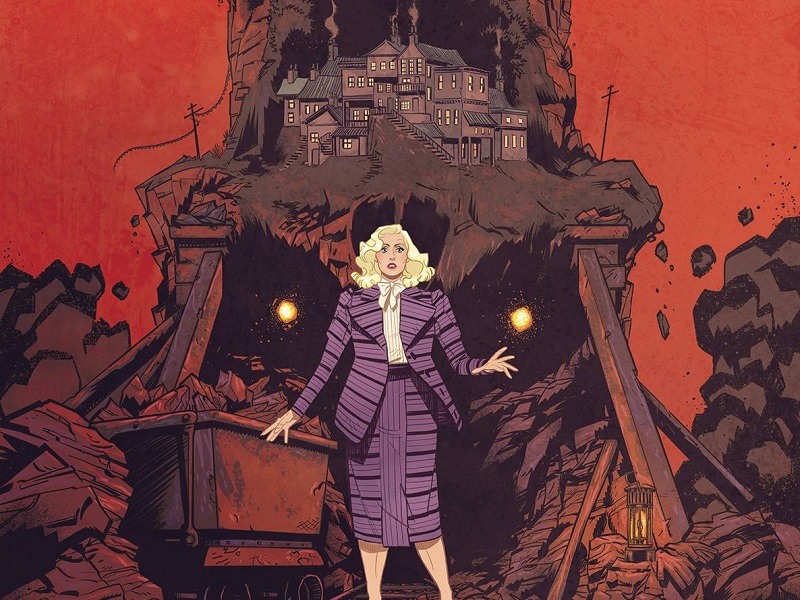
Vivian Drake is no stranger to playing heroes in the movies. When given the chance to behave like a hero in real life, though, will Vivian rise to the occasion? Find out in writer, Jeremy Lambert, and artist, Claire Roe’s, upcoming series, Dark Spaces: The Hollywood Special. Featuring colors by Jordie Bellaire and letters by Becca Carey, learn why Lambert set the story in Minersville and how Roe landed on Vivian’s final look in the following interview:

Rachel Bellwoar: The train may be called Hollywood Special, but Minersville is about as far from Hollywood as a person can get. This isn’t the first town Vivian and Lou have stopped in, as part of their US war bond tour, but what made you decide to make it the setting of this series?
Jeremy Lambert: Minersville, Pennsylvania was where the idea for this book came from, actually. My grandfather was from Minersville and I still have some family members living there. We’d visit when I was younger and shortly after my grandfather passed away in 1997, I was reading his memoir, which was just this old Word document that my dad had on the family computer. It certainly wasn’t intended to be published or anything, just a collection of memories that my grandfather wrote down. But it was full to the brim of what Minersville was like and how everything revolved around the mines for everyone in the town, and how the young boys of the town would work as breaker boys – kids whose hands and fingers were small enough to sort the coal that came up onto the breaker. I was eleven or twelve at the time I was reading it and imagining kids younger than me working in that environment was scary. But what was even more scary was a paragraph where Pop talked about how sometimes, after a cave-in or mine collapse, body parts would come through the breaker along with the coal and debris.
That stuck with me ever since. My imagination ran with it. So I have been thinking about a horror story set in Minersville for a long time, one that would use that paragraph as a core element of the story. Additionally and much later on, I had scribbled a few ideas about Vivian and Lou on a train called the Hollywood Special against the backdrop of the Second World War and the war effort at home. So they were these two separate story ideas, and the real propulsion came from combining them. Once that happened, something that was more plot and monster based (Minersville/Mismatch Man) met an idea that was really just some character thoughts (Vivian and Lou). Bridge that with the fact that I’m a massive fan of model trains and likely just wanted to put a train in there for fun and bam! In all seriousness though, I really love the compartmentalized structure of a train, so the joining of those two innately segmented things – the train and the Mismatch Man – made a lot of sense in being these two things that could reflect different parts of our hero Vivian. Both the parts she played on the screen and the parts of her that she wants to forget.
Whew, first question and I’m already rambling, I’m sorry!
Bellwoar: No, everything you’re saying is fascinating, and I wouldn’t have realized the personal connection you have to Minersville. Thanks to Jordie Bellaire’s colors, Minersville is literally a dark, washed out space (especially compared to the interiors of the train) but Vivian is in a dark head space, too, when we first meet her. Where did the idea to let Vivian’s daughter introduce her (via letter) come from?
Lambert: I thank Jordie Bellaire’s colors every day of my life on this book or otherwise, haha. I’m a massive, massive fan of Jordie’s work and am so lucky to be working with her. And while I’m on the subject, I’m lucky to be working with the brilliant Claire Roe as well, who completely stuns me with designs and layouts, let alone inked pages. Most of my emails to both Claire and Jordie are so jubilant that they’re incoherent messes of caps lock and exclamation points. It’s such a dream come true, the way this team was put together. And I constantly feel like a fraud who has tricked everyone, working with such talented people as Claire and Jordie and Becca. But yes, that’s a great point. And is really indicative of how dialed in Jordie was from go with this story and her approach to the colors in helping to give a sense of where Vivian is emotionally from the start.
The letter existed in the first draft of the pitch. It came about because of something I try to solve with every Issue #1 that I write. Because, at least for me, it’s important to distill the core emotional hook of the story down to something that could fit in the opening pages. A character-defining emotion/feeling and a scene that acts as a lens or a mirror for us to see that clearly, as our introduction to them. And, if I’m doing my job right, doing this without bogging us down in exposition. So the danger with a letter is being too text/caption heavy. But keeping the captions shorter and punchier and showcasing a clearly troubled relationship as the first thing we really learn about Vivian – from the perspective of someone who is upset with Vivian and for good reason – is hopefully an engaging way to draw us into how Viv is feeling from the opening pages.

Bellwoar: If Vivian Drake resembles Veronica Lake, physically, her backstory recalls Joan Crawford’s. Were they any actresses you specifically modeled Vivian after?
Lambert: Veronica Lake was certainly the initial inspiration for Vivian, and then so much of the inspiration for Vivian came together from Ingrid Bergman, Barbara Stanwyck, and others. She’s a reaction to how actresses in particular were treated when it came to media coverage, their personal lives, and relationships romantic or otherwise that were essentially the same as our own even though they weren’t/aren’t treated as such. We’re all a mess from time to time, at least in someone’s eyes. There’s also some development to her character that came from outside Hollywood history and was a bit more personal, but Vivian became this outlet for that and some of my film studies and interests and concerns and then Claire and Jordie defined her in so many more ways. Claire, I know you had done so much design work and costuming that you sent over for everyone but especially for Vivian. Did you have any other inspirations?
Claire Roe: Well one of her later outfits was actually inspired by Katharine Hepburn in The Philadelphia Story! And I used Lauren Becall as hair-inspiration for the older Vivian, to separate her from her more Veronica Lake long silky locks of her younger days. A lot of her costuming ideas came from sewing patterns of that era too, as well as fashion photography- isn’t the internet just great? I tried to stick with strong lines, heavy blacks, or patterned fabrics. Things that look good in black and white, and make her stand out from the more conventionally dressed, less glamorous people around her.
Bellwoar: In the same way that we often only know actors from their image, for a good chunk of the first issue we only see Vivian’s face as reflected on screen (where she’s playing a role) or in the glass of a bottle. What made you want to hold off on showing Vivian’s face directly?
Lambert: This circles back a bit to a previous answer but I’m very happy you asked. And I think Claire can really speak to this, because her work is so precise here. For me, I remember watching the openings of movies on VHS or DVD or Turner Classic Movies (and now blu-rays/streaming) over and over and over whenever I would get the opportunity, just to see how characters were introduced and how so much of who they are could be contained in their first action/s, what they’re wearing, or who they’re speaking to and how they’re speaking to them, or even just their reaction to something. Especially if they were a “star” that already came with a handful of expectations and how those might be subverted or embraced. And then doing the same for comics with issue #1’s and seeing that first panel or splash of them – that first bit of character acting and emotion, wardrobe, how crowded or spacious it was, if anything else was given a place of prominence in the panel – or the opening pages of some of my favorite books to see what that paragraph looked like or that opening line of dialogue that introduced me to a character I’d follow throughout a series.
It’s just so much fun to study. And for this book, I really wanted to introduce her like a true star would be introduced in the late ’40s or ’50s, actually. I remember thinking about Cary Grant’s intro in Notorious for example, and the silhouette/shadow work. And some of the character introductions in The Sandman as well, actually. Infusing as much character and backstory into that simple introduction as possible. Anyway, all credit has to be given to Claire for how it plays, and plays wonderfully in issue #1. It’s just absolutely beautiful work and page design. And again, the ideal version of all of this is that you’re getting that, with the letter from her daughter, the setting and destination for the book, and the understanding of who Vivian is in Hollywood, the public eye, and her personal life, all in the first five pages, without feeling like those first five pages are too noisy or are essentially homework.
Roe: I love that trope in movies or comics where a character’s face is partially distorted or shrouded in shadow, so I’m glad I got to try that out here. It was Jeremy’s idea to have Vivian seen through her glass and through the bottles at the bar, then as I was drawing it out we decided MORE DISTORTION. From the p.o.v. panels to through the gin bottles, this really is a fun but precise introduction to her character. You get a real sense for who she is and what her story might be, without, as Jeremy said, getting bogged down in exposition.
Bellwoar: If Vivian’s initial reason, at least, for agreeing to go on this war bond tour was to generate some positive press for herself, it’s less clear why fellow actor, Lou Gaines, joined. Will future issues also focus on Vivian or will some come from Lou’s point of view?
Lambert: Vivian is definitely our hero, but Lou’s along on this journey as well for reasons of his own, and brings some of what I wanted to say about machismo and expectations of masculinity and things that bothered me growing up and still bother me now. All wrapped up in a story set in 1942, sure, but it’s still an engine for our feelings now. So, Vivian’s perspective is paramount, but Lou’s point of view will definitely be focused on in future issues and we will understand why he’s here.

Bellwoar: What was it like getting to design the movie posters for some of Vivian and Lou’s films, like The Adventures of Sally Steel and The Flyin’ Aces?
Roe: It was a lot of fun looking through movie posters from the 1930s and on, the drama, staging and colours really make for great stand-alone illustrations. Often the posters are more exciting than the movies themselves hah! The titles and fonts also play a huge role, so I tried to capture that with the big arching movie titles that look almost kitsch now. But the bright popping colours are the best part! So Jordie really made them stand out amongst the more muted colours of their surroundings. The Flash Gordon serials of 1936 were a big inspiration for Sally Steel, and for The Flyin’ Aces our goal was to showcase that Hollywood Machismo – standing in stark contrast to who Lou Gaines really is (physically, but also in his heart) outside of the movie screen.
Bellwoar: Traveling by train always seems so glamorous in the movies. Do you have a favorite train-set movie (whether it actually came out in the ’30s or ’40s, like Shanghai Express, or is supposed to be set there, like Sidney Lumet’s Murder on the Orient Express)?
Lambert: Strangers on a Train! With an honorable mention to The Lady Vanishes. Also, the more recent Snowpiercer and Train to Busan are both fantastic. Okay, sorry, I’m done, I promise.
Roe: I’ve never watched Strangers on a Train! Though it’s a Patricia Highsmith book that I always come back to. I second Snowpiercer and Train to Busan!
Bellwoar: Thanks for agreeing to this interview, Jeremy and Claire!
Dark Spaces: The Hollywood Special #1 goes on sale August 16th from IDW and is part of Scott Snyder’s anthology series, Dark Spaces. The FOC date for the first issue is July 10th.
