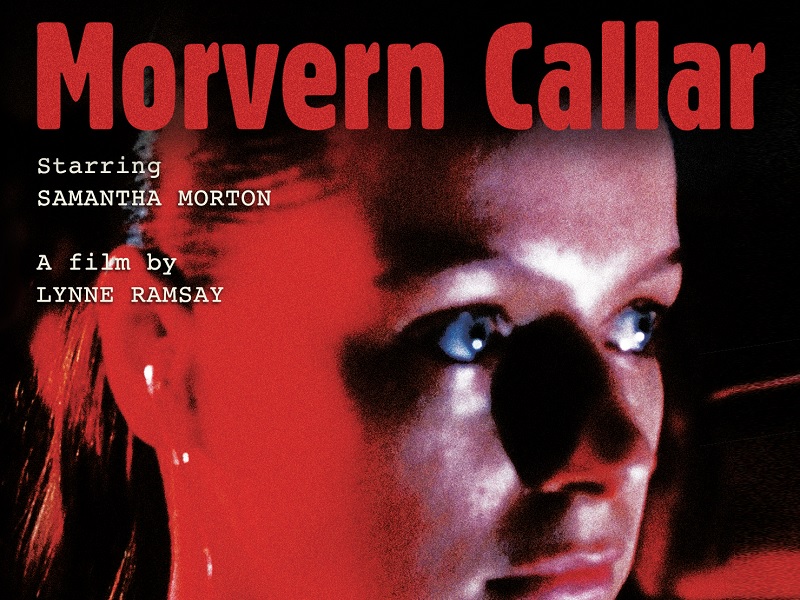
Camus, Grief, And Christmas Tree Lights: A Review Of Fun City Editions’ Blu-ray Of ‘Morvern Callar’
by Rachel Bellwoar
Never assume you know what a person’s going through in real life. An easy enough statement to agree with, but few films (if any) have embodied that message more than Lynne Ramsay’s Morvern Callar.

Morvern Callar isn’t the first film to tackle grief, but in terms of capturing that feeling of everything closing in around you – of the world becoming smaller and numb, and unreal, so that even the simplest tasks are strange and surreal – the opening moments of Morvern Callar are indelible, which is why, if you’d prefer to go in blind, this would be the moment to stop reading.
It’s all about what Ramsay leaves out of frame. There’s nothing alarming about a person lying down next to their boyfriend, until the next shot you see is of their boyfriend’s cut wrist. After the title card, Ramsay pulls back further to show Morvern (Samantha Morton, The Serpent Queen), still on the floor, but facing the other way. Her boyfriend has committed suicide yet, close-up, you would never know anything’s wrong.
As the sequence continues, and Morvern tries to go about her business, Ramsay goes back to leaving Morvern’s boyfriend’s corpse out of frame, but once you know he’s there, it’s all you can think about, and the oppressiveness of the situation shines through.
Without having to resort to voiceover, Ramsay is able to put viewers in Morvern’s headspace, so that even when she leaves the apartment to go to a party and doesn’t tell her friends what’s going on, you know she’s thinking about her boyfriend because you, as a viewer, can’t stop thinking about him (Chris O’Neill considers this decision not to use voiceover in their visual essay on Fun City Editions’ Blu-ray).
The choice to set Morvern Callar at Christmastime is another stroke of genius on Ramsay and co-screenwriter, Liana Dognini’s, part. The way Ramsay uses Christmas tree lights, in particular, as a spatial reminder of where Morvern is in relation to her boyfriend’s corpse in the room is as dark as dark gets, yet so is grief, and that’s ultimately what Morvern Callar is about.
It’s also about how Morvern grieves, though, or more specifically the way Morvern interprets her boyfriend’s last request. Instead of submitting his final manuscript to publishers under his name, Morvern passes the book off as her own. It’s a major plot point yet, in my opinion, one both trailers for the film on Fun City Editions’ Blu-ray emphasize too much. Going by the trailers, you would think Morvern was all about money, and that is one way of interpreting her actions, yet it’s not the only way (plus, if I had to critique one thing about Morvern Callar, it’s that I don’t think it’s entirely accurate in its portrayal of the publishing industry – would a publisher really have responded back so quickly to an unsolicited manuscript over the holidays?).
Bonus Features:
Even if it’s a film you love, it can be hard to come up with enough things to sustain a commentary about it. Listening to film critics and authors Alexandra Heller-Nicholas and Josh Nelson talk about Morvern Callar on their commentary for Fun City Editions’ Blu-ray, it felt like they could’ve kept going for hours and still not have run out of insightful things to say. They bring up some of the differences between the film and Alan Warner’s novel of the same name. The book was more entrenched in rave culture and there’s a line deleted from Morvern’s boyfriend’s suicide note in the movie that could’ve changed how viewers perceived Morvern’s actions in the film (the ethics of which also gets brought up by Heller-Nicholas and Nelson). My favorite part is when they talk about Morvern’s mother and draw connections between Morvern Callar and Albert Camus’ The Stranger.
Other films that would make great double features with Morvern Callar include A.T. White’s Starfish (which also uses music to tell a story about grief) and Wim Wenders’ Paris, Texas. The latter I didn’t think of until Heller-Nicholas and Nelson compared Morvern Callar to a western, with Morvern as a female wanderer, but, like Harry Dean Stanton, Samantha Morton isn’t afraid to act in silence.
The standard edition of Morvern Callar is available on Blu-ray now from Fun City Editions.