
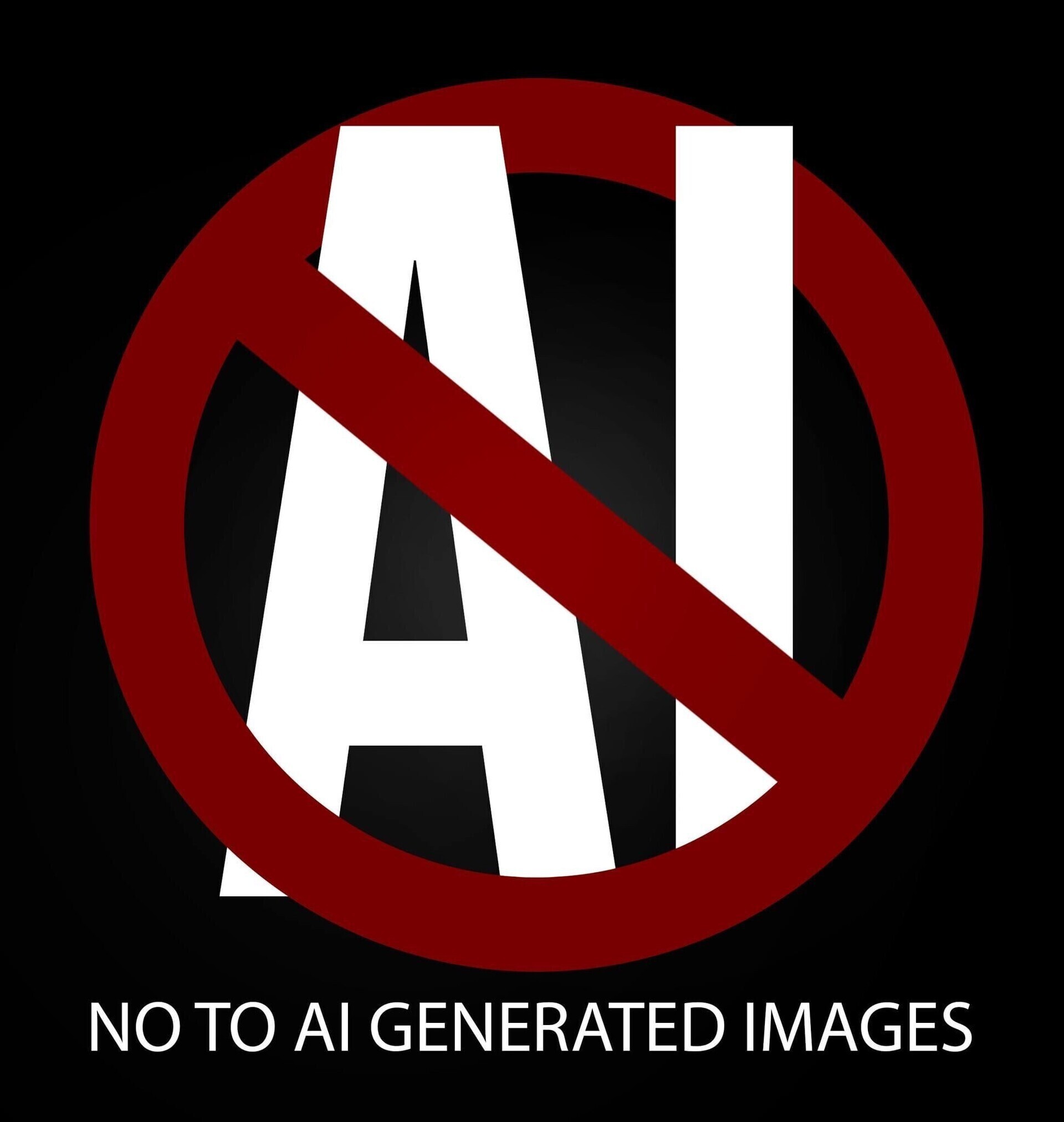
Opinion: Why Comic Book Publishers Should Stand Up to AI And Machine Learning
by Tito W. James
The following is the opinion of the author and does not necessarily reflect the the opinions of Comicon.com.

Recently, the Massachusetts Independent Comics Expo (MICE) released a statement regarding the use of AI/Machine Learning. The full statement can be read here.
AI/ML Stance:
MICE has been steadily monitoring the rise of Machine Learning and AI generated art. We can affirm that it is our position that AI art is counter to the spirit of our festival and the support of our community of independent creators. We are developing a policy for our exhibitor and mini-grant application process reflecting this stance and will release it ahead of next year’s application window.
It’s a relief to finally see a convention grow a spine and stand up to AI image generation. As a reviewer, I’m only interested in reading comics and watching movies that are created by humans. The idea that a screenwriter can be given an AI-generated screenplay and then told to “punch it up” by a corporation is nauseating. The use of digital tools and taking inspiration from artists that have come before are both fine. However, AI image generation exists in a legally grey-zone that feels more like plagiarism, fraud, and forgery rather than a new tool in Photoshop.
This is a tool created by mega-corporations with the purpose of automating imagery by ripping off artists’ hard work and erasing their jobs. While visions of killer robots invading cities is still farfetched (for now), there is still clear and present danger from this unregulated technology. AI/Machine Learning has the very real power to generate false images and propaganda that can be used to manipulate and mislead people.
Judy Estrin (former chief technical officer of Cisco) gave an in depth perspective on why we should stand up to AI. The full statement can be read here.
“I have never had such mixed feelings about technological innovation. In stark contrast to the early days of internet development, when many stakeholders had a say, discussions about AI and our future are being shaped by leaders who seem to be striving for absolute ideological power. The result is “Authoritarian Intelligence.” The hubris and determination of tech leaders to control society is threatening our individual, societal, and business autonomy.
Here in Silicon Valley, this top-down authoritarian technique is amplified by a bottom-up culture of inevitability. An orchestrated frenzy begins when the next big thing to fuel the Valley’s economic and innovation ecosystem is heralded by companies, investors, media, and influencers.
They surround us with language coopted from common values—democratization, creativity, open, safe. In behavioral psych classes, product designers are taught to eliminate friction—removing any resistance to us to acting on impulse.
The promise of short-term efficiency, convenience, and productivity lures us. Any semblance of pushback is decried as ignorance, or a threat to global competition. No one wants to be called a Luddite. Tech leaders, seeking to look concerned about the public interest, call for limited, friendly regulation, and the process moves forward until the tech is fully enmeshed in our society.
We bought into this narrative before, when social media, smartphones and cloud computing came on the scene. We didn’t question whether the only way to build community, find like-minded people, or be heard, was through one enormous “town square,” rife with behavioral manipulation, pernicious algorithmic feeds, amplification of pre-existing bias, and the pursuit of likes and follows.
It’s now obvious that it was a path towards polarization, toxicity of conversation, and societal disruption. Big Tech was the main beneficiary as industries and institutions jumped on board, accelerating their own disruption, and civic leaders were focused on how to use these new tools to grow their brands and not on helping us understand the risks.”
Even within the Art/Entertainment world, there are people who are buying too quickly into the idea that, “AI is here to stay so we’d all better get used to it.” I’m also hearing heartless statements like, “adapt or die.” Now is the time for solidarity not cynicism.
Popular webcomic artist Sarah Andersen wrote an eloquent and impassioned article for The New York Times detailing her experience with AI generating images using her work. The full statement can be read here.
“I felt violated. The way I draw is the complex culmination of my education, the comics I devoured as a child and the many small choices that make up the sum of my life. The details are often more personal than people realize — the striped shirt my character wears, for instance, is a direct nod to the protagonist of “Calvin and Hobbes,” my favorite newspaper comic. Even when a person copies me, the many variations and nuances in things like line weight make exact reproductions difficult. Humans cannot help bringing their own humanity into art. Art is deeply personal, and A.I. had just erased the humanity from it by reducing my life’s work to an algorithm.
It gets darker. The LAION data sets have also been found to include photos of extreme violence, medical records and nonconsensual pornography. There’s a chance that somewhere in there lurks a photo of you. There are some guardrails for the more well-known A.I. generators, such as limiting certain search terms, but that doesn’t change the fact that the data set is still rife with disturbing material, and that users can find ways around the term limitations. Furthermore, because LAION is open source, people are creating new A.I. generators that don’t have these same guardrails and that are often used to make pornography.
In theory, everyone is at risk for their work or image to become a vulgarity with A.I., but I suspect those who will be the most hurt are those who are already facing the consequences of improving technology, namely members of marginalized groups. Alexandria Ocasio-Cortez, for instance, has an entire saga of deep-fake nonconsensual pornography attached to her image. I can only imagine that some of her more malicious detractors would be more than happy to use A.I. to harass her further. In the future, with A.I. technology, many more people will have a shadow self with whom they must reckon. Once the features that we consider personal and unique — our facial structure, our handwriting, the way we draw — can be programmed and contorted at the click of a mouse, the possibilities for violations are endless.”
AI image generation, if left unchecked and unregulated, is discriminatory, derogatory, and dangerous. It stands in opposition to fairness, respect, and authenticity. That’s why I’m asking publishers and conventions large and small to take a hard stance on AI. Follow MICE’s example and stand with real artists against frauds and machines. The future has always been what we choose to make it.
