
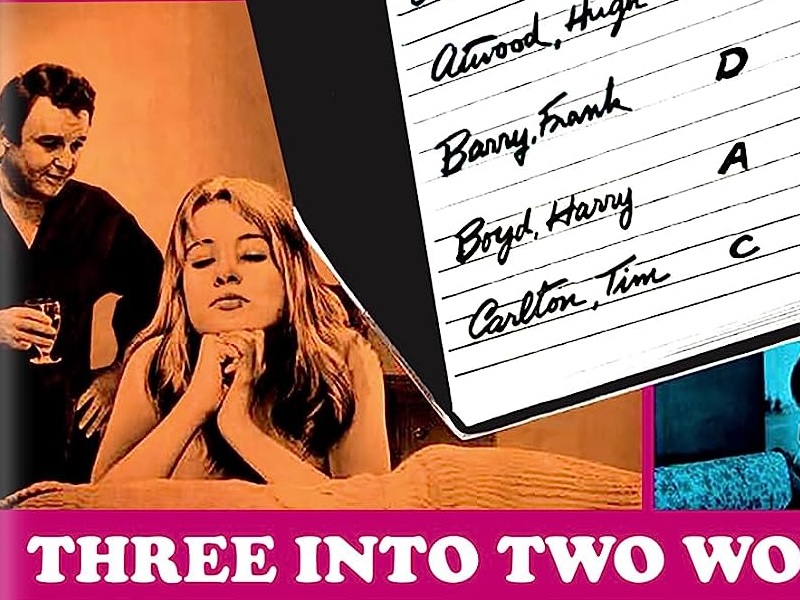
Rod Steiger Picks Up A Hitchhiker: ‘Three Into Two Won’t Go’ Reviewed
by Rachel Bellwoar
Sometimes it’s the hitchhikers getting killed (Road Games). Other times it’s the hitchhikers doing the killing (The Hitch-Hiker). No matter what, hitchhiking in the movies always means trouble, and in Peter Hall‘s Three Into Two Won’t Go that trouble thumbs a ride in the form of To Sir, With Love‘s Judy Geeson.

While murder isn’t on the menu for this movie, Steven (Rod Steiger) is flirting with disaster from the moment he decides to offer Ella (Geeson) a ride. Since it’s a disaster of his own making he’s not a sympathetic figure by any stretch of the imagination, but Steven’s behavior isn’t what’s surprising anyway. Cheating husband’s are a dime a dozen in the movies and that Steven’s wife, Fran, is played by the stunning Claire Bloom (who was married at the time to Steiger in real life) doesn’t ultimately make a difference.
The person who keeps viewers on their toes in this movie is Ella, as she immediately subverts the expected power dynamics of a hitchhiker being at the mercy of their driver by demanding that Steven back the car up and come to her, rather than walk the few steps to the car door herself. Throw in her age and gender and Ella’s sense of self-worth and command of her own sexuality makes her a force to be reckoned with, even if her motives for getting involved in Steven’s life aren’t clear.
Edna O’Brien – no stranger to writing films about love triangles (X, Y, and Zee) and May-December romances (Girl with Green Eyes) – wrote the screenplay for this movie, and as film historians, Troy Howarth and Nathaniel Thompson, bring up in their commentary, that ambiguousness, in terms of how much characters know or why they make the decisions they do (especially at the end, when the camera stays on Ella’s face), is why Three Into Two Won’t Go offers more food for thought than the average cheating movie.
The set decoration by Bryan Graves also adds to the subtext, particularly the choice to have so many windows and glass walls in this movie. Narratively it makes sense because Fran and Steven just moved, so they haven’t had time to put up curtains yet, but it also makes it really stand out when Fran goes to the trouble of tacking a blanket over the guest room window. Suddenly privacy becomes important yet, if anything, the blanket draws more attention to the problem.
Other topics covered in Howarth and Thompson’s commentary include Steiger’s career, other films about failing marriages, and Francis Lai‘s score (which was supposed to include more music than the film’s overused main theme). They also talk about a TV cut of the film which Kino Lorber have included as a bonus feature on their disc and which is much more than a version of the film with the bedroom scenes cut out.
Time stamp-wise, the TV cut is only seven minutes longer but, according to Howarth and Thompson, twenty minutes of new footage was added so that means thirteen minutes must have been taken out to compensate. None of these news scenes are with Steiger, Bloom, or Geeson (the plus side being that it’s very easy to fast forward and find the scenes if you aren’t up to rewatching right away). Basically there’s a new subplot around a probation officer who’s looking for Ella, as well as a few scenes at Steven’s job that show his affairs haven’t gone unnoticed by his bosses. None of these scenes are to the film’s benefit. The whole point is to keep the cast small, so the tension between the three love triangle participants isn’t broken. Adding new characters and an after school special vibe completely misses the point and ruins the ambiguous ending, but it’s exactly because these scenes are so wrong that they make for fascinating comparison, and I’m glad Kino Lorber included them.
Three Into Two Won’t Go is available on Blu-ray from Kino Lorber.


