
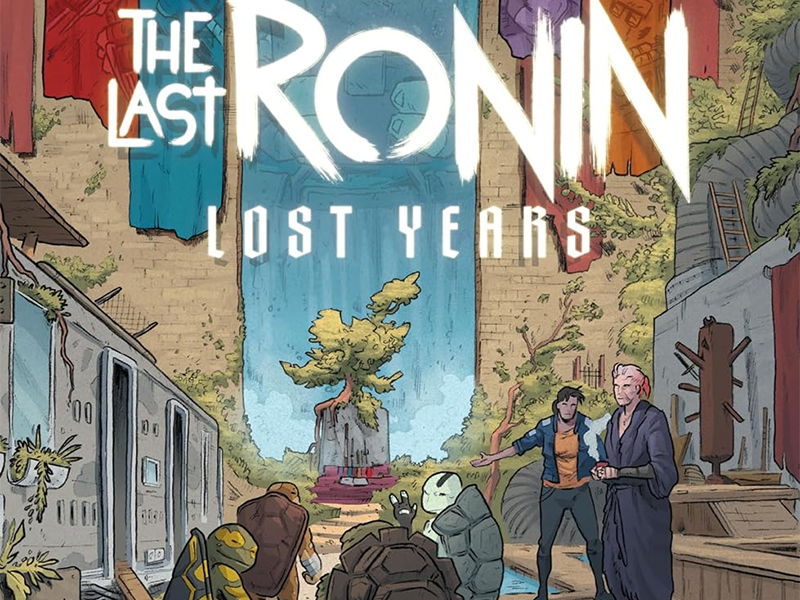
The Journey, Not The Destination — Reviewing ‘TMNT: The Last Ronin – The Lost Years’
by Scott Redmond
Overview
Past and present continue to intertwine as ‘Teenage Mutant Ninja Turtles: The Last Ronin – The Lost Years’ returns to the world built within the first miniseries. A typical and serviceable prequel series is chock full of great art and expressive energetic moments, even as it delivers a story a bit too familiar in some spots.
Overall
8/10Just because we have witnessed how a story ends doesn’t mean that there isn’t still plenty of meat on the bone. While the mission of the Last Ronin — the final surviving ninja turtle, Michelangelo — to avenge his family in a dystopian future ended with his own end, what happened in those years before he returned to New York is ripe for exploration. One might call them … the lost years.

And that’s where Teenage Mutant Ninja Turtles: The Last Ronin – The Lost Years picks up. Those crafting the tale are Kevin Eastman, Tom Waltz, SL Gallant, Maria Keane, Ben Bishop, Luis Antonio Delgado, and Shawn Lee.
One of the things that worked so well in that original series was how it beautifully it married the past and present (a dystopian future but present for the characters). Showing us what happened to the other Turtles over the years, and what led to this broken future through which Mikey achieved his quest for vengeance and peace. It’s a beat that carries over into this new series, focusing both on the aforementioned lost years of Mikey’s wandering, but also picking up from the epilogue of the first series. Where Casey Marie Jones, daughter of April O’Neil and Casey Jones, is working to train the next generation of Teenage Mutant Ninja Turtles alongside her mother.
In some cases, this dual timeline situation works out well, as Eastman and Waltz take us into Mikey’s mind while also showcasing the hardships that Casey and April must face with their growing charges. Yet, it’s also a format that is lacking. Very few of the pages were spent on the young new turtles, despite their story having a much more powerful bite to it. There is a reason this series is getting another miniseries that is focused on those characters.

Part of what makes it work less this time is that many of the beats Mikey thinks about and deals with are repetitive. There are two whole spreads, like a page apart, where he runs through a mental checklist on how he lost each of his family members. The entire first mini was about him dealing with the trauma and getting his revenge (while finding a new family), so having us rehash some of that journey set in the past feels a bit off.
We get a very diverse but also similar sort of artistic approach with Gallant and Keane on the lost years’ portion and Bishop on the future segment. Both styles have a bit of roughness to them that speaks to the tone of this universe with heavily expressive characters on display. In Bishop’s section is more about capturing the variety of emotions and personalities on display as the characters are less active overall in their portions, while Gallant and Keane also work in a lot of fluid dynamic movement and action into their pages.

Separating them is how the past pages are overall heavier with the inks and the overall aspects, giving them more weight than the other pages. By that, I mean that there is an overall feeling of heaviness there because of the content and the emotions of Mikey’s journey. Whereas the future pages are still happening in a dark future world, but are about hope and the future Turtles finding their way. So they visually have a much lighter feel to them that enhances that hopeful feeling.
Across both periods are the colors of Delgado who finds a way to maintain a certain style while also displaying different palates for each era. Just like how I spoke about the art overall above, there is a heavier darker more shadowy type of colors chosen for the lost years while the future pages have a lot more vibrancy and flashes of color to them. Not only does it play to the different energies of the periods, but it makes sure that right away one can feel the changes when moving to another period, beyond just the apparent changes in the artwork and the characters.

One of the connective tissues across the Turtle books often comes down to the lettering, which is commonly done by Lee. His work brings great energy and personality to every single word that appears on a page. Lee makes sure that not only do all the captions and bits of dialogue flow around the page easily in the best way to follow but also infuse them with the right energy needed in any given moment. This includes colorful boxes, emphasized text that helps set the volume/tone, sharp boxy dialogue boxes that are perfectly fitting for this universe, and so much more.
Teenage Mutant Ninja Turtles: The Last Ronin – The Lost Years is now available from IDW Publishing.

