
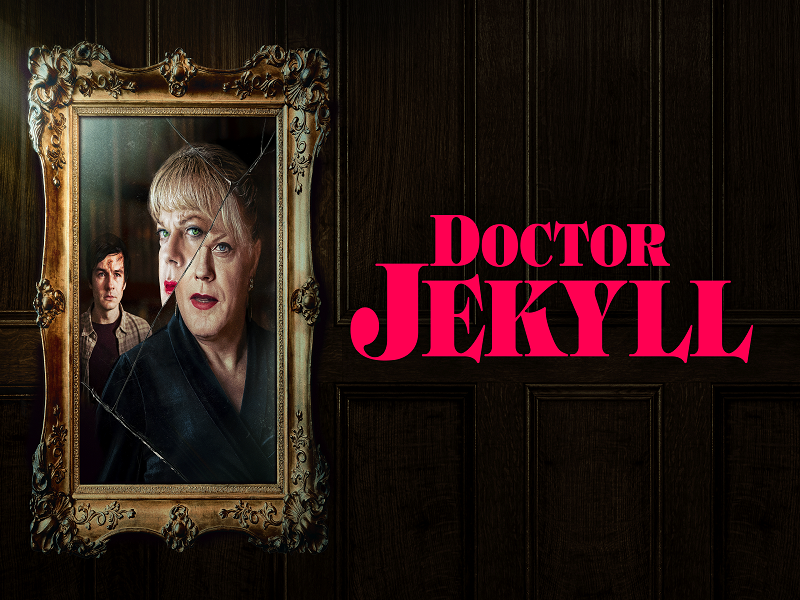
Talking Hammer’s ‘Doctor Jekyll’ With Director Joe Stephenson
by Rachel Bellwoar
Having recently been released from prison, Robert (Scott Chambers) is in need of a job and Dr. Nina Jekyll (Eddie Izzard) is in need of helper. Their meeting should be kismet. Instead the whole arrangement threatens to be a nightmare in Joe Stephenson‘s latest movie, Doctor Jekyll. For more on what it was like getting to work with Hammer Films, check out this interview with Stephenson below:

Rachel Bellwoar: What does Hammer Films mean to you and what was it like getting to make a film for that studio?
Joe Stephenson: Its interesting because Hammer Films represents to me a type of British film that doesn’t get made any more, and since I am not of the generation that got to experience this first hand its all quite nostalgic! This film is an independent film, and a low budget one at that! It just so happened that what I wanted to do was a throwback to those films, whether it be the camp wink, the gothic lighting designs or the more leisurely pace building atmospheric over the modern style of genre films. What then happened was the new Hammer loved it and wanted to make it an actual Hammer film! Which is a beautiful outcome for a film like this!
Bellwoar: This isn’t Hammer’s first rodeo, in terms of adapting Robert Louis Stevenson’s novella. Were you familiar with their previous adaptations going into this project and why do you think a new version was needed?
Stephenson: I was indeed, and not just Hammer’s versions but several others! The fact that it is so adapted was actually quite freeing, I felt that with a story so familiar to so many people there’s no need to be religiously faithful, the challenge here was how to make it feel fresh and yet still true to the themes of the original work. Can we find ways to surprise people when they already think they know where it is going? Stevenson’s work becomes a storytelling toolbox, and the novella is such a wonderful one to play in as a filmmaker. It is one of the great classics of literature and part of doing a new version is certainly to inspire new generations to revisit the original, but also seeing what it can say about the world we live in today.
Bellwoar: Often in Jekyll and Hyde movies the story revolves around the title character(s). What appealed to you about framing this story around Robert instead?
Stephenson: I ultimately felt that modern audiences wouldn’t be able to relate to Jekyll so easily, but they would to a character like Rob. He’s a modern boy trying to navigate an older generation’s ideas — for me it was always akin to the modern cinemagoer trying to navigate the world of older films. Rob is a modern boy thrown into an old world: old money, old house, older generation, old ideas. He has had a rough time but he isn’t without hope, he’s been caught up in drugs but is refusing to let it define him, he’s frustrated with the world but isn’t angry with it, he’s emotionally intelligent but academically not. And all these things become particularly interesting when you realise he’s the exact opposite, on all these fronts, to Jekyll and Hyde.
Bellwoar: Similar to your first feature, Chicken, which was about two brothers, Robert is extremely close to his brother, Ewan (Morgan Watkins). Would you say sibling relationships are something your drawn to in your work?
Stephenson: It’s not so much sibling relationships directly, but family dynamics I think I’m drawn to. We have an instinctual trust of people we are blood related to, and that’s interesting to me since it’s just a societal expectation. There’s no logic to it when you think about it, and nearly all statistics on the various forms of abuses say they occur within the family most often. That sounds like I’m alluding to some tragic family set up of my own, which I assure you I’m not! I just think it’s fascinating, and from a storytelling perspective it allows you a slight shorthand with the audience as a result of those expectations of such relationships.
Bellwoar: What was it like working with Chambers and Robyn Cara again, having previously worked with them on Chicken and Ackley Bridge respectively?
Stephenson: Wonderful. Scott also played young Ian McKellen in romanticised memories in my documentary too, we’ve known each other years and we just have a great time working together. I trust him and he trusts me, and we always find ways to keep working together. Robyn is such a versatile actress, thoughtful and dedicated, which I could tell straight away on Ackley Bridge so I was keen to work together again. I love working with people I trust, not least because when you work on the budgets I have had to deal with so far, I need to know I can trust everyone to do their job and bring their everything. In independent film those restraints can be incredibly painful, and sometimes require everyone to think on their feet, so I look for those people who can do just that and when I find them I work with them again and again!
Bellwoar: There’s always a lot of anticipation around Jekyll’s transformation into Hyde. Was there ever a point when you considered using makeup and/or prosthetics to aid Eddie Izzard’s performance?
Stephenson: No, this version is very much about the evil within and we wanted it to be more subtle than its been before (until the climax!) We wanted people to be guessing which one was on screen, to engage in that mystery, and if Eddie had some major physical transformation that game would be up immediately and Rob would, for certain, have got out that house very quickly.
Bellwoar: Most of the film takes place in Nina Jekyll’s home. Did you always want to keep the number of locations low?
Stephenson: Budget restraints! Naturally, if we’d had the budget of a normal film in this genre then we would have certainly loved to take the characters out and about, expanded their world. In particular Doctor Jekyll’s world in the pharmaceutical industry. I always wanted to be able to see her make a public appearance at the opening of something, that Sandra would have made her go to. Someone would have been rude and Hyde would have made an earlier appearance. But sadly low budget film making is all about sacrifice and spending what you have on the most important things to you, one of the first things you do is limit the amount of locations and the amount of days in a way that guarantees you actually can finish the film with what you have. So that’s what we did!
Bellwoar: Your next film, Midas Man, is about The Beatles’ manager, Brian Epstein, and includes Izzard as part of the cast. Do you ever see yourself making another horror movie someday?
Stephenson: I’m always trying to do something very different each time, I like to challenge myself! Midas Man couldn’t be more different than Doctor Jekyll. Doctor Jekyll couldn’t be more different from my McKellen documentary, and so on. As for making a horror movie, I don’t feel like I’ve made one yet! Doctor Jekyll is a very particular type of genre film, and its priority is not to scare you all the time. It’s to disturb you and make you uneasy, for sure, but it’s not an outright horror movie in the modern sense. For me it’s a camp gothic melodrama with some claustrophobia, shocks and a bit of terror in the end… so a modern horror film is definitely something I’d like to still do!
Bellwoar: Thanks for agreeing to this interview, Joe!
Doctor Jekyll is available in the UK on Digital Download.


