
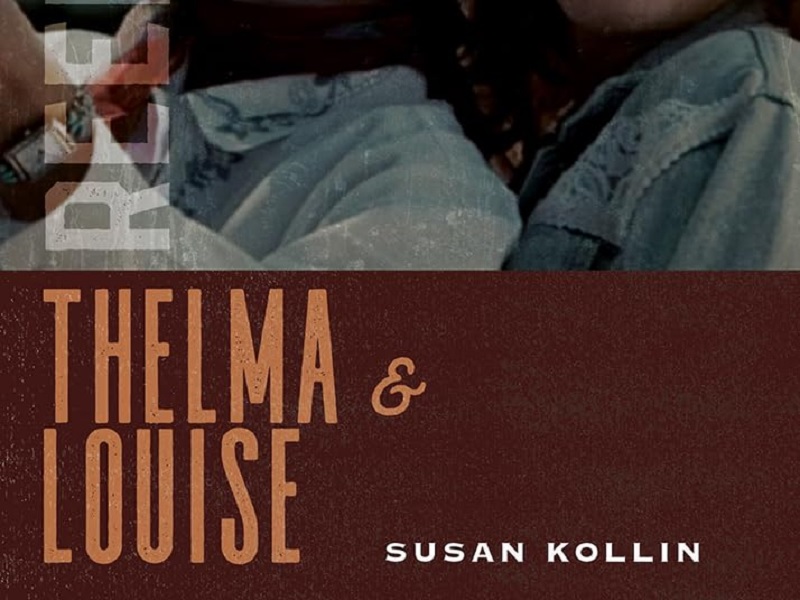
Talking ‘Thelma & Louise’ With Author Susan Kollin
by Rachel Bellwoar
Westerns aren’t just lone cowboys and period pieces. They can also be about two women played by Geena Davis and Susan Sarandon whose vacation goes horribly wrong. In her latest book, Reel West: Thelma & Louise, Susan Kollin considers the insights that can be gained from reading Ridley Scott’s Thelma & Louise as a Western. For more on the book and the film (which won an Oscar for best original screenplay by Callie Khouri), check out this interview with Kollin below:

Rachel Bellwoar: From buddy film to road movie, there are a lot of different categories that Thelma & Louise falls into yet Western isn’t always mentioned. Do you think the fact that Thelma & Louise takes place in contemporary times plays into that?
Susan Kollin: Thelma & Louise definitely crosses a lot of categories. By bringing together different storytelling traditions, Thelma & Louise was able to push the boundaries of the genre in unexpected ways. It showed that themes such as freedom, mobility, violence, and belonging are important concerns for both female and male characters in the Western. These concepts, of course, might appear quite differently when told from a female character’s perspective.
I think it’s important to note that in general, popular audiences are less familiar with the early history of cinema. While there is a long tradition of women’s Westerns dating back to the silent era, many of these movies have fallen out of film history or become classified in different ways. Because of this, I think a woman’s Western set in modern times was regarded as a bit unusual for audiences in the early 1990s. Today, partly because of the success of Thelma & Louise and other films, we are better able to see that the Western can be a vehicle that tells us about the struggles and conflicts shaping other lives in the contemporary West.
Bellwoar: When approached with the idea of writing a book for this series, was Thelma & Louise always your first choice?
Kollin: I had other films in mind that I was also interested in writing about for the series. I like offbeat movies, so my initial list included Westerns such as The Furies, a 1950s film from the “golden age” of the Western. Directed by Anthony Mann, the movie features Barbara Stanwyck as the daughter of a self-centered rancher who has to fight for a place in her family and the West, both of which are haunted by a racial panic that threatens the overall community. Not surprising for the era, it is also Freudian in its depiction of the father/daughter relationship. I was likewise interested in The Homesman, a 2014 Western directed by Tommy Lee Jones. The film was adapted from a novel by Glendon Swarthout and tells the story of the “unsettling” of the West. Both films are gothic and disturbing takes that force us to rethink white settler histories of the region. Later in the process, I came to appreciate Bandidas (2006) even more. It’s a parody of Hollywood Westerns that is sort of a cross between Sergio Leone films and Blazing Saddles.
Bellwoar: One way that the contributions of women to the Western genre have been ignored in the past is by not labeling them as Westerns. Having studied this area for years, who do you think are some of the key, overlooked players?
Kollin: The Wind, featuring Lillian Gish, would be at the top of my list. Directed by Victor Sjöström and adapted from a novel by Dorothy Scarborough, this 1928 silent film is often overlooked as a Western, yet it’s not difficult to see links between the movie and Thelma & Louise, especially in terms of sexual threat and terror. In Kelly Reichardt’s Meek’s Cutoff (2010), which is another women’s Western, there’s also a scene that directly references a moment in The Wind. The staged movements of a very pregnant character who is nearly swept off the landscape by a tremendous gust of wind replays and updates a similar scene in the 1928 film. The Wind was also recently adapted by Emma Tammi. Her 2018 version brings the tradition of the horror film to the women’s Western in unexpected, fascinating, and supernatural ways.
Bellwoar: What was one of the biggest revelations you made while doing research on this project?
Kollin: I wasn’t prepared for the number of Westerns that featured rape or sexual assault. That was a very disturbing discovery for me.
Bellwoar: Even if you haven’t seen Thelma & Louise there’s a good chance you’re aware of the ending. How much do you think Thelma and Louise’s fate is in keeping with the traditional fate of gunslingers in Westerns?
Kollin: In interviews, Callie Khouri has talked about how she envisioned the ending even before she began writing the film. When we think of Thelma & Louise as building on and extending the Western, the screwball comedy, the buddy film, and the action-adventure movie, the ending makes most sense within the tradition of the Western. The gunslinger—the man or woman of violence—cannot be reincorporated into society according to the conventions of the genre. In this way, I think the ending really helps identify Thelma & Louise as a Western.
Bellwoar: In the book you talk about the moral panic that was set off by the film’s release. Would it have been different if Louise had shot Harlan (Timothy Carhart) in self-defense instead of revenge?
Kollin: Sadly, I think the film would have still received some form of backlash. The idea of women defending themselves against the unjust actions of men is unfortunately still quite radical today. The feminist philosopher Kate Manne talks about what she calls the “smackdown,” the common outcome, result, or payback when women question male power in ways that are disturbing or threatening to men.
Bellwoar: Why do you think Westerns were more willing, or able, to address rape than other genres?
Kollin: Scholars of the Western from Richard Slotkin to Edward Buscombe and Lee Clark Mitchell have defined violence as a key element of the genre. Throughout film history, the Western has depicted many diverse types of violence. It makes sense to me that the genre would also take up sexual violence. Rape is a weapon of war and a tool of colonization. Westerns have typically depicted the conflict between white settlers and Native Americans as a war. In this way, I think it’s important to note that Westerns are not always known for their feminist or anti-racist treatment of rape.
Bellwoar: What do you think sets Thelma and Louise apart from other Western heroines?
Kollin: Thelma & Louise is a Western set in contemporary times that features not just one but two female leads. Right off the bat, that makes the film’s main characters quite different from other female figures in the genre. They have each other and thus are able to create a female support system. They don’t fight each other or cut each other down, but instead have each other’s back. If you think about Vienna and Emma in the film Johnny Guitar (1954), for instance, you can see that Thelma and Louise are really a tremendous departure from the norm.
Bellwoar: Thanks for agreeing to this interview, Susan!
Reel West: Thelma & Louise is available now from University of New Mexico Press.

