
Characterization In The Buffyverse — ‘Angel’ Season 1, Episode 16
by Benjamin Hall
This is part of a bi-weekly series concerning the characterization of Buffyverse characters. The first installment in this series can be found here. Arguably the best place to begin reading this series is at the beginning, but that is up to each reader. As a reminder this column will cover major and some minor characters from the shows Buffy The Vampire Slayer (1997-2003) and Angel (1999-2004). Other Buffyverse media, such as the graphic novel Spike: Into The Light (2014) are not pertinent to this series. Also there will be no referencing real world events that have direct relation to either show in this bi-weekly series.

This week: Angel (David Boreanaz) unwillingly joins a demon fight ring. Also, a prominent lawyer for Wolfram & Hart appears.
(Warning of spoilers from this point on!)
Angel tries to play a Spartacus role in this episode. However, he arguably only provides verbal inspiration versus being any kind of real leader.
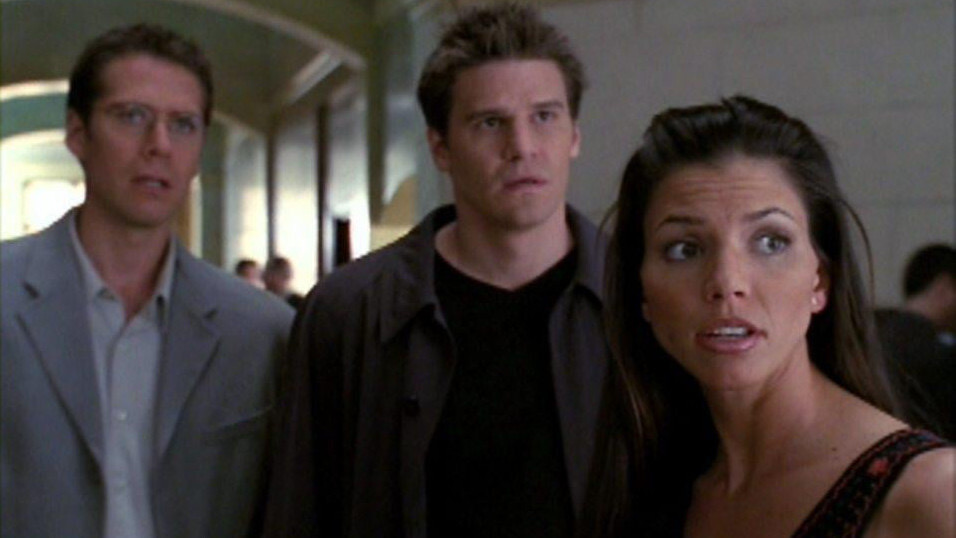
Cordelia Chase (Charisma Carpenter) and Wesley Wyndam-Pryce (Alexis Denisof) get tiny bits of growth. Yet, both only really exist in this episode to act as plot devices and help with the escape, as well as give out exposition. When it comes to Cordelia’s growth, she demonstrates the ability to act while briefly pretending to be a cop. Yes, it is rather on the fly, but it is better than any of the acting Cordelia attempts professionally. As for Wesley, he is still gag character, but that sees a severe reduction. In place of being comic relief, he gets to serve as both a science/magic expert and a kind of action hero.
Lilah (Stephanie Romanov) acts as a temptress to Angel by offering a way out from the demon fight ring. She otherwise is a mysterious gambler who works as a lawyer for Wolfram & Hart.
Darin MacNamara (Douglas Roberts) and Jack MacNamara (Scott William Winters) are the owners of an underground fight club that uses demons as slaves. They apparently have access to either a good make-up artist or a supernatural method of looking beat-up. However, neither seems overly knowledgeable about the supernatural. Of the two, Jack seems more street smart and casual. While Darin seems more pragmatic of mind and cold of heart. Despite their differences in personality, their respective egos are massive and lead to each of their deaths.
Tom Cribb (Mark Redmond) is a demon with toad-like qualities that acts like a jerk. He does eventually act as a leader when it comes to gaining freedom for the demons, though
Lasovic (Mark Ginther) and Baker (No actor credited) are two demons in the fight ring that are of differing subspecies. Both are very stock in characterization, but Lasovic fails to understand English unlike the characters.
Mellish (Mark Rose) is a demon who seems rather young. He also comes across as rather insecure due to his near constant pretense at being tougher than he is.
Mr. Winslow (Chris Flanders) is the standard wealthy businessman. He exists as a plot device to allow Cordelia and Wesley to steal a ticket into the demon fight ring.
Ernie Nellins (Anthony Guidera) is a bookie working for Darin McNamara. His only truly noticeable traits are being smug and a smoker.
Val Trepkos (Juan A. Riojas) is a demon who acts mostly as a literal strong and silent type. He is also a sort of symbolic leader to the other demons when it comes to their escaping.
The doorman (David Kallaway) the announcer (Michael Philip), and the club dancer (Nicki Sixteen) are extraneous characters. That said, the announcer has a purpose for existing, but announcing fights could easily go to Darin or Jack
There is a social commentary with the villains being human and their victims being demons. Also, the demons seem to get a lot of human qualities in this episode that blur the lines between human and demon. While this goes back to an explanation that Anya (Emma Caulfield Ford) gives about most demons being partly human (Buffy The Vampire Slayer Season 3, Episode 21, ’Graduation Day, Part One’). As for the commentary, it seems to be that sometimes the average looking person can be just as evil as the non-typical looking person. Despite this twist, and the humanization of the demons, the message gets undercut by the last lines of the episode. Lastly, what little characterization exists seems reliant on tropes and clichés.