
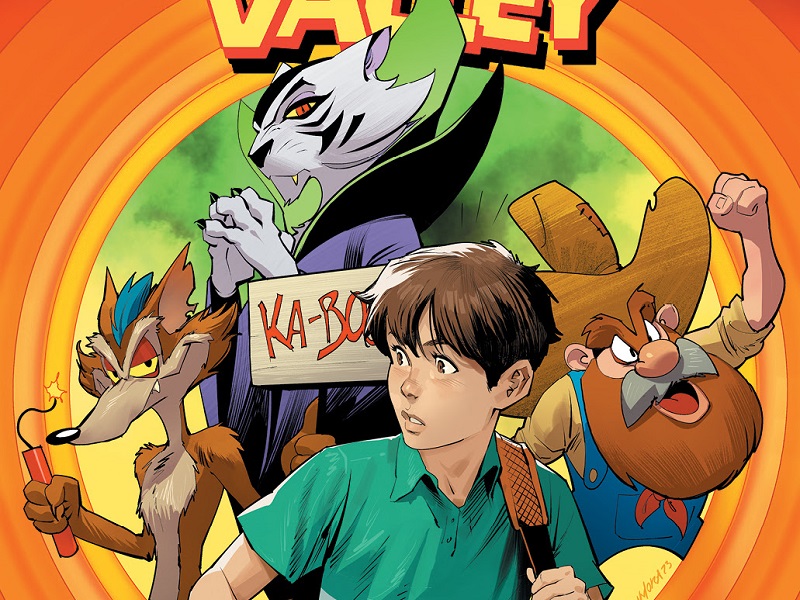
Talking ‘Uncanny Valley’ With Writer Tony Fleecs And Artist Dave Wachter
by Rachel Bellwoar
Oliver didn’t think his mom would believe him if he tried to explain what’s been been going on recently. As it turns out, though, his mom may know more than she’s let on in writer Tony Fleecs and artist Dave Wachter‘s new series, Uncanny Valley. With letters by Pat Brosseau, find out why Oliver’s been having such a rough time at his new school in this interview with Fleecs and Wachter below:

Rachel Bellwoar: How would you explain “uncanny valley” to someone who’s never heard the term before?
Tony Fleecs: The way we’re using it, it’s the distance between something being real and being animated. It’s usually used to describe that gap in either CGI or AI… When something looks just slightly off. Our story’s about a kid that’s going through changes and he… feels slightly off.
Dave Wachter: Easiest explanation is when animation tries to look real, like really real, but doesn’t quite pull it off. Think Polar Express. You know it looks wrong even if you can’t figure out exactly why it looks wrong. And it ends up giving the viewer an uneasy feeling.
Bellwoar: Growing up, what were you favorite cartoons to watch and did you have a favorite Looney Tunes character?
Fleecs: I feel like I’m a Daffy Duck. I couldn’t identify with Bugs’ cool, carefree attitude. But I could definitely identify with Daffy Duck’s hapless rage.
Wachter: I figure, like most kids my age, I watched any cartoon I could get my eyes onto. Early favorites include Scooby-Doo (pre-Scrappy), ’60s Spider-Man, Looney Tunes, Thundaar the Barbarian, and Super Friends. As a child of the ’80s, I moved into all those “boy-centric” action toons of the time, like He-Man and the Masters of the Universe, Transformers, and Thundercats, and some early anime like Starblazers and Robotech. But I didn’t stop, Batman the Animated Series, Ren and Stimpy, and anything by Genndy Tartakovsky invaded my late teenage years. And of course, since the time they were shorts before the commercial breaks on The Tracy Ullman Show: The Simpsons.
My favorite Looney Tunes character? That’s tough narrow down, Bugs is the best, of course. Sam the Sheepdog was great. I like that big red tennis shoe monster, but I always got a huge kick out of the Goofy Gophers. They were so insanely polite, with their little English accents, but then they’d do something incredibly violent, and I just thought that was hilarious.

Bellwoar: Like Who Framed Roger Rabbit? before it, Uncanny Valley bridges the world between cartoons and real life. Who Framed Roger Rabbit? was a movie, though. What was it like achieving that effect in a comic book series?
Fleecs: That’s a Dave question– The only thing I did was tell him what Brad Simpson did with color to make Stray Dogs look like an animated movie and then he went and figured it out.
Wachter: As far as the visual look, my challenge was to make sure that the “real” world and the cartoon world were distinct from each other. It’s a comic book, so everything is still drawn. But by using different inking styles, and especially, different coloring styles, I could achieve the look. Therefore, the linework of the real world resembles pencil lines, and the coloring is painterly, for an organic appearance. Meanwhile, the cartoons have a distinct inked line, and bright, flat colors resembling a cell animation style.
Bellwoar: It’s been a while since I’ve seen the film, but while humans were aware of Toons in Who Framed Roger Rabbit?, I believe Bob Hoskins’ character only experienced cartoon physics for himself in Toontown. Oliver’s experience in Uncanny Valley is very different. Did you always want the larger world to be unaware that cartoons exist and were there any effects from animation that didn’t translate well when you tried to replicate them in the real world?
Fleecs: Yeah– I love a story about a secret world or a hidden world. This kid gets to discover something and be a part of something that nobody else even knew existed.
Bellwoar: Roger Rabbit isn’t the only film Uncanny Valley recalls. There’s also Alfred Hitchcock’s The Birds. Why did you decide to make one of the antagonists in this series birds?
Fleecs: I was thinking about things that are universal to cartoons and one of those things was crows. They’re in Dumbo, In sleeping beauty, Heckle and Jeckel are magpies but… still basically crows. I also wanted something that we could have in the book from the very first page and not know that it was a cartoon. Crows in nature look pretty close to the way they look in cartoons minus the beaks and eyes.
Also, they’re creepy.

Bellwoar: There’s nothing like a family tree project at school to stir up some family secrets. How would you describe Oliver’s relationship with his mother?
Fleecs: That’s basically what the whole book is about: Oliver’s relationship with his mom and her relationship with her dad and family bonds and how they make us into who we are. Oliver has very little connection to any family beyond his mom and the book is about him finding out where he comes from while he’s going through changes.
Bellwoar: From the fast food cups in the car to her nurse’s uniform, Oliver’s mom doesn’t have to say a word for readers to know she’s under a lot of pressure. How did you come up with the visual clues to get across her situation?
Fleecs: I’m not sure where those came from but I’m always trying to think of stuff that we can do visually that saves me having to write stuff out. Dave does such a good job of capturing these characters’ essence and part of that is- what’s the world around them like? What’s their neighborhood look like based on his mom’s nursing income. What are the houses like? What state are they in if they’re driving distance to the desert. He’s very thorough.
I just sprinkle in stuff like the fast food cups when I think of them and I know Dave will throw in so much more when he draws it.
Wachter: My wife is a nurse. And she’s a mom. So naturally, I made my wife the visual model for Oliver’s Mom Margaret. I’ve seen the effect that her job can have on her. Nurses have a tough job, and they are underpaid and under appreciated. So when Margaret has to take off work to come to the school when her son gets in trouble, she’s going to be looking like she’s been working that tough job, and her body language and expressions are going to tell you that she doesn’t have time for nonsense.

Bellwoar: I’m always boggled when kids rooms on TV are shown completely bare without any shelf space. Oliver’s bedroom feels much more true to life. What was it like filling that space with knick knacks?
Fleecs: That’s all Dave. Like I said, I give him a rough idea and he just cooks.
Wachter: I spent a lot of time designing his bedroom. I was once a 12 year old boy with a messy bedroom, toys scattered around and posters covering the walls. And I have two step kids who were that age not that long ago, so it wasn’t too much of a stretch to think about what their rooms have looked like. Thinking about that, my main objective was to fill up that space as much as I possible could.
Bellwoar: Because cartoons are often (though not exclusively) geared towards children, it’s easy to forget how violent they are. Is that something this series brings attention to?
Fleecs: I guess it does. If you’re familiar with my work, you know my cartoon books sometimes get very violent– this one we ARE using cartoon style violence and showing the effects of it, sometimes on real people but— I’m not sure if we’re commenting on anything. My mind is just as warped from watching all these cartoons as everyone else’s is.
Wachter: I think so. And I think it highlights how dangerous a cartoon world would be for a regular person, and how weird a person would be if they started a sting like a cartoon in the regular world.
Bellwoar: Thanks for agreeing to this interview, Tony and Dave!
Uncanny Valley #1 is out now from BOOM! Studios.

