
Talking ‘Lowborn High’ With Writer David Barnett And Artist Anna Morozova
by Rachel Bellwoar
Andy always thought getting into Wyndusk Manor would be a snap. His last name was supposed to be all he needed, but when grades end up mattering more than Andy expected, it’s off to Lowborn High until he can prove he’s serious. Written by David Barnett, with art by Anna Morozova and Mike Walters, Lowborn High is a magical school series like only 2000 AD can produce. With colors by Morozova, Pippa Bowland and Phillip Vaughan and letters by Jim Campbell, it was wonderful to be able to ask Barnett and Morozova some questions about what it’s been like working on the strip:

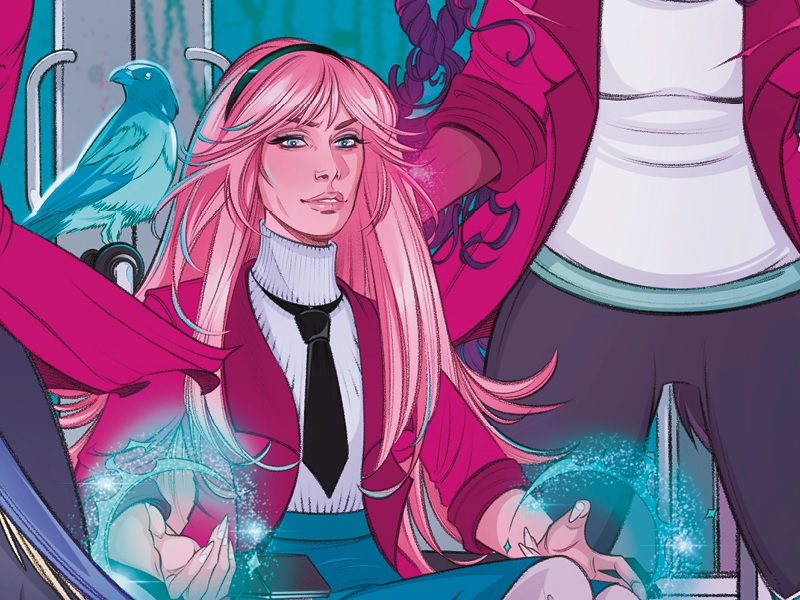
Rachel Bellwoar: For the book cover, how did you decide which stories to tease (like Maisy’s familiar and Drill’s identity)?
Anna Morozova: The final cover is the development of the third cover concept. Originally, we started with two different cover ideas that also featured other character(s) (or a HINT of other characters) in them. After delivering drafts structured around the first two concepts, the decision was then made to keep the focus on our main cast (the Deadbeats Club) only, with the cover clearly indicating their location: Lowborn High that is.
Adding a bit of the forthcoming stories’ tease would make the image more dynamic, I thought. Having placed the main four characters in front of the school entrance, I added a little bit of extra, something that clearly illustrates the magical elements readers can expect from the storyline. The decision on which elements to introduce into the cover seemed very natural at the point of illustrating the image. Suggesting a glimpse of Drill’s werewolf identity was an opportunity that would had been difficult to miss. Adding Maisy’s familiar into the picture was a nice and subtle touch too, in my opinion.
These elements also showcase that there are different dimensions to magic in the story.
David Barnett: The cover is just perfect in the way it presents the main characters against the shabby backdrop of the school… it sums up the ethos of the strip perfectly.
Bellwoar: Another way of telling this story would’ve been to have a student from Lowborn High get transferred or earn a scholarship to Wychdusk. What made you opt for option B (having a student from Wychdusk Manor be forced to attend Lowborn Manor)?
Barnett: You’re right, this would be the time-honoured way to introduce readers to a new environment, through the eyes of the outsider whose journey we follow. But with stories such as this, the norm has become the big, posh boarding school, which we generally see through the eyes of the “commoner” newcomer.
From Enid Blyton to Harry Potter, we all know what those environments are like, they’ve become ingrained in our cultural consciousness. So the idea here was to flip it on its head, take the well-worn trope of the privileged kid with magical powers and put him in the situation on the other side of the fence. That said, if we got a second series, the more traditional set-up is something that we’d explore… but obviously with a twist.

Bellwoar: Due to limited funds Lowborn Manor isn’t the most pristine of buildings. Did you always want to feature graffiti on the walls?
Barnett: I think that was the idea of first Anna and then Mike, as a shorthand way of showing that this place is a bit run-down, that the kids who go there express their frustrations through the time-honoured tradition of scrawling on walls. There’s some great graffiti there if you study the panels!
Morozova: Graffiti is one way to reflect on the rebelliousness and conflicting nature of some of the cast members. Graffiti is a visual language utilised by some not only as a way of creative expression, but also as the way of reflecting on their emotions about injustice, unfairness, and internal frustration… why have Wychdusk students got it all?
The story’s second episode is a sports centred one, and when it comes to sports, graffiti is often a communication tool utilised by teams’ support groups. On top of all things, it is possible to use graffiti in the story to add some little Easter eggs here and there: small references either to the parts of the actual story, or to something completely outside of it (although still something that 2000 AD readership can pick up on).
Bellwoar: Another way class differences are reflected between the schools is by what brooms the student can afford when playing Orbitus (the main sport). Did that make designing a broom for each student more random, since they’re not always reflective of their personalities?
Morozova: Whilst Wychdusk students have access to high-end brooms, Lowborn ones have to resort to what is accessible and often make use of what is actually there with the help of some spell-casting. No room for choice, but the necessity to make the most out of what is available. At the end of the day, it is not so much about the equipment, but the skills, correct? Having a high-end tool helps to a certain extent, but it is ultimately about the person using it; and without having the upper hand, one has to compensate with ability, talent and strive for success.
For the Wychdusk students’ brooms, I thought utilising animalistic elements was just a fun idea. Andy having a broom featuring a unicorn is a way to say: here, it is beautiful, stylish, it has a degree of grace to it. Although at the same time, we know those toy stick horses that kids play with? A slight reference on the different dimensions of Andy’s personality; how he wants to be perceived and what lies underneath the layers of beauty and graciousness.
Barnett: The fact Anna got a Henry Hoover in there made me laugh so much.

Bellwoar: With each story in book one readers learn more about one of the members of the Deadbeats Club. The exception is Zack, who’s actually the school bully. What made you want to get into his backstory and is there a story behind the gold chains he wears?
Barnett: Every school needs a bully, and Zack is Lowborn’s. But just as every good villain doesn’t actually think they’re evil, they think they’re doing the right thing, Zack isn’t just the way he is because he feels like it. Well, maybe sometimes he is, but I thought it was important to show his own story as well as the Deadbeats. Zack comes from a family that saw the potential in his magical powers for, basically, petty crime. Whether he likes that or not is something we can hopefully delve into a bit deeper further down the line.
Bellwoar: While there’s no question that the Deadbeats Club are having a positive influence on Andy, his judgement is continuously impaired by his desire to get into Wychdusk. It feels honest that way but is it difficult sticking to a long game in comics?
Barnett: Andy is basically, apart from on a couple of occasions where he steps up and proves himself, just an awful person. In the same way that Zack is awful, Andy’s attitude comes from privilege and entitlement, in other words, his upbringing. I suppose the ongoing question is whether we can rise above our conditioning to become our own people, or if that sort of thing is so ingrained it’s impossible to shake off.
As to playing the long game, the first two episodes of Lowborn were basically designed as standalones with the potential to get more if it proved popular, which it did. So it was a case of seeding over-arching situations until we got the go ahead for a long run, when we could bring them to the fore a little more.

Bellwoar: From imps to trogs, what’s been your favorite magical creature to introduce on the series?
Barnett: I love the imps in Anna’s episodes and Mike did an amazing job on the underground Trogs in his first job illustrating the strip.
Morozova: I quite enjoyed drawing those imps, I must admit. Those Gremlin-alikes are quite quirky and fun to illustrate.
Bellwoar: Representation matters. What was it like getting to incorporate Maisy’s diagnosis of multiple sclerosis into the story?
Barnett: Every character has a backstory, and that is just part of Maisy’s. She uses a wheelchair and it was natural to want to explain why without that completely defining her. Aside from some nasty comments from Zack and his crew in the early episodes, Maisy’s disability is basically just part of her, but by no means the standout feature. Later on we tackle something that’s quite sensitive – should a character with a disability be “cured” if they can be?
This is a plot driver for one of the later episodes and it was interesting to explore that moral conundrum.

Bellwoar: Without getting into spoilers, there is a Big Bad. How big of a clue is their name, The Votary?
Barnett: A votary is someone who has made vows of service. often in a religious meaning, but in this case in a more general sense. So, it is a clue, yes, but it’s a mystery that is revealed by the end of the book. I only learned later that it’s also the name of an expensive skincare brand, so I possibly should have researched that more deeply before using the term!
Bellwoar: Of the members of the Deadbeats Club, is there a character you identify with the most?
Barnett: Not really, because they all have different aspects of their characters that I like writing. I think Drill is possibly the most fun to write, though, because she’s got a lot of attitude!

Bellwoar: Thanks for agreeing to this interview, David and Anna!

Lowborn High goes on sale April 24th from 2000 AD.
