
Review: Diving Into The Marvelous Magical World Of ‘Lowborn High’ — Good Yet Predictable, Inspired, And Important
by Richard Bruton
Time to take a deeper dive into the magical world of teen wizards found in David Barnett, Anna Morozova, and Mike Walters‘ Lowborn High – welcome to a very different wizarding world…

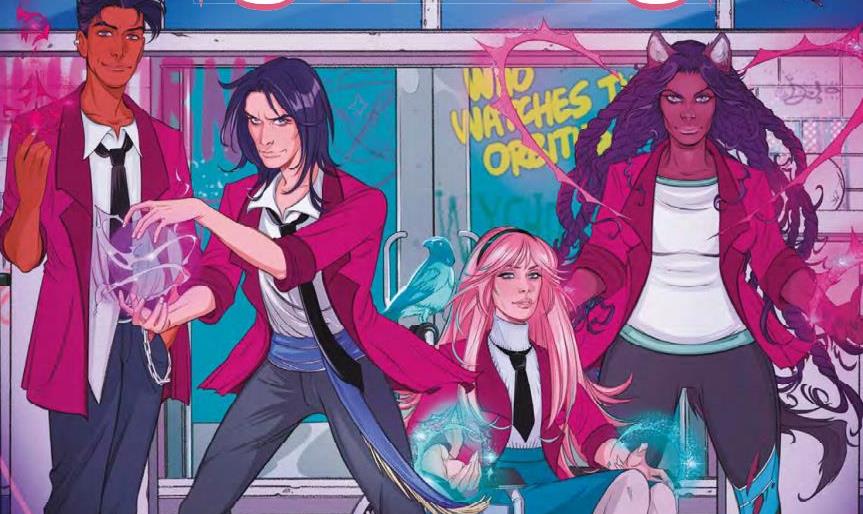
Originally published in 2000 AD‘s all-ages, Lowborn High Book One has been recently collected, giving me a perfect chance to explore the world of teen wizards and witches living life in the wizarding world’s not-so-elite school – the Lowborn High of the title.
Lowborn High is where the also-rans of this particular wizarding world end up, the ones who don’t come up to scratch. Yes, if you’re high-born and magically gifted you’ll end up in Wychdusk Manor, the beautiful school where the finest wizards from the finest wizarding families in the world are prepared for the rest of their great, privileged lives.
Now, Wychdusk was where Androgeus Frost, son of one of this wizarding world’s most illustrious and powerful families, was always headed. The problem for Androgeus and for Wychdusk is that this particular young wizard has a huge chip on his shoulder and an attitude to learning that falls somewhat short of what’s expected.
So, with a bad attitude and terrible grades, the unthinkable has happened and this wizard meant to be headed for greatness is instead headed for Lowborn High, home of the failed wizarding kids from the not-so-elite families.
Lowborn High is your pretty standard, run-down, struggling for funding, no resources, building falling apart at the seams, comprehensive school that’s been very familiar to everyone growing up in Britain across the 70s and 80s. The only difference being that this particular crumbling comp is home to the waifs and strays of the wizarding world. And now Androgeus Frost is headed there. And he’s really not happy about it…

There you go, that’s your set-up in Lowborn High, and a fine one it is too. I’ve frequently called it Hogwarts meets Grange Hill. You’ll know Hogwarts of course but Grange Hill might be a particularly British reference for us ’70s and ’80s kids. Go to YouTube and have a search, it’s a great Brit kids show that moved far away from The Famous Five and it’s impossibly posh well-turned-out kids. No, this was council estate culture on our TV screens and that’s just the sort of vibe that Barnett is obviously going for here, a vibe that he definitely nails.
But Lowborn High also wears its comic influences so well, ditching the jolly hockey sticks elements of those all those school days comic tales of the 50s and 60s and moving into the territory of the classic girls’ comics of the 70s, the ones where the poor kids featured and suffered terribly – with magic thrown in for good measure.

Aiding Barnett in this is Anna Morozova, a relatively new artist but one whose style is absolutely sumptuous and so recognisable, very stylish, very stylised. In some ways she was a strange choice for doing something that’s meant to be a little down in the gutter, given that Morozova’s people and places are so gorgeous. But no, turns out it’s not too much of a problem at all, Morozova’s work sometimes paints a picture of the school that is at odds with the down-at-heel look it’s meant to have but it’s so lovely to look at and has such artistic strength that you can easily get over it.
Unfortunately, Morozova couldn’t stay with the book for the whole run, scheduling conflicts are a pain, but even more of a newcomer Mike Walters stepped in for the second half of this first book with his own style but one that keeps things looking great.
So, as far as storylines go, this has everything you really expect it to have, ticking all the predictable boxes – posh arrogant kid moves into crappy school and has trouble fitting in, riles up both the good and the bad kids, finds he’s got more in common with the group of outcasts and misfits – the Deadbeats Club – and forms fast yet lasting friendships, all against the backdrop of wizarding classes and magical mishaps.

Yes, there are times it veers way too far into the predictable, especially with the obvious boy wizard comparisons and particularly in the first two storylines which you could pretty much call ‘intro to Hogwarts’ and ‘the quidditch episode’.
Thankfully, Barnett’s dialogue and particularly Morozova’s art keeps it as fresh as it can be. But trust me, if you’re reading this and thinking it’s a straight HP clone there’s way better to come.

Indeed, with Barnett and Morozova’s skills at storytelling, the predictable element to those early episodes doesn’t spoil it too much, it’s all still lots of fun, very readable, and very enjoyable. But it’s going get a hell of a lot better as it goes along, with the addition of the backgrounds to the Deadbeat Club, the mysterious coven of witches at Lowborn, and the developing tale of the Frost family, who’ve got a chequered past and an unfortunate habit of mysteriously dying or disappearing.
Lowborn gets a lot better as it veers away from the obvious influences and becomes its own thing, with Barnett developing the tentative friendships within the Deadbeat Club and the friction Androgeus and his attitude brings to things. Again, there’s no huge originality in the idea of the new boy causing waves at school, but it’s the way that Barnett writes it and Morozova draws it that makes it work really well.
The whole thing definitely shifts up a gear when we drop into the second half of the book. Artistically there’s a shift with the departure of Morozova and the addition of Walters, but that’s not the key here. Yes, the book misses some of the stylistic stuff Morozova can do, but Walters’ more grounded and, meaning this with no disapproval at all, slightly more grubby art gives it a different and important look.
In this latter part of the book we have a lot more of the Frost family storyline, the intrigues and machinations of the witch’s coven at Lowborn, and the bigger adventure it’s all been leading up to.
However, as good as that big adventure that ends the book is, the real high point comes when Barnett ventures back into the past of two members of the Deadbeat Club. This is the glorious moment where Lowborn High really takes off, casts off its influences, and becomes a great book. We have the emotive tale of Maisy, the witch in the wheelchair, seeing just how she came to be in the wheelchair and how it affects her and a very bad decision to make a deal to make the school Prom very special, especially as it might be her last chance to make a move on Androgeus.
Before that though, we have the best episodes of the entire book, with Barnett focusing on Ali’s backstory and the fact that he’s always struggled with his gender identity…

What could have gone the obvious, predictable route – the dad shocked and ashamed by his son’s experimentation leading to Ali being thrown out – instead turns into something far more important and well done.
Because Ali’s dad’s not at all concerned about the make-up, it’s the witchcraft he’s worried by, that fear that Ali might be following in mum’s footsteps. As I said at the time in doing the Weekly 2000 AD column – Witchcraft as a trans allegory? That will work just fine.
We even get a lovely, heartfelt, absolutely positive gag at the end of that particular sequence…

After that brilliant and heartwarmingly well-executed piece, we’re back to the present day with Ali and the obnoxious school bully Zach trapped beneath the school with some nasty magical creatures coming to get them.
But again, it’s not the magical elements that matter here at all, it’s the incredibly sympathetic and believable burgeoning relationship between Ali and Zach that really shines, together with the tragic backstory for Zach that explains his surface nastiness.

Yes, full credit to Barnett for taking Lowborn High into its own space and bringing something far more interesting and important in what is absolutely a book that should appeal to youngsters and teens. Having that visibility in Lowborn High, that easy acceptance and fully-rounded characters who can be seen to explore their gender identity and sexuality, is important in a world where the bigotry and hatred against anyone labelled as different is on the rise.
It’s that element of Lowborn High that elevates this one way above the obvious, early influences. It’s those moments that make this one something very special and something to be loved.
Sure, Lowborn High might start off as a really attractive and well done mash-up of its influences, but it’s how it develops that really makes it shine.
We’re left with a cliffhanger here and I really hope there’s a space in 2000 AD or somewhere for Barnett and Walters, possibly Morzova as well, to return to the storyline and continue the great work it became in time.

LOWBORN HIGH – by David Barnett, Anna Morozova, and Mike Walters. Colours by Anna Morozova, Pippa Bowland, and Phillip Vaughan, letters by Jim Campbell.
Originally serialised in 2000 AD Progs 2280, 2288, 2325, 2336, 2346, 2356
Published by 2000 AD on 24 April 2024
Summary
Lowborn High has all the familiar going on, to its detriment at the beginning – a wizarding school, the new kid dropped in who doesn’t want to be there, a group of misfits coming together, a bigger threat in the background – but it’s the way the whole story develops thanks to all concerned that gives us something different and fresh, gorgeous looking, and trying to do and say important things.


