
Talking ‘William Of Newbury’ With Michael Avon Oeming — Exclusive Preview And TPB Details, Too!
by Rachel Bellwoar
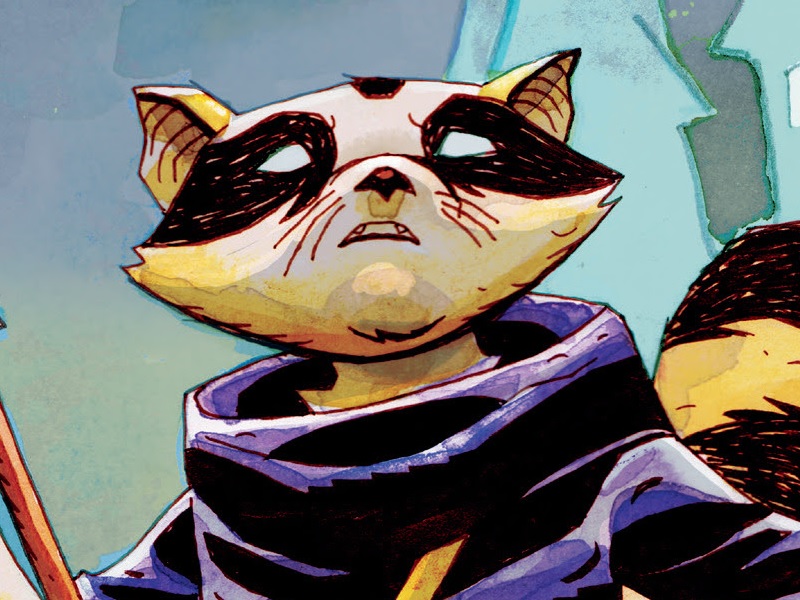
Father William might not be a household name. He wasn’t a racoon either, but he was a real person before becoming the subject of Michael Avon Oeming‘s new series, William of Newbury. For more on why he decided to depict William as a racoon and the history behind this series, check out this interview with Oeming below, along with an exclusive preview of the first issue and details about when the paperback collection will be available:

Rachel Bellwoar: As someone whose talents extend to both writing and drawing, what made you want to both write and draw the art for this series?
Michael Avon Oeming: When I first thought of William, the whole project came into my head in a flash, it was complete with all of its content. All I had to do was to edit it down, cut out any fat and to make sure the characters motivations were clear. I could also see the coloring that I wanted. So early on, I knew I was going to do everything on this one, and even decided to leap into lettering. These are skills I picked up along the way doing kickstarters, short stories and creator owned works, but this was the first time it felt right to do “everything” in series.

Bellwoar: Why do you think William of Newbury benefited from being told as an anthropomorphic story like The Mice Templar?
Oeming: Being influenced by a real historian, I had certain imagery in my mind, but it felt kind of obvious. I’ve been missing anthropomorphic characters, that kind of cozy world contrasted against darker themes. Then I asked myself what kind of themes could I come up with using animals, what animals would I use and not use, what kind of subtext is there? I thought about the imperfections of humanity and our need for a higher spiritual self and what I could say about that with these images. All of the “people” are mammals while all of the spiritual characters are human, something I never draw attention to in the book but I think it says a lot about the world view I’m presenting here. I’m looking to show that we are all equal, all flawed and lesser than our higher spiritual potential. Even if that spirit is just the idea of our best selves.
Bellwoar: Due to that choice and the inclusion of demons, it’s not immediately obvious that Father William was a real person. Can you talk a little bit about the history behind this series and how you first heard of Father William?
Oeming: That’s why I loved this story! To these people in these times, demons and ghosts were very much real. That’s why these stories are all found in The History of English Affairs written by Newbury next to historical facts. It was very much real to them. When James Tynion asked me to do a story for his True Weird series I knew I wanted to do a retelling of one of my favorite folk tales, the Green Children of Woolpit. It’s a true story about these odd children appearing in a medieval village, dressed in green with green skin who spoke a strange language. One of them dies but the other grows up to tell the tale that they came from a fairy land called “Saint Martins land.” One of the historians who recorded the account was William of Newburgh, also known as William of Newbury. He recorded the first history of Britain, mostly surrounding the events of “The Anarchy” time when England was caught in a struggle of succession between King Stephen and Queen Matilda. But in the middle of these true stories he’s also recording stories of revenants and ghosts. Four of which I chose to retell here, using the same titles as Newbury gave them in his history. Little is known about the true William other than he spent almost his entire life in the monastery.

Bellwoar: How did you decide that a “racoon” would be the best animal to embody William?
Oeming: Honestly, it was because of Mike Mignola. He’s obviously a huge influence on me, but I also try not to get lost in that influence. At first I was drawing William as a fox but there are a few anthropomorphic foxes that Mike has drawn over the years and I felt like I was just imitating that because I love his design so much. So I forced myself to rethink it and felt I could bring my own specific life to William as a Raccoon, even though Mike has drawn that mammal lots over the years, I was able to find my own voice in it.

Bellwoar: William and his brother both work for the church yet couldn’t be more different in their views and beliefs. Did you always want to address both faith and superstitions with this series?
Oeming: Absolutely. I grew up Christian but I don’t hold any religious views, most especially to dogma. But I still wanted to respect this religious backdrop as I would any religion I would write about. So I needed a character like Edward to hold those views. Not messing with the supernatural world is a big part of that. I also didn’t want to write that religiously stalwart character one-dimensionally, like a fanatic. It’s such a worn trope. His brother Edward is an antagonist, but not the bad guy and my hope is that any reader, secular or non-secular will understand and appreciate his motivations.
Bellwoar: Along the way William meets Winnie, a mouse thief whose loyalties are still unclear. Was it always the plan to give Winnie a more androgynous style?
Oeming: It wasn’t a plan, but it fits the larger themes I have about equality. I want to show that Winnie and William (and others) are all equal in both body and spirit, we all have the same value, be we monk or thief. William couldn’t really survive outside of the monastery on his own and Winnie wouldn’t get any further in life without William. Neither character is always in the right. We love to categorize things and people and write out history that doesn’t fit that narrative. Medieval history is full of people who don’t fit these traditional roles and labels, they are largely just left out of history. You could say the “traditional” masculine/feminine roles are reversed here, Winnie is the protector, the hunter, the fighter. William is about strength through empathy, education, sharing of power and knowledge. It isn’t that simple, but that’s vaguely their dynamic. When you read deeper into the history of the Middle Ages, you’ll find this wasn’t as uncommon as it seems. I never ever want to be heavy handed with anything, but I hope the subtext of equality comes through both in the story and the concept.

Bellwoar: Occasionally throughout the first issue there are skeletons that talk to William. Are these meant to represent visions that he is receiving?
Oeming: I love the idea of omens and warnings, something visual that tells you trouble is on the way. Kind of like Shaun of the Dead, they’d say “you’ve got red on you” before a character would die, or the “X” that would show up behind someone in [Martin] Scorsese’s The Departed. I love a good creepy omen. If only I could spot them in real life.

Bellwoar: What’s the best part about setting a series in the 12th century, a period known as “The Anarchy?”
Oeming: Oh god, I love history! I’ve been fascinated with Medieval and early Medieval history in England since I was a kid. I think it always engaged my imagination because it was real history that was adjacent to the mystery of not really knowing the full picture. It left a lot to the imagination, which often led into fantasy. The Anarchy is so interesting that George Martin based the House of Dragon series on it. A king names his daughter as successor but few people are ready to accept a Queen and years of war and chaos follows. If we get to do more Newbury, there will be more of that in the next volume. I did cheat on the plague stuff though, I wanted to add that to make everything feel even more dark. I like the idea that the world was dying as a metaphor for the dead rising across the land. War, plague and zombies! William of Newbury is an anthropomorphic Medieval Horror story — but you know, fun!
Bellwoar: Thanks for agreeing to this interview, Michael!
William of Newbury #1 goes on sale May 29th from Dark Horse Comics. We also can officially announce that the trade paperback edition containing all four issues will be available January 1st, 2025 and is available for preorder from http://bookshop.org or you can find a local comic book shop at www.comicshoplocator.com/.

William of Newbury TPB Details:
Writer: Michael Avon Oeming
Artist: Michael Avon Oeming
Colorist: Michael Avon Oeming
Cover Artist: Michael Avon Oeming
Genre: Crime, Fantasy, Horror
Publication Date: January 1, 2025
Format: FC, 104 pages; Trade Paperback
Price: $19.99
Age range: 14+
ISBN: 9781506740836

