
Review: ‘Inside Out 2’ Is A Satisfying Sequel Thanks To Added Complexity
by Erik Amaya

It is amazing how often Pixar sequels prove creatively successful. Monsters University, for example, is a surprisingly well-executed prequel to Monsters Inc. that does a great job establishing the key relationship from the original and expanding the Monster reality. Incredibles 2, while a lesser film than the original, still manages to add some interesting ideas to its environment. Inside Out 2, in theaters today, may be the most successful of the Pixar sequels. Well, provided you’re more in tune with the concept behind Inside Out than, say, Toy Story or Finding Nemo.
This reviewer happens to be one of those people and, thus, the film hits all the right notes.
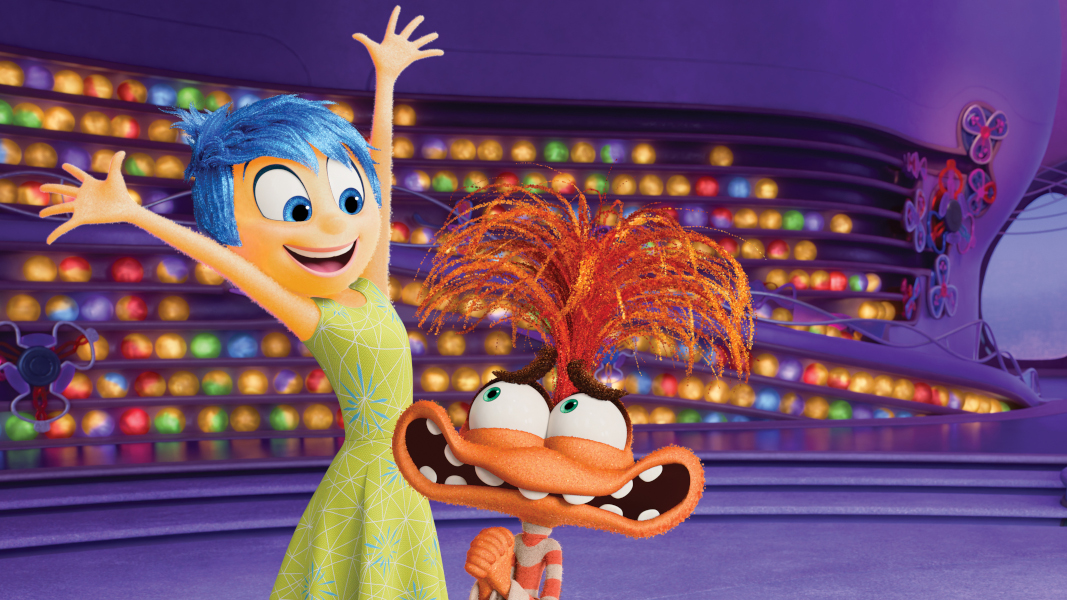
Set a year or so after Inside Out, the film sees Joy (Amy Poehler), Sadness (Phyillis Smith), Anger (Lewis Black), Fear (Tony Hale), and Disgust (Liza Lapira, taking over from Mindy Kaling) navigating the early teens years of Riley (Kensington Tallman). But just as teased at the end of the first film, the puberty alarm has yet to go off. That soon changes, nd with the alarm new emotions arrive: Anxiety (Maya Hawke), Embarrassment (Paul Walter Hauser), Envy (Ayo Edebiri) and Ennui (Adèle Exarchopoulos) — the French word that so well captures the adolescent feeling of “meh” that the character can only really deployed to aid Riley a handful of times.
Despite Joy’s management of Riley toward overall happiness and a sense of self-worth, the arrival of puberty and Anxiety sends everything into chaos. It also has the potential for Joy to doubt if she has been doing the right thing this whole time. Outside of Riley’s head, this drama plays out as she makes some early adolescent choices at a three-day hockey camp.
We mention the situation for Riley as it proves to be one of the best expansion of the Inside Out concept. While her major conflict in the first film was largely external — the move to San Francisco is forced upon her — the hockey camp places Riley in a lot of ethical quandaries not so easily answered by the original set of emotions. As Anxiety puts it, Riley is growing up and needs more complex emotional states than Joy and the others.
That’s largely the internal conflict of the film. It allows director Kelsey Mann (taking over from the first film’s Pete Docter) to realize new aspects of Riley’s mind in genuinely thrilling ways. A notion like the Stream of Consciousness or what a certain teenage reflex does to the mind become more than just throwaway sight gags; they end up integral to the journey the emotions take this time around.
Yes, the sequel repeats the idea that Joy must journey to headquarters again, but it is done so with a different grouping of characters and, ultimately, with a different objective. It also leads to a very different Imagination Land and a sequence that may very well be the highlight of the film as both Joy and Anxiety vie for control of Riley’s imaginative thoughts. For anyone who confronts anxiety in their own lives, the scene will feel familiar and its resolution may offer a little catharsis halfway through the film.
It is probably no surprise that Anxiety is an antagonistic force in the plot, but just as the first film dealt with Sadness in a surprisingly mature way, Anxiety proves to be more than a two-dimensional concept. Which is a good thing as it maintains Inside Out‘s understanding of the human emotional landscape. That aspect will definitely appeal to adults seeing the film, but we expect the colorfulness of the film and the stunningly great animation will keep kids engaged even if they don’t grasp everything going on in Riley’s head.
As before, the returning voice cast delivers such life to their characters with the new crop proving just as adept. Hawke’s Anxiety is, somehow, very compelling in her arguments while Edebiri’s Envy proves to be the right sort of spice needed to offer comic relief in certain moments. But the big performance highlight here is Tallman as Riley. Replacing Kaitlyn Dias from the first film, she is called upon to give the character more depth and has to pull off a really tense scene toward the end. She rises to the occasion and makes Riley as much of a participant this time around as the emotions themselves.
And that might the reason Inside Out 2 strikes this reviewer as a better film than its predecessor. While both use Riley’s choices as a source of tension and drama, she feels more like a character this time than a vehicle for the emotions. Of course, that value judgement translates to maybe half a star as the film very much carries on the premise and visual language of its predecessor. At the same time, that slight improvement also speaks to what an Inside Out sequel should do: make the inner and outer world of its key human character more complex while still celebrating the sometimes contradictory elements of the mind. The film definitely accomplishes that with humor, great voice performances, stellar animation, and a rare wit.
Inside Out 2 is in theaters now.