
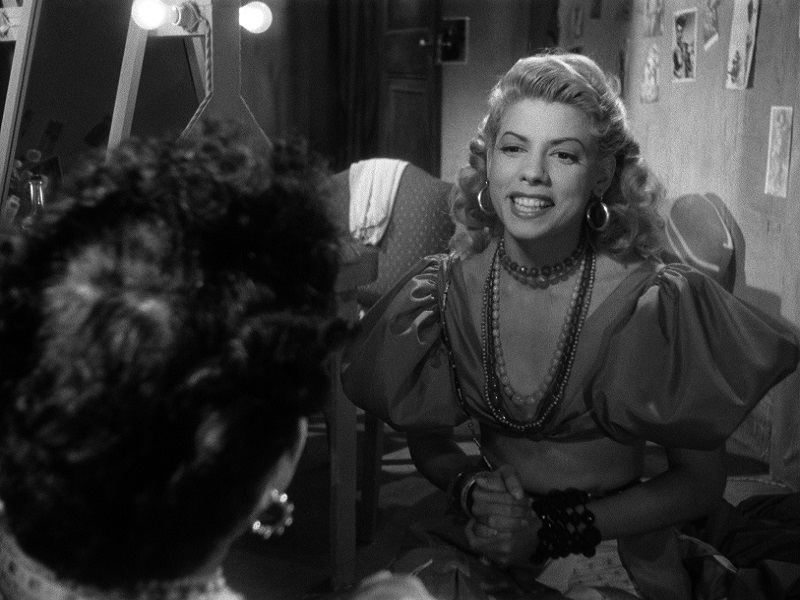
A Mother’s Love: ‘Victims Of Sin’ Reviewed
by Rachel Bellwoar
“We don’t have the right to have children,” Violeta (Ninón Sevilla) tells one of her friends, after learning a colleague of theirs, Rosa (Margarita Ceballos), is about to have baby. There’s no menace in her voice. No sadness or anger. It’s simply said as a statement of fact and with the certainty that no one will contradict her.

The “we” in this scenario are the women who work in The Changoo and on the streets around the bar in Emilio Fernández‘s Victims of Sin. The first time Roldofo (Rodolfo Acosta) walks into the joint another guy is being carried out over someone’s shoulder. In the economic visual language of this film, it’s clear that this is not meant to be a reputable institution.
Still, while Violeta includes herself in the “we,” her career is on the rise, having newly been promoted as a dancer, and she has everything to lose by intervening when she realizes the decision Rosa has made.
There have been films where babies have been left at churches and fire stations before, but Victims of Sin takes things a step further. Rodolfo doesn’t want the child to hurt his reputation so he gives Rosa a choice – either she puts the baby in a trash can or he’ll never see her again.
Rescuing a baby from the trash might seem like a no-brainer, but it’s a decision with consequences and being morally in the clear doesn’t spare Violeta from facing them. It’s this honesty about how Violeta’s choices will affect her life that sets Victims of Sin apart from other melodramas that will happily partake in showing women get into catfights but won’t show when slapping becomes abuse.

Despite having started the film with the conviction that “We don’t have the right to have children,” Violeta quickly steps into the role of mother, taking full responsibility for the child and never feeling the need to explain that they’re not biologically related. It’s a change of heart that’s intense and the film never really tries to explain it. Violeta is also never really shown wrestling with this decisions afterwards, which could be seen as unrealistic.
It should be noted, though, that while the film takes care to show what a remarkable person Violeta is, it does so without tearing down the other women in her circle who aren’t willing to make the same sacrifices. These aren’t heartless people – when the subject comes up of raising money for Rosa’s clinic visit not one of them has the cash to spare, and it’s only after trying to get out of contributing that they change their minds and raise the funds, but these are the hard choices that their circumstances force them to make, and for all of the good Violeta is doing, she’s still judged a sinner for doing what it takes to survive.
Sevilla, who was an actress and dancer in real life, shows off both talents here, often at the same time, as when Violeta has to react to someone showing up at the cabaret in the middle of her act. It’s a tour de force performance that’s enhanced by Fernández’s wisdom to show rather than tell, and let the visuals fill-in the gaps. While the film caves a little at the end, in order to offer some hope, this is not a sugar-coated story and manages to be entertaining while also being socially conscious.
Victims of Sin is available on Blu-ray and DVD from Criterion. The release will also include the following bonus features (as listed on their web-site):
- New interview with filmmaker and archivist Viviana Garcia Besné
- New interview with cinematographer Rodrigo Prieto on the work of Gabriel Figueroa
- Archival documentary on cine de rumberas, featuring interviews with actor Ninón Sevilla
- An essay by scholar Jacqueline Avila

